Languages
Tuesday, October 13, 2026



News and Views from the Global South
Aid

Cash-Strapped U.N. to Seek Funds for Syria at Pledging Conference in Kuwait
A cash-strapped United Nations, which is struggling to reach out to millions of Syrian refugees with food, medicine and shelter, is desperately in need of funds.
Afghanistan’s Economic Recovery: A New Horizon for South-South Partnerships?
First the centre of the silk route, then the epicenter of bloody conflicts, Afghanistan’s history can be charted through many diverse chapters, the most recent of which opened with the election of President Ashraf Ghani in September 2014.
Pacific Islanders Say Climate Finance “Essential” for Paris Agreement
As Pacific Islanders contemplate the scale of devastation wrought by Cyclone Pam this month across four Pacific Island states, including Vanuatu, leaders in the region are calling with renewed urgency for global action on climate finance, which they say is vital for building climate resilience and arresting development losses.
Opinion: Sharing the Vision of a Changed World
This year has many initiatives taking place in the realm of women’s leadership, but one platform and movement in particular is standing out, and people are noticing. We are the founders of IMPACT Leadership 21, leadership architects for inclusive, high growth economies.
Hold the Rich Accountable in New U.N. Development Goals, Say NGOs
When the World Economic Forum (WEF) met last January in Switzerland, attended mostly by the rich and the super-rich, the London-based charity Oxfam unveiled a report with an alarming statistic: if current trends continue, the world’s richest one percent would own more than 50 percent of the world’s wealth by 2016.
Multi-Drug Resistance Adds to Tuberculosis Epidemic in Papua New Guinea
Rising multi-drug resistance in patients suffering from tuberculosis, a debilitating infectious lung disease which mainly impacts the developing world, has led to a public health emergency in the southwest Pacific Island state of Papua New Guinea, according to state officials.
Development and Taxes, a Vital Piece of the Post-2015 Puzzle
Public funds are vitally important to achieving the Sustainable Development Goals (SDGs), making corporate tax avoidance trends a pressing issue for post-2015 Financing for Development discussions.
Women in the Philippines at the Forefront of the Health Food Movement
When Tinay Alterado’s team from ARUGAAN, an organisation of women healthcare advocates, visited Eastern Visayas, a region of the Philippines devastated by Typhoon Haiyan in November 2013, they noticed that the relief and rescue sites were flooded with donated milk formula, which nursing mothers were feeding to their babies in vast quantities.
UNDP Unveils Blueprint for Swift, Unified Crisis Response
The United Nations Development Programme (UNDP) has announced a new 10-year global plan to support country efforts to reduce the risk of disasters that kill people and destroy livelihoods. The plan was unveiled at the Third World Conference on Disaster Risk Reduction which ended on Mar. 18.U.N. Envoy Pushes for Safer Schools Worldwide
Speaking from the United Nations Headquarters in New York on Wednesday, the U.N. Special Envoy for Global Education, Gordon Brown, defined 2015 as the year to end violations of the rights of the children worldwide.
World’s Richest One Percent Undermine Fight Against Economic Inequalities
The growing economic inequalities between rich and poor – and the lopsided concentration of wealth and power in the hands of the world’s one percent - are undermining international efforts to fight global poverty, environmental degradation and social injustice, according to a civil society alliance.
Key to Preventing Disasters Lies in Understanding Them
The Third World Conference on Disaster Risk Reduction concluded on Wednesday after a long drawn-out round of final negotiations, with representatives of 187 U.N. member states finally agreeing on what is being described as a far-reaching new framework for the next 15 years: 2015-2030.
Middle Income Nations Home to Half the World’s Hungry
Nearly half of the world’s hungry, amounting to about 363 million people, live in some of the rising middle income countries, including Brazil, China, India, Indonesia and Mexico, according to a new report released Wednesday by the Washington-based International Food Policy Research Institute (IFPRI).
Women Turn Drought into a Lesson on Sustainability
When a group of women in the remote village of Sadhuraks in Pakistan’s Thar Desert, some 800 km from the port city of Karachi, were asked if they would want to be born a woman in their next life, the answer from each was a resounding ‘no’.
Veto Costs Lives as Syrian Civil War Passes Deadly Milestone
As the long drawn-out Syrian military conflict passed a four-year milestone over the weekend, the New York-based Global Centre for the Responsibility to Protect (R2P) summed it up in a striking headline: 4 years, 4 vetoes, 220,000 dead.
Contradictions Beset U.N. Response to Sexual Abuse by Peacekeepers
An internal United Nations expert report released Monday by the non-governmental organisation AIDS-Free World reveals serious contradictions in the U.N.’s reporting of sexual exploitation and abuse by U.N. peacekeepers.
Sendai Conference Stresses Importance of Women’s Leadership
Women play a critical role in reducing disaster risk and planning and decision-making during and after disasters strike, according to senior United Nations, government and civil society representatives.
Cyclone Pam Prompts Action for Vanuatu at Sendai Conference
Cyclone Pam has not only caused unprecedented damages to the Pacific island of Vanuatu but also lent urgency to U.N. Secretary-General Ban Ki-moon’s plea that disaster risk reduction is in “everybody’s interest”.
Empower Rural Women for Their Dignity and Future
Rural women make major contributions to rural economies by producing and processing food, feeding and caring for families, generating income and contributing to the overall well-being of their households – but, in many countries, they face discrimination in access to agricultural assets, education, healthcare and employment, among others, preventing them from fully enjoying their basic rights.
Sendai Conference to Move From Managing Disasters to Risk Prevention
As the world inched towards a crucial United Nations Conference in Sendai, Japan, Margareta Wahlström, head of the U.N. Office for Disaster Risk Reduction (UNISDR), assured that there was “general agreement” on the need to “move from managing disasters to managing disaster risk”.
Feeding a Warmer, Riskier World
Artificial meat. Indoor aquaculture. Vertical farms. Irrigation drones. Once the realm of science fiction, these things are now fact. Food production is going high tech – at least, in some places.« Previous Page — Next Page »





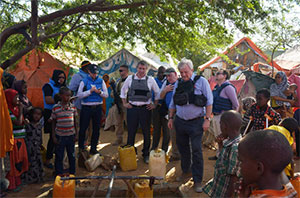 UN Emergency Relief Coordinator Visits Somalia. Credit: UN Photo/Tobin Jones
In recent years, conflicts have broken out across the world with no sign of slowing down or stopping. In times like this, millions of people globally are in dire need of humanitarian aid. Famine, warfare, natural disasters, and economic decline plague a host of nations, including Palestine, Sudan, Chad, Lebanon, and Haiti, to name a few. Humanitarian aid provides millions of people with critical services including healthcare, food, clean drinking water, psychosocial support, housing, and access to education. UN agencies such as the UNDP, UNICEF, the World Food Programme (WFP), UNHCR, UNRWA, and UNEP work with the UN Office for the Coordination of Humanitarian Aid (OCHA) and local organizations to come up with the best possible strategies to support affected communities. At the same time, humanitarian aid and those working on the frontlines are consistently threatened by both actors directly involved in conflict as well as those who are meant to contribute to the international humanitarian regime at large. The near-collapse of United States international aid structures in 2025, including the termination of 83% of USAID’s 6,300 global initiatives, has left millions of people without access to vital humanitarian assistance. 98 million people in 2025, only 65% of people targeted for humanitarian assistance, received the help they needed. In contrast, 123 million people received some form of humanitarian assistance in 2024, and OCHA’s 2026 Global Humanitarian Overview estimates that 239 million people are in need of assistance in 2026. IPS is well-positioned to discuss current initiatives to provide aid and relief through in-depth reporting and opinion content.

The Week with IPS

NEXT STOP - SDGs
Tracking global progress towards a sustainable world
Tracking global progress towards a sustainable world
