Languages
Friday, October 23, 2026



News and Views from the Global South
Aid

Civil Society Warns of New Land Grabs as World Bank Pushes for Tenure Reforms in Africa
As the COP30 negotiations intensify in Belém, Brazil, civil society organizations and research experts have called out major financial institutions for promoting foreign interests in controlling Africa's land by formalizing land tenure and seeking to convert Africa's land into industrial farms or carbon markets.
Why Climate Finance Is Vital for the Implementation of NDCs in Africa
Funding cuts from the United States, the United Kingdom and Europe have left a funding gap in climate change programmes across Africa.
Africa Wants Health to Be at the Center of Adaptation Finance
With the COP30 Presidency prioritizing health at the United Nations climate summit in Belém, African leaders are calling for finance to be channeled towards improving the health systems of developing countries.
Belém’s Hunger, Poverty Declaration Places World’s Most Vulnerable Populations at Centre of Global Climate Policy
A young woman at COP30 speaks about retracing her father’s footsteps. At only 16, her father and her grandfather were among the first families displaced by an unfolding climatic crisis of erratic weather and worsening climate conditions that goes on to date from their ancestral village in Sundarbans. Nearly 60 years later, she is on a mission to reclaim her ancestral lands.
Poor Countries Welcome Loss and Damage Fund’s Call for Requests, Warn It Falls Short of Needs
Least Developed Countries have hailed the debut call for proposals for the Loss and Damage Fund, which was launched on 11 November at the United Nations climate summit known as COP30 in Belem, Brazil.
Syria’s Fragile Transition Threatened by Severe Aid Shortfalls and Increasing Abductions, UN Warns
Eleven months after the fall of the Assad regime, Syria continues to grapple with severe instability as the country navigates a turbulent political transition. Rates of displacement have surged, and humanitarian organizations are struggling to support large numbers of refugees returning home. In recent weeks, the United Nations (UN) has documented numerous cases of enforced disappearances and abductions, calling for stronger accountability measures as the transition continues to unfold.
Asia-Arab Parliamentarians Forge Regional Pathways for Gender Justice and Youth Empowerment
Inclusive legislation, empowered youth, and anti-violence policies are inseparable aspects of sustainable development and were the key messages at a conference of the Inter-Regional Meeting of Asian and Arab Parliamentarians on Population and Development held in Cairo on October 24, 2025.
Guatemalan Peasants Overcome Drought in the Dry Corridor
Water scarcity that relentlessly hits the rural communities in eastern Guatemala, located in the so-called Central American Dry Corridor, is a constant threat due to the challenges in producing food, year after year. But it is also an incentive to strive to overcome adversities.
Adaptation Finance Shortfalls Leave Developing World Exposed
Hurricane Melissa made landfall in Jamaica yesterday—the strongest hurricane to impact the island on record since 1851—with expectations of tens of thousands of people being displaced and devastating damage to infrastructure. The tropical storm, slightly downgraded but nevertheless devastating, made landfall in Cuba today as UNEP’s newly released Adaptation Gap Report 2025: Running on Empty shows that the finance needed for developing countries to adapt to the climate crisis is falling far behind their needs.
Gaza Shows Subtle Signs of Recovery as UN Agencies Work to Meet Aid Needs
Since the declaration of a ceasefire between Israel and Hamas on October 10, families in the Gaza Strip have begun returning to previously inaccessible areas, as humanitarian organizations work to scale up aid operations to meet growing needs on the ground even amid security risks, including unexploded ordnance.
World Food Programme Warns of Emergency Levels of Hunger Amid Severe Funding Cuts
In 2025, unprecedented cuts to foreign aid and humanitarian funding have exacerbated global hunger crises, leaving millions without access to food or basic services. Funding shortfalls have forced aid agencies to scale back or suspend lifesaving programs in some of the world’s most food-insecure regions, particularly across the Global South—exacerbating already dire conditions caused by conflict, displacement, economic instability, and climate shocks.
XDR-TB Drug Trial Participants Continue to Celebrate its Success
When Tsholofelo Msimango joined a small trial of a new drug regimen for tuberculosis (TB) treatment a decade ago, she had no idea whether the medicines she was about to be given would help her.
They Have Known Nothing but War—The Plight of Syria’s Out-of-School Children
The war has deprived thousands of Syrian children of their right to education, especially displaced children in makeshift camps. Amidst difficult economic conditions and the inability of many families to afford educational costs, the future of these children is under threat.
With Ceasefire in Effect, Tonnes of Aid Expected to be Delivered into Gaza
After two years of conflict with Israel, Hamas has released the remaining 20 living hostages, while Israel has freed 250 Palestinian prisoners and over 1,700 detainees who have since returned to Gaza. Following a ceasefire agreement that took effect on October 10, Israeli forces are set to withdraw from designated areas within the Gaza Strip as humanitarian organizations mobilize to assist Palestinians in urgent need.
Darjeeling’s Wake-Up Call: Expert at IUCN Congress Calls for Agile Climate Finance
As global conservation leaders gather in Abu Dhabi for the IUCN World Conservation Congress, communities in the hills of Darjeeling, thousands of kilometers away, are still counting their losses. In early October, heavy rains triggered deadly landslides that buried homes, blocked key roads, and left several people dead. The destruction has once again exposed how vulnerable India’s mountain regions are to extreme weather.
Two-Thirds of Climate Funding for Global South are Loans as Rich Nations Profiteer from Escalating Climate Crisis
New research by Oxfam and the CARE Climate Justice Centre finds developing countries are now paying more back to wealthy nations for climate finance loans than they receive—for every USD 5 they receive, they are paying USD 7 back, and 65 percent of funding is delivered in the form of loans.
International Community, Civil Society Urge Minority Rights and Accountability Amid Ongoing Violence Against Rohingyas in Myanmar
On September 30, the United Nations (UN) convened a high-level meeting on the situation of Rohingya Muslims and other minorities in Myanmar shortly following the end of the 80th session of the General Assembly (UNGA80). The conference was an opportunity to draw global attention once more to the Rohingya refugee situation with dialogue from UN officials, world representatives and civil society organizations.
Drought-hit Tanzania’s Villages Confront Harshest Reality of Climate Change
The dust was already swirling when Asherly William Hogo lifted himself from a makeshift bed before dawn. The 62-year-old pastoralist, lean from a lifetime of walking these plains, slipped into his sandals and stepped outside. Stars glittered over Dodoma, but the air was warmer than it used to be, Hogo swears. He whistled for his cows. Years ago, this hour meant an arduous trek to distant waterholes.
‘The North Korean Human Rights Movement Is Facing Its Greatest Crisis since It Began in the 1990s’
CIVICUS discusses North Korea’s closed civic space with Hanna Song, Executive Director of the Database Center for North Korean Human Rights (NKDB). Based in Seoul, South Korea, NKDB documents systematic human rights violations in North Korea through testimonies from escapees, and has built the world’s largest private database of such abuses.

Climate Finance Will Be the First Casualty of Rising Militarism: Ali T. Sheikh Warns Ahead of COP30
As the COP30 approaches amid darkening geopolitical clouds—marked by rising rightwing extremism, corporate backtracking and rising militarism—Ali T. Sheikh, Pakistan’s leading expert on sustainable development and climate change, views the world’s largest diplomatic gathering with a mix of apprehension and caution.
UN at 80: Civil Society Must Have a Say in the Struggle for Renewal
As the high-level opening week of the UN General Assembly unfolds, with heads of states delivering often self-serving speeches from the UN’s podium, the organisation is undergoing one of its worst set of crises since its founding 80 years ago. This year’s General Assembly – ostensibly focused on development, human rights and peace – comes as wars are raging across multiple continents, climate targets are dangerously being missed and the institution designed to address these global challenges is being hollowed out by funding cuts and political withdrawals.« Previous Page — Next Page »





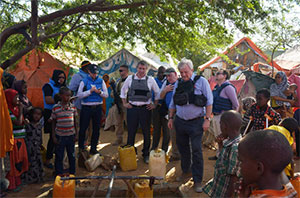 UN Emergency Relief Coordinator Visits Somalia. Credit: UN Photo/Tobin Jones
In recent years, conflicts have broken out across the world with no sign of slowing down or stopping. In times like this, millions of people globally are in dire need of humanitarian aid. Famine, warfare, natural disasters, and economic decline plague a host of nations, including Palestine, Sudan, Chad, Lebanon, and Haiti, to name a few. Humanitarian aid provides millions of people with critical services including healthcare, food, clean drinking water, psychosocial support, housing, and access to education. UN agencies such as the UNDP, UNICEF, the World Food Programme (WFP), UNHCR, UNRWA, and UNEP work with the UN Office for the Coordination of Humanitarian Aid (OCHA) and local organizations to come up with the best possible strategies to support affected communities. At the same time, humanitarian aid and those working on the frontlines are consistently threatened by both actors directly involved in conflict as well as those who are meant to contribute to the international humanitarian regime at large. The near-collapse of United States international aid structures in 2025, including the termination of 83% of USAID’s 6,300 global initiatives, has left millions of people without access to vital humanitarian assistance. 98 million people in 2025, only 65% of people targeted for humanitarian assistance, received the help they needed. In contrast, 123 million people received some form of humanitarian assistance in 2024, and OCHA’s 2026 Global Humanitarian Overview estimates that 239 million people are in need of assistance in 2026. IPS is well-positioned to discuss current initiatives to provide aid and relief through in-depth reporting and opinion content.

The Week with IPS

NEXT STOP - SDGs
Tracking global progress towards a sustainable world
Tracking global progress towards a sustainable world
