Languages
Saturday, November 7, 2026



News and Views from the Global South
Energy
ENERGY: African Sun may Light up European Homes
Twelve German companies have drawn up ambitious plans to meet at least 15 percent of the European electricity demand by 2020 from solar thermal power plants installed in the North African Maghreb region.
ENVIRONMENT: Swedes Going Green in Emergency
Patients in Stockholm can now be rushed to hospital in an ambulance that runs on processed sewage.TRADE: African Producers Press Rich Nations on Cotton Subsidies
Representatives from four major cotton-producing African countries came to Washington this week to engage in a dialogue about what they consider to be unfair U.S. trade practices.
ENERGY-CHILE: Geothermal Debate Simmers in El Tatio
El Tatio geyser field, a tourist destination in the northern Chilean region of Antofagasta, is at the heart of a controversy over a geothermal energy project being developed four kilometres away. The entire area is claimed by Atacama indigenous communities, who now stand divided.MIDEAST: Turkey Gets Boost from Pipeline Politics
The political geography of the modern Middle East has been affected for one hundred years by the appetite of westerners and other outsiders for the region's hydrocarbons.
ENVIRONMENT-NIGERIA: Playing With Fire
Nigeria's gas flare-out date has once again been extended - this time to 2011. The decision follows 25 years of political procrastination by the federal government and illegal behaviour on the part of major oil multinationals engaged in flaring associated gas (AG), the byproduct of oil production in the Niger Delta.ENVIRONMENT-BRAZIL: Take the Squeaky Clean Hydro Bus
The government of the state of Sao Paulo in southern Brazil has launched the first hydrogen-fuelled bus in Latin America - the first step towards environmentally sustainable public transport of the future.
ENVIRONMENT-MAURITIUS: Hold Your Fire
Mauritius appears to have a happy problem with the 400,000 tons of waste it produces each year. The island's only landfill is full and the government must decide whether to turn to incinerating waste - generating electricity in the process - or to compost it, to the benefit of farmers.ENERGY: Germany Gets Some Nuclear Jolts
The faults at the nuclear plant at Kruemmel near Hamburg surfaced just three days after Chancellor Angela Merkel declared nuclear energy "indispensable" to Germany.AFRICA: FAO Paper On Land Grab Is "Wishy-Washy"
The boom in the acquisition of arable land in Africa by foreign companies and governments has stirred an international debate between international institutions such as the United Nations’ Food and Agriculture Organisation (FAO) and non-governmental groups and independent experts.SPAIN-EQUATORIAL GUINEA: More Trade, Little Pressure
Trade between Spain and Equatorial Guinea is flourishing, amidst calls by activists for the government of Spanish Prime Minister José Luis Rodríguez Zapatero to push for democracy in this tiny country on the Atlantic coast of Africa, still under the yoke of dictatorship.
TRADE: Crisis Pushing Emerging Markets to Move Beyond the Dollar
The global economic crisis is pushing countries in regions with emerging markets, such as Russia and South Africa, to together move beyond the dollar-based economic model. Given their politico-economic similarities, these two countries should build on opportunities to share expertise and technology.
Q&A: "It’s Wrong to Burn Food of the Poor to Drive Cars of the Rich"
The world needs to overcome "the bizarre irony that rural areas, where food is grown, is home to cruel poverty and hunger," says Ismail Serageldin, former chair of the Consultative Group on International Agricultural Research (CGIAR).TRANSPORT-BRAZIL: Recharge Your Batteries Here
Brazil has long been committed to developing alternatives to fossil fuels to power its vehicle fleet, to the extent that 90 percent of new cars sold in the country are flex-fuel, running on ethanol or gasoline in any proportion. Now the government is embarking on another technological field: electric vehicles.CLIMATE CHANGE: 2020 Deadline Is the Crucial “Litmus Test”
"So who here thinks there will be a meaningful deal in Copenhagen?" Few of the more than 600 energy ministers, officials and experts from 80 countries attending the Vienna Energy Conference raised their hands in response to the conference moderator's question about the final round of climate negotiations this December in Copenhagen.U.S.: House Passes Controversial Climate Legislation
Amid furious lobbying on both sides, the U.S. House of Representatives narrowly approved landmark legislation Friday designed to reduce the nation's greenhouse emissions that contribute to global warming 17 percent below 2005 levels by 2020 and 83 percent by 2050.DEVELOPMENT: Green Energy for All by 2030?
While industrialised countries struggle to switch from climate-damaging, carbon-based energy to greener energy sources, much of the world is desperately energy poor, with 1.6 billion people having no access to electricity and 2.4 billion relying on wood and dung for heat and cooking.SOUTH AMERICA: Anti-Nuclear Activists to Form Common Front
Environmental organisations in Chile plan to revive the anti-nuclear movement in the Southern Cone of South America, in response to vigorous lobbying by corporations and politicians in favour of nuclear energy in the region.
ENVIRONMENT: Earth Can Generate Summer out of Winter
Iceland manages to produce tomatoes, paprika and cucumbers all year round by harnessing geothermal energy locally, even though the growing season is short.
POLITICS-GABON: Will Bongo’s Death Signal a New Chapter?
As Omar Bongo Ondimba, the Gabonese president who died at age 73 in Barcelona on Jun. 8, is buried in Franceville in the south-west of Gabon on Thursday, his 41-year-reign as absolute ruler of this oil-producing country of 1.5 million has received mixed reviews.
Q&A: "The Global Crisis Is Really About a 140-dollar Barrel of Oil"*
Sitting in the restaurant of Vancouver's posh Fairmount Waterfront Hotel, the former chief economist for one of Canada's largest banks doesn't seem like the typical apocalyptic peak oil theorist.« Previous Page — Next Page »





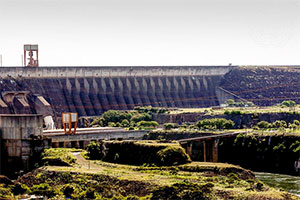 UN Power Plant, Paraguay. Credit: UN Photo/Evan Schneider
Energy has posed a great challenge for economies around the world. As global energy consumption skyrockets throughout the years, so does the need for sustainable solutions. The Sustainable Development Goals are essential in providing people with access to safe, affordable, and sustainable energy sources that minimize harm on the planet. Progress towards these goals opens the door for an advancement in modernization for communities on a global level and allows for a potential mitigation of tensions between nations.
The UN’s Summit of the Future in 2024 offered new initiatives that are being taken to achieve these goals, including a decreased reliance on fossil fuels, a switch to renewable energy sources, and improved climate financing.
IPS is well positioned to provide relevant, insightful, and compelling analysis of recent updates and measures being taken around the world to achieve a cleaner future.

The Week with IPS

NEXT STOP - SDGs
Tracking global progress towards a sustainable world
Tracking global progress towards a sustainable world
