Languages
Saturday, November 7, 2026



News and Views from the Global South
Energy

CLIMATE CHANGE: The Fault Lies Not in Our Cars but in Ourselves
Rising levels of carbon dioxide (CO2) in Earth's atmosphere can be compared to a flooding river, swamping low areas at first but inevitably bursting its banks.CHILE: Environmentalists Defend Patagonian Wilderness from Dams
Robert Kennedy, senior attorney for the U.S.-based Natural Resources Defence Council (NRDC), is in Chile to support opponents of a plan for building five dams in the southern region of Patagonia.CLIMATE CHANGE: The Future Is Now
Our fingers are glued to the global thermostat, pushing it ever higher, and climate catastrophe has already begun to reshape human civilisation.MIDEAST: Palestinians Not Helping Themselves Either
A deal currently being discussed by Israel and Egypt would see Israel sever a major tie with the Gaza Strip. Under the agreement, Egypt would become the sole external supplier of power to Gaza, replacing Israel which is today the major provider of electricity to the coastal strip.OIL-MEXICO: Floundering in Deep Waters
Billions of barrels of crude are lying under the deep seabed in the Gulf of Mexico, an area divided between Cuba, the United States and Mexico. But while the first two countries are approaching full commercial exploitation, the third is still trying to come up with a plan.CAMBODIA: Planned Lao Dam Raises Concerns on the Mekong
The Lao government’s decision earlier this year to press ahead with plans to build the Don Sahong dam on the mainstream of the Mekong River in southern Laos is causing major concern in Cambodia and internationally.ENVIRONMENT-CHILE: Experts Call for Stronger Anti-Smog Measures
"It’s as if we were swimming at a beach unfit for bathing. For four or five months a year, the air is unfit to breathe in the Chilean capital, and the government throws out a lifejacket when people are in difficulties, so that they don’t drown," Patricio Pérez of the University of Santiago told IPS.
ARGENTINA-BRAZIL: Planned Binational Dam Under Fire
Feeling the pressure of rising energy demand, the governments of Argentina and Brazil are taking a fresh look at old plans for the Garabí hydroelectric dam on the Uruguay River, which environmentalists say would endanger the flow of this already highly exploited water source.ENERGY-EUROPE: Nuclear Power Debate Heats Up
French President Nicolas Sarkozy and British Prime Minister Gordon Brown are about to agree on a new generation of nuclear power plants in London this week, and plan to export the technology to the rest of the world, according to unconfirmed reports.RUSSIA: Nuclear Deal with Egypt Signed
After years of diplomatic negotiations, Russia and Egypt finally signed an agreement Tuesday that paves the way for cooperation in the civilian nuclear energy sector.RUSSIA: Price Fuels Gas War
A renewed Russian-Ukrainian gas conflict has been provisionally averted, but as Ukrainian politicians struggle for control of the gas sector, the next months are likely to bring more price wars.DEVELOPMENT- ANGOLA: Research Initiative Nets Interesting Discoveries
More than 50 species of fish have been recorded in the initial phase of a two-year joint research project on the Kwanza River in Angola.DEVELOPMENT-CAMBODIA: Bowing to Regional Hydropower Demands
For the Cambodian government, hydropower development represents great economic opportunities. But for non-government organisations (NGOs), and the communities they serve, dams pose severe social and environmental impacts.KYRGYZSTAN: Opposition Runs Separate Parliament
A nation of five million, Kyrgyzstan has ended up with two parliaments: the official one, and the second that many consider the more legitimate one.ENVIRONMENT-PORTUGAL: Enjoying the Outdoors in a Greener Lisbon
Steered by a city government that proudly proclaims its environmental credentials, the Portuguese capital is planning to develop wind energy, restore and connect its green areas, and promote clean transport and the outdoor life.
BRAZIL: Developing "Clean" Petrochemical Products
Glycerine, a by-product of biodiesel, is currently an environmental and economic problem for companies involved in the production of plant-based fuel in Brazil and other parts of the world. It can't be dumped, because it would harm the environment, and storing it racks up additional costs.INDIA/US: New Deal in Nuclear Poker
As the political window of opportunity to conclude the United States-India civilian nuclear cooperation deal during George W. Bush’s presidency further narrows, the "now-it’s-off, now-it’s-on" game of political poker over the agreement has taken another turn in New Delhi.VENEZUELA: Gov’t Celebrates British Ruling Against Exxon
Venezuela celebrated, as a triumph for countries of the developing South, Tuesday’s ruling in its favour by a British court in a legal dispute with U.S. oil giant Exxon Mobil, which overturned an earlier court order to freeze around 12 billion dollars in Venezuelan assets.OIL: Price Bubble Could Burst in Medium Term
While oil prices recently soared to a record 111 dollars a barrel, fuelled by the weak U.S. dollar, analysts warn that the bubble will not last forever, and may burst in the medium term.ENVIRONMENT-CHILE: Campaign Against Dams – and Against the Clock
On the International Day of Action for Rivers, Chilean environmental groups delivered an open letter Friday to President Michelle Bachelet describing the serious environmental, social and cultural impacts that they say are caused by large hydroelectric dams.CLIMATE CHANGE: Europe Stepping Back
A year after the European Union's governments promised to take the lead in fighting climate change, they appeared to back-pedal on that pledge at a summit in Brussels Mar. 13-14.« Previous Page — Next Page »





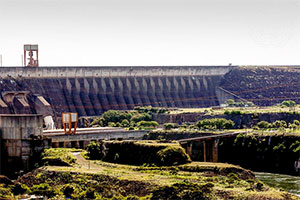 UN Power Plant, Paraguay. Credit: UN Photo/Evan Schneider
Energy has posed a great challenge for economies around the world. As global energy consumption skyrockets throughout the years, so does the need for sustainable solutions. The Sustainable Development Goals are essential in providing people with access to safe, affordable, and sustainable energy sources that minimize harm on the planet. Progress towards these goals opens the door for an advancement in modernization for communities on a global level and allows for a potential mitigation of tensions between nations.
The UN’s Summit of the Future in 2024 offered new initiatives that are being taken to achieve these goals, including a decreased reliance on fossil fuels, a switch to renewable energy sources, and improved climate financing.
IPS is well positioned to provide relevant, insightful, and compelling analysis of recent updates and measures being taken around the world to achieve a cleaner future.

The Week with IPS

NEXT STOP - SDGs
Tracking global progress towards a sustainable world
Tracking global progress towards a sustainable world
