Languages
Saturday, November 7, 2026



News and Views from the Global South
Energy
RUSSIA: In a Quick New Embrace with Germany
In his first week as president-elect, Dmitry Medvedev has sought to build new bridges with German Chancellor Angela Merkel. The reinforced relations rest on the pillar of a major energy deal.BALKANS: Serbia Goes to Polls over Kosovo Independence
The coalition government of Serbia has become the first political victim of the independence declared by Kosovo, once the southern region of Serbia.ENVIRONMENT: Polar Bears in Limbo as Drilling Leases Go Forward
A coalition of environmental groups sued the George W. Bush administration Monday for delaying a decision to protect polar bears threatened with extinction due to the melting ice in its Arctic habitat. Polar bears could be the first species officially threatened by climate change.AUSTRALIA: Act Now On Climate Change Gov’t Warned
An interim report on Australia’s ability to combat climate change has called on the government to take action now as a matter of urgency.CLIMATE CHANGE: Brazilian Ethanol Goes It Alone
Despite the urgency to reduce emissions that contribute to climate change, Brazil has been unable to stave off the doubts that are slowing the growth of an international market for plant-based biofuels.DEVELOPMENT-SOUTH AFRICA: Farmers Can Plan – But Not Indefinitely
Millions of dollars worth of agricultural produce have been lost due to the electricity crisis in South Africa, which has seen rolling power cuts - referred to locally as "load shedding" - across the country over the past few months. Yet industry players who spoke to IPS about the crisis seemed positive about their ability to weather the storm.ENVIRONMENT: Galapagos Islands in Search of Clean Energy
Ecuador has taken the first step towards ending the oil dependence of its Galápagos Islands, in the eastern Pacific Ocean, with the official opening of a 10.8 million dollar wind energy facility on the island of San Cristóbal.EGYPT: Opposition Slams Gas Sale to Israel
On Monday, Egypt began pumping natural gas to Israel in accordance with an energy accord between Cairo and Tel Aviv. While the government defends the move as being in the country's best interest, opposition figures decry the notion of economic cooperation with Israel, especially in light of the latter's ongoing siege of the Gaza Strip.ENERGY: Investors Warned Against Coal-Fired Power Plants
Prospects for coal-fired power plants have dimmed amid soaring construction costs, regulatory uncertainty and concern about global warming, say energy economists.AUSTRALIA/INDIA: Uranium Export Policy Not Set In Stone – Analysts
Despite Australia’s recently confirming that it will not be exporting uranium to India - reversing an agreement made by the previous government - analysts argue that a deal could yet be struck.ENERGY-MEXICO: PEMEX in Death Throes Amid Political Squabbling
Mexico’s state oil company, PEMEX, is broke, and the country’s crude oil reserves will run out in less than 10 years. But although local politicians agree on the diagnosis, few are proposing solutions, while recriminations, by contrast, are flying thick and fast.CLIMATE CHANGE: Lula Calls for Flexibility from Rich Countries
Industrialised nations must live up to their Kyoto Protocol commitments and be flexible in trade negotiations in order for the world to make progress towards solutions to climate change and to prevent the poor from being steeped in poverty for a long time to come, Brazilian President Luiz Inácio Lula da Silva said Thursday.
CLIMATE CHANGE: Canada’s Polar Bears Beset on All Sides
Melting sea ice caused by climate change and government inaction is putting polar bears at extreme risk in Canada as a species over the next 50 years, according to local environmental groups.BULGARIA: Challenge to Pipeline Grows
The Bulgarian government is committed to building an oil pipeline through the seaside town of Burgas, but local people are starting to complain they were not consulted before a potentially harmful deal was made in their name.EUROPE: Forgetting Rights, Looking at Opportunities in Central Asia
With the attention of the world's media rarely turned towards Central Asia, it is easy to forget about the Andijan massacre of May 2005. Several hundred demonstrators died when Uzbek government forces opened fire on a demonstration, in what is believed to be the worst mass killing since the 1989 Tiananmen Square massacre in China.
DEVELOPMENT: Farmers Mull New Opportunities – And Threats
The sharp increase in the international prices of basic food is hitting the poorest rural communities, according to groups representing millions of small farmers.CHILE: Drought Raises Likelihood of Energy Rationing
The severe drought affecting Chile has caused an agricultural emergency in 50 rural districts in the centre of the country, and large sectors of the economy are concerned about possible electricity rationing in March.IRAQ: The Lights Have Gone Out, Who Cares
Lack of electricity in Baquba has shattered businesses, and the lives of families. Months of power failures has darkened morale everywhere.ECONOMY-ANGOLA: (Responsible) Foreign Investment Welcome
A high-level mission from Angola visited Portugal to entice potential investors with new business opportunities arising from the newfound stability in the southwestern African nation, one of the fastest-growing economies in the world today.DEVELOPMENT: ‘Food Miles’ Hard to Digest
European consumers shunning imported food supposedly to limit climate change should not make African farmers a scapegoat, a Brussels conference has been told.ARGENTINA: Boost for Coal Mine Revives Stagnant Town
With winter temperatures that plunge to 20 degrees below zero, the small Argentine town of Río Turbio, 3,000 kilometres southwest of Buenos Aires, would not exist but for the coal beneath its soil.« Previous Page — Next Page »





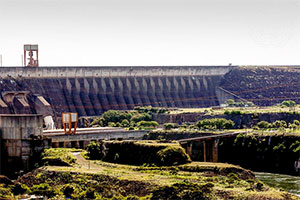 UN Power Plant, Paraguay. Credit: UN Photo/Evan Schneider
Energy has posed a great challenge for economies around the world. As global energy consumption skyrockets throughout the years, so does the need for sustainable solutions. The Sustainable Development Goals are essential in providing people with access to safe, affordable, and sustainable energy sources that minimize harm on the planet. Progress towards these goals opens the door for an advancement in modernization for communities on a global level and allows for a potential mitigation of tensions between nations.
The UN’s Summit of the Future in 2024 offered new initiatives that are being taken to achieve these goals, including a decreased reliance on fossil fuels, a switch to renewable energy sources, and improved climate financing.
IPS is well positioned to provide relevant, insightful, and compelling analysis of recent updates and measures being taken around the world to achieve a cleaner future.

The Week with IPS

NEXT STOP - SDGs
Tracking global progress towards a sustainable world
Tracking global progress towards a sustainable world
