Languages
Sunday, November 8, 2026



News and Views from the Global South
Energy
ENERGY-CENTRAL ASIA: Wrangling Over Pipelines Wrecks Early Prospects
A combination of East-West geopolitical rivalries and haggling between former Soviet republics is delaying the construction of a series of oil and gas pipelines that could help alleviate the world's future energy supply concerns.POLITICS-SUDAN: “Do Something Now, Because People Are Dying Every Day”
On a blazing spring day in New York's financial district, as executives hurry past in suits and ties, a handful of protestors position themselves directly in front of the headquarters of Fidelity, one of the leading investment firms in the United States.CLIMATE CHANGE: UN Panel Has Solutions for the Willing
Solutions to stop global warming outlined in a new United Nations-backed report may ignite heated debates, if not actually compel governments to make choices that would impact their respective economies.CLIMATE CHANGE: EU Emissions to Rise, Despite Claims
One month after the European Union's leaders promised robust action against climate change, green campaigners have accused key EU bodies of implementing policies that will lead to increased emissions of greenhouse gases.DEVELOPMENT-AFRICA: ”Extreme Water Events” Predicted
In Africa, 25 countries are expected to experience water scarcity or water stress in the next 20 to 30 years. This translates into 16 percent or 230 million of Africa's population facing water scarcity by 2025, and 32 percent or 460 million people living in water-stressed countries by that time.CLIMATE CHANGE-CHINA: Racing to Be World’s Leading Polluter
China has delayed the release of a long-expected national plan on tackling global warming amid warnings that the country is set to overtake the United States as the world's biggest source of greenhouse gases (GHGs) this year - much earlier than forecast - because of its runaway economic growth.DEVELOPMENT: Biofuels vs Food Crops?
While South Africa is planning on increasing biofuels production some experts warn the move may hurt subsistence farmers and cause more hunger in impoverished areas of the country.POLITICS-MALI: A Presidential Election That Breaks With Tradition
When Malians queue to cast ballots in presidential elections Sunday, they will be participating in a poll with a difference: for the first time ever, a woman will be amongst the candidates voters have to choose between.POLITICS-US: To Drill or Not to Drill Off the Florida Coast
The issue of whether or not oil companies should be allowed to drill off the coast of the south-eastern U.S. state of Florida - especially along the Gulf of Mexico - is creating political friction for state and federal government politicians alike.ENVIRONMENT: Prepare for the ‘Nuclear Century’
Representatives of the nuclear industry met this week to discuss strategies to meet challenges posed by what they assume will be "the nuclear century."BOLIVIA: One Dead, Police Held Hostage in Provincial Gas Dispute
Protesters stormed natural gas plants in the Bolivian border town of Yacuiba and took 47 police officers hostage after a demonstrator was killed, in the midst of a provincial dispute for control over a gas field that could generate some 100 million dollars a year in taxes.CLIMATE CHANGE: Divisions Surface Over Nuclear Option
Several governments are planning new investment in nuclear energy, ignoring opposition by environmental scientists who say that nuclear power is not a solution to providing carbon- free energy.CLIMATE CHANGE: Legitimacy of Security Council Meeting Challenged
The legitimacy of a much-ballyhooed Security Council meeting on climate change was challenged by developing nations who argued that the threat to the global environment is not a subject within the purview of the U.N.'s most powerful political body.ENVIRONMENT-BRAZIL: Hybrid Electric Vehicles – Better Than Ethanol
Hybrid electric vehicles (HEVs) are the best way to achieve a drastic reduction in greenhouse gases produced by vehicle exhaust fumes, until hydrogen-powered models become viable. They are even more environmentally-friendly than the use of biofuels.SOUTH AMERICA: Leaders Seek Regional Energy Sovereignty
The South American energy summit that got underway Monday marks a point of convergence between the certainty that the region has the energy resources needed for its development and the political will to translate that into socially and economically viable undertakings.ENERGY-MALI: Wood – The Gift That Can’t Keep on Giving
Year by year, the figures have increased relentlessly. While some 600,000 tonnes of wood were transported to the Malian capital of Bamako in 1994, according to official figures, 750,000 tonnes were sent in 1997. This year, the city is projected to consume 900,000 tonnes - and the country as a whole, seven million tonnes.POLITICS: Security Council to Take Up Climate Change
The U.N. Security Council, whose primary mandate is to prevent wars and preserve world peace, will once again break tradition next week when it debates the newest threat to international security: climate change.CLIMATE CHANGE-US: Grasping the Geopolitics of Warming
The Central Intelligence Agency, National Security Agency, the Pentagon and the Federal Bureau of Investigation should pool data and offer a comprehensive review of the national security threat posed by global warming, say U.S. Senators Dick Durbin and Chuck Hagel.BOLIVIA: Errors in Contracts Complicate Gas Nationalisation
In the face of gas shortages, Bolivians are criticising the way the nationalisation of the country's energy reserves is being carried out, and social activists have once again begun to demand the outright confiscation of the assets of the 12 foreign oil companies operating here.HUNGARY: Russian Energy Troubles West
Western powers are concerned that Hungary's relations with Russia, and especially the Russian state-owned energy giant Gazprom, are becoming too warm at a time when Europe seeks to reduce dependence from Russian natural gas.Q&A: Community Involvement in Conservation a “Big Step Forward”
This year marks the fifth anniversary of Benin's Programme to Manage Forests and Surrounding Areas (Programme de gestion des forêts et terroirs riverains, PGFTR), started to prevent wooded regions of the West African country from succumbing to soil degradation - and ultimately desertification.« Previous Page — Next Page »





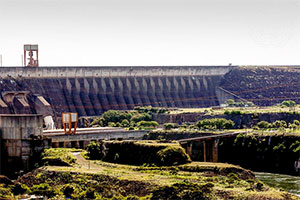 UN Power Plant, Paraguay. Credit: UN Photo/Evan Schneider
Energy has posed a great challenge for economies around the world. As global energy consumption skyrockets throughout the years, so does the need for sustainable solutions. The Sustainable Development Goals are essential in providing people with access to safe, affordable, and sustainable energy sources that minimize harm on the planet. Progress towards these goals opens the door for an advancement in modernization for communities on a global level and allows for a potential mitigation of tensions between nations.
The UN’s Summit of the Future in 2024 offered new initiatives that are being taken to achieve these goals, including a decreased reliance on fossil fuels, a switch to renewable energy sources, and improved climate financing.
IPS is well positioned to provide relevant, insightful, and compelling analysis of recent updates and measures being taken around the world to achieve a cleaner future.

The Week with IPS

NEXT STOP - SDGs
Tracking global progress towards a sustainable world
Tracking global progress towards a sustainable world
