Languages
Sunday, November 22, 2026



News and Views from the Global South
Food and Agriculture
AGRICULTURE-ARGENTINA: Using Internet and Bicycles to Search Out Markets
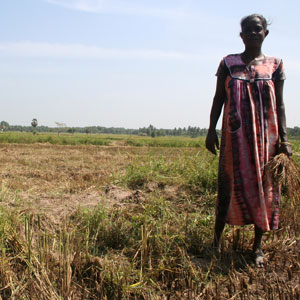
Just 45 kilometres outside of Buenos Aires, a group of 20 families have set up a farming operation where they work in harmony with nature and without bosses, selling their products through a small network of consumers who appreciate the benefits of organic food and cooperative labour.TRADE: Subsidies Reform Still a Game of "You First"
Back in 2001, the European Union committed itself to phasing out all forms of subsidies that help its farmers sell food abroad.TRADE-AFRICA: ''Focus Should Be on Domestic Needs, Not Exports''
African states should address the needs of local markets and of their regions before looking at what can be exported globally, and not the other way round as is currently the case.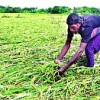
BANGLADESH: Fear of Famine Follows Cyclone Havoc
With its grain crops wiped out, Bangladesh has appealed to the world community for half a million tonnes of rice or wheat to immediately feed thousands of starving survivors of the Nov. 15 cyclone and stave of a possible famine.SOUTH AMERICA: Consumers Pay the Price for Agricultural Boom
Why are the prices of bread, potatoes, tomatoes and beef on the rise in the Southern Cone region of South America? In this predominantly agricultural area, many blame the price rises on circumstantial local factors. But analysts point to a wider phenomenon: the rising global demand for food and biofuels commodities, which is here to stay.
SRI LANKA: Fair Trade Labels Ensure Returns For Farmers
Organic farmers in this hilly, central region of Sri Lanka are convinced that they have a simple fair trade model that could be replicated in other parts of the world.
ENVIRONMENT-INDIA: Tribals Distressed by Ban on Forest Gathering
The magical trill of the Nilgiri Whistling Thrush deep in the jungles of this remote southern Indian wildlife sanctuary is no comfort to its nearly 2,000 Soliga aboriginal tribal families.ECONOMY-US: Hunger Stalks World's Wealthiest Country
More than one in 10 people in the United States go hungry, according to new official figures that suggest government food programmes are falling short in the world's wealthiest country.PARAGUAY: State Accused of Violating Rights of Rural Poor
Civil society groups in Paraguay are hoping to persuade a United Nations expert committee to send international observers to investigate allegations of violations of the rights of peasant farmers and indigenous people in this country.AGRICULTURE: Costly Prosperity
Many of the people who are now complaining that biofuels are driving up agricultural prices fought in the past against the "deterioration of the terms of exchange," or the devaluation of commodities with respect to manufactured goods, as a key factor in underdevelopment.LABOUR-SRI LANKA: Inflation Wears Garment Industry Thin
Thousands of garment workers, mostly young women from rural Sri Lanka, are clamouring for better wages in a campaign that could trigger a mass fallout in the industry, and a possible shift in production to other countries where costs are cheaper.DEVELOPMENT: Farming Boost Could Lift a Billion People
The World Bank urged greater investment in the developing world's farms Friday, warning that failure to boost agriculture would doom the international community's ambition to halve extreme poverty in the next eight years.TRADE: 'EU Undermining Agriculture in Africa'
Europe is undermining its own efforts to strengthen African agriculture by foisting free trade on the continent, a Ghanaian farm leader has complained.SOUTH AMERICA: Scarcity Amid Abundance
Hunger continues to be a problem in South America, barely contained by the safety nets created by government programmes and networks of civil society groups, as deep-rooted inequality nourishes the ranks of the poor despite economic growth and an abundance of food.CENTRAL AMERICA: Little Enthusiasm Over Anti-Poverty Campaign
The enthusiasm among social groups in Mexico and Central America for the Global Call to Action against Poverty (GCAP) is not reflected by the general public, which has displayed scant interest in this week's event.LATIN AMERICA: Historic Chance to Get Rid of Hunger
High economic growth rates, political will and laws aimed at ensuring the right to food will not be enough to eradicate hunger in Latin America by 2025, according to the United Nations Food and Agriculture Organisation (FAO), which calls for ongoing investment, improved coordination of programmes and support for family farming.FAR EAST: Koreas in Win-Win Deal
Surpassing all expectations historic talks between the leaders of North and South Korea in Pyongyang have produced a joint declaration that seeks a formal end to the 1950-53 Korean war and bridge distrust, a vestige of the Cold War years.POPULATION-PHILIPPINES: Manila Women to Fight Ban on Contraceptives
Lourdes Esplana-Osil has seven children, all born within a space of 12 years. Warned by her doctor of complications from repeated pregnancies, she started using injectable contraceptives provided free at a local government health centre.HEALTH-PAKISTAN: Poor Worse Off After Selling Kidneys
"The only time I’ve been to Rawalpindi was in 2004 when I was taken by an ‘agent’ (middleman in the human organ trade) to a hospital there to sell my kidney," says Faqir Masih, 23. He never wants to visit the city, again.PAKISTAN/AFGHANISTAN: Conflict, Shortages Push Food Prices Up
An acute shortage of food items in Afghanistan and Pakistan have sent prices shooting upwards in both countries.TRADE: Only a Handful Are Lords of the Food Harvest
The food and beverage industry is experiencing a high degree of concentration, with 10 distributing companies controlling 24 percent of the world market, according to a report being studied this week by workers’, employers’ and government representatives gathered by the International Labour Organisation (ILO).« Previous Page — Next Page »


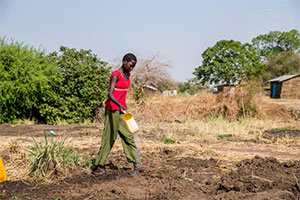 Farming on the Outskirts of Juba. Credit: UN Photo/JC McIlwaine
Promoting human and planetary health is a central focus of the United Nations, as laid out in the 2030 Sustainable Development Goals (SDGs). World hunger and unsustainable farming practices continue to be pressing concerns for the world. According to the 2025 State of Food Security and Nutrition in the World report by the Food and Agriculture Organization (FAO), 673 million people faced hunger in 2024. There are stark regional disparities, with the FAO projecting that 60% of the world population facing hunger will reside in Africa by 2030. Globally, the prevalence of food insecurity has remained consistently higher for women than men.
Sustainable and efficient national food systems are essential in preserving health, education, environmental well-being, peace, economy, and security. However, creating sustainable food systems can be a challenging endeavor, as food production takes a heavy toll on the environment. The agricultural sector accounts for a significant portion of greenhouse gases. Finding safe, sustainable, and ethical strategies to feed the world is crucial in ensuring planetary longevity. A recent initiative from 2023, the EU Regulation on Deforestation-free Products (EUDR), seeks to advocate for sustainable food systems. The main driver of deforestation is the expansion of agricultural land used to produce commodities like cattle, wood, cocoa, coffee, etc. The EUDR is part of the 2020 European Green New Deal and the EU Biodiversity Strategy for 2030 and aims to limit Europe’s consumption of products linked with deforestation by requiring that companies prove that their products are deforestation-free. Despite aiming to achieve major strides in sustainability, policies such as EUDR also raise socioeconomic concerns for targeted countries. Many emerging Latin American economies are impacted by the policy, and have raised the question of how developing countries can grapple with the tensions between economic development and advancing sustainability.
IPS has been at the forefront of providing compelling and insightful stories on communities facing hunger as well as the cost of food production. IPS uses statistics from FAO, the World Food Programme (WFP) and the International Fund for Agricultural Development (IFAD) to bring relevant and hard-hitting facts to readers. This gathering of information and data from such organizations helps bring the best stories from IPS journalists working in the different regions in consultation with experts on the ground.

The Week with IPS

NEXT STOP - SDGs
Tracking global progress towards a sustainable world
Tracking global progress towards a sustainable world