Languages
Monday, August 31, 2026



News and Views from the Global South
Health

Resilience in a Riskier World
Over the past two decades, the Asia-Pacific region has made remarkable progress in managing disaster risk. But countries can never let down their guard. The COVID-19 pandemic, with its epicentre now in Asia, and all its tragic consequences, has exposed the frailties of human societies in the face of powerful natural forces. As of mid-August 2021, Asian and Pacific countries had reported 65 million confirmed coronavirus cases and more than 1 million deaths. This is compounded by the extreme climate events which are affecting the entire world. Despite the varying contexts across geographic zones, the climate change connection is evident as floods swept across parts of China, India and Western Europe, while heatwaves and fires raged in parts of North America, Southern Europe and Asia.
Prioritising Profits Reversed Health Progress
Instead of a health system striving to provide universal healthcare, a fragmented, profit-driven market ‘non-system’ has emerged. The 1980s’ neo-liberal counter-revolution against the historic 1978 Alma-Ata Declaration is responsible.
Southern African Migrants Excluded as COVID-19 Pandemic Grows
Migrants across the Southern Africa region are massively disadvantaged as they find themselves excluded from vaccine programmes – even when the global vaccine initiative COVAX often funds these programmes.
Parliamentarians Determined to Reach ICPD 25 Goals
Politicians from Asia and Africa shared activism anecdotes demonstrating their determination to meet ICPD 25 commitments. They were speaking at a hybrid conference held simultaneously in Kampala, Uganda, and online.
Internationally Trained Medical Doctors Sidelined in Canada
Canada is ranked number one out of 78 countries globally, with the highest marks in social purpose indicators, emphasizing human rights, social justice, and racial equity commitment, according to a recent U.S. News & World Report survey.
Privatised Health Services Worsen Pandemic
Decades of public health cuts have quietly taken a huge human toll, now even more pronounced with the pandemic. Austerity programmes, by the International Monetary Fund (IMF) and World Bank, have forced countries to cut public spending, including health provisioning.
UN’s Ultimatum to Staff & Diplomats: Get Vaccinated or Go Hungry
As New York city struggles to cope with the widespread outbreak of the deadly new coronavirus Delta variant -– which has claimed more than 100,000 cases per day in the US— the United Nations is laying down strict guidelines at its headquarters (UNHQ) for staffers, diplomats and visiting delegates.
Power of Creative Expression during Lockdown
Screens, devices, and smartphones replaced the human touch and day-to-day interactions as COVID-19 protocols forced millions of people into harsh lockdowns and prolonged isolation.
How to Sustainably Finance Universal Health Care
To achieve universal health coverage, a country needs a healthcare system that provides equitable access to high quality health care requiring sustainable financing over the long term. Publicly provided healthcare should be on the basis of need, a citizen’s entitlement for all regardless of means.
Child Protection Schemes Are Failing Children Orphaned by COVID-19 in India
The second wave of COVID-19 brought with it unimaginable grief, agony, and frustration. India saw a sharp increase in the number of deaths, especially among younger people, which meant that many children lost one or both parents. Reports of people seeking help for orphaned children as well as requests to ‘adopt’ these children emerged on social media.
We Were Born to Do This!
The first time I visited South Sudan in 2004 - prior to its independence - I travelled across the entire the country which was then a region devastated by man’s inhumanity to man. Although South Sudan is slightly larger than France, I could find only one concrete school building in Rumbek.
The ‘Covid-19 Timebomb’ – Dispelling the Single- Story Humanitarian Narrative for Africa
An article published in April 2020 by the World Economic Forum warning that Africa was facing a Covid-19 time bomb was widely shared among the humanitarian sector, with increasing alarm.
ECW Interviews the Honourable Awut Deng Acuil, Minister of General Education and Instruction for South Sudan
Awut Deng Acuil is the first female Minister of Education for South Sudan, and only the second person to serve as Minister of Education for her country – which became independent country in 2011. Prior to this role, Minister Acuil was the first woman to serve as the country’s Minister of Foreign Affairs and International Cooperation. Recently, Minister Acuil made history as the first women to lead a South Sudan university when she was appointed head of council at the University of Bahr El-Ghazal.
‘Don’t Forget Leprosy’ Campaign Amid COVID-19 Pandemic
A visit to a leprosy facility in Korea with his father, Ryoichi Sasakawa, spurred Yohei Sasakawa to dedicate his life to eliminating both the disease and discrimination of those affected.
Central Banks Must Address Pandemic Challenges
Hopes for an inclusive global economic recovery are fast fading. As rich countries have done little to ensure poor countries’ access to vaccines and fiscal resources, North-South “fault lines” will certainly widen. Enhancing relief, recovery, transformation While the International Monetary Fund (IMF) has revised rich countries’ recovery prospects upward, the United Nations (UN) notes formidable challenges, especially for developing countries, due to the pandemic.
Increasing Revenue & Protecting Public Health During the COVID-19 Pandemic
The COVID-19 pandemic has taken its toll on millions of families and damaged the economy of countries around the globe. Rich countries with higher vaccination rates have opened up their economy ahead of poor countries that are still struggling to fight the pandemic.
Civil Society Leading Covid-19 Mask Campaign in South Asia – Podcast
 Footage of flames engulfing bodies at makeshift funeral pyres and stories of people dying in cars as drivers desperately raced from hospital to hospital seeking a bed. These scenes marked the second wave of the Covid-19 pandemic in India just months ago.
What Public Health Officials Can Learn from a New Long COVID Survey
A new survey on public awareness of long COVID by ‘Resolve to Save Lives” showed that among the 40% of Americans who were not vaccinated, seeing testimonials of those who suffer from long COVID inspired nearly two-thirds to consider the vaccine. A representative sample of nearly 2,000 Americans 18 and older took the survey between May 21 and June 10, 2021.
Are UN’s Sustainable Development Goals in the Doldrums Due to the Corona Virus?
A short answer to this question is yes, but it is obvious and predictable failure was visible for some time. This debate started before 2015, the year in which the Sustainable Development Goals (or SDGs) were adopted as successors to the Millennium Development Goals (MDGs) agreed in 2000. The 8 MDGs were expanded to 17 massive goals and 169 targets.
DR Congo, Ituri. Fleeing War, Weaving Life in IDP Camps of Bunia
He moves aside the curtain, thin as gauze, and then bends over. The darkness dazzles for a few seconds when one enters the house—actually, a den made of earth where air and light filter through the narrow entrance. Jean de Dieu Amani Paye holds her tiny baby, wrapped in an elegant fabric, in his arms. He was a teacher of French and Latin and had a small business. He also cultivated the land: cassava, corn, sorghum, and beans.
Revamped UN System Crucial for a Changing World
From an international humanitarian perspective, the first half of 2021 has been disappointing. We’re no further ahead in ending the conflict in Syria and Yemen. From the fledgling democracy that it had become, Myanmar has descended into what most of its people had hoped was a bygone era of military rule. And in Ethiopia, where its Prime Minister, Ably Ahmed, was awarded the Nobel Peace Prize in 2019, armed conflict in Tigray is preventing the 2020 winners of the very same prize, the World Food Programme, from delivering the food needed to stop at least 350,000 Ethiopians from starving to death.« Previous Page — Next Page »


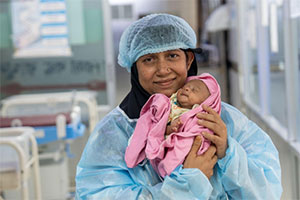 Bangladesh: Sarid, born one month early, receives specialized newborn care and grows stronger every day. Credit: UNICEF/UNI944397/Mojumder
Since the onset of the 2000s, global life expectancy has seen an overall rise, attributed to significant technological and scientific innovations in healthcare. Due to an increased understanding of different conditions as well as a rise in cooperation among healthcare experts around the world, there have been major strides made in ensuring that as few people die from chronic illnesses as possible. Despite the belief that healthcare is a fundamental human right, people from low- or middle-class backgrounds, marginalized groups, and underdeveloped countries have far more limited access to basic healthcare services.
The COVID-19 pandemic showed how marginalized communities are disproportionately affected by health crises, proving that we have much work to do in ensuring that no one dies of terminal conditions. While the global response to the coronavirus saw significant strides in immunization and vaccine development, the global outbreak of mpox in 2022 and its upsurge in parts of Africa in 2024 must remind us to remain vigilant.
Other major disease outbreaks in recent years have been linked to the destruction of infrastructure during warfare. Notably, in 2024, the Gaza Strip witnessed a return of the poliovirus since its eradication in the region 25 years ago. Israel’s blockade on Gaza has resulted in the collapse of the region’s sewage plants and desalination plants, and also destroyed healthcare capacities. The UN stated that this lack of clean water and sanitation would lead to an outbreak of cholera and other deadly infectious diseases. The 2026 OCHA Humanitarian Situation Report confirmed that the over two years of conflict in Gaza has produced a catastrophic health emergency, with millions remaining dependent on relief aid amid tight restrictions and no functioning public health system.
IPS is committed to providing full and comprehensive coverage on healthcare challenges around the world. IPS seeks to address the multifaceted causes of such challenges, including unprecedented pandemics, conflict-driven disease outbreaks, as well as socioeconomic barriers to equal healthcare access. IPS is also dedicated to reporting on innovations in the healthcare industry.

The Week with IPS

NEXT STOP - SDGs
Tracking global progress towards a sustainable world
Tracking global progress towards a sustainable world
