Languages
Saturday, November 7, 2026



News and Views from the Global South
Humanitarian Emergencies

An Ambitious, Stakeholder-Driven Climate Change Commitment Ahead of COP26: Eswatini’s Revised Nationally Determined Contribution (NDC) Process
There is no country today that has not experienced the effects of climate change, from changing weather patterns to extreme, devastating weather events.
We Heard Public Development Banks, but Will They Have the Guts to Deliver?
Public development banks have committed to ramp up action to tackle climate change, to protect biodiversity, to promote human rights, to align their investments with the SDGs and the Paris Agreement, and to create spaces of dialogue with civil society, farmers, indigenous peoples, and communities affected by the projects that they, as banks, finance.
Bringing Quality Education to Syria’s Most Vulnerable, Crisis-Impacted Children – Their Education Cannot Wait
In war-torn Syria, the support of Education Cannot Wait (ECW) – the United Nations global fund for education in emergencies and protracted crises – is bringing positive, life-changing educational opportunities tailored to children like 11-year-old Ali.
COP26: Building Climate Resilience Will Require a Focus on Those Furthest Behind
As the United Nations Climate Change Conference, also known as COP26, approaches (31 October -12 November in Glasgow, Scotland), climate action is more urgent than ever. Yes, we need climate change mitigation.
Guess Who’s Behind Paralysis on COVID19 in the UN Committee on World Food Security
‘COVID 19 has multiplied hunger and malnutrition challenges. We need transformative action!’ The first speaker at the UN Committee on World Food Security’s (CFS) 49th Plenary Session, the Secretary-General of the United Nations, turned the spotlight on the disastrous impacts of the pandemic that have afflicted communities around the world for close to two years.
We Will Never Give Up the Slavery Reparations Fight, say Caribbean Rastafarians
The Rastafarian organizations in the Caribbean are determined that the issue of slavery reparations will emerge from the eclipse of COVID-19. As the world deals with the impacts of efforts to contain the virus’ spread and regional governments tackle vaccine hesitancy and a wave of misinformation, issues not directly related to COVID-19 have had to be temporarily shelved.
Table Banking Helping Women in Kenya to Put Food on the Table
Pascaline Chemutai’s five acres of land located in the country’s breadbasket region of Rift Valley recently produced 115 bags of maize, each weighing 90 kilograms. She tells IPS that of these, 110 bags will be transported to traders in Nairobi and neighbouring Kiambu County at a negotiated price of $23 per bag.
Inclusive Education to Break the Cycles of Poverty
In September 2021, children in the northern hemisphere returned to school after the summer break. For some, the end of the holidays signaled a return to normalcy and to the joys of learning after facing months of school closures due to the Covid-19 pandemic. For the majority of children in the Global South, however, the return to reality looked grimmer.
Winning the Human Race, Together
“Now is the time for a stronger, more networked and inclusive multilateral system anchored in the United Nations,” said UN Secretary-General António Guterres in his latest report “Our Common Agenda.” Indeed, there is a fork in the road: we can either choose to breakdown or to breakthrough.
Atoll Nation of Tuvalu Adopts ‘Cubes’ to Step Up Nutritious Food Production
Tuvalu, a small atoll island nation in the Central Pacific Ocean, is one of few countries in the world to have so far evaded the pandemic. But, while it has achieved a milestone with no recorded cases of COVID-19, its population of about 11,931 continues to battle food uncertainties and poor nutrition. These challenges, present long before the pandemic emerged, have been exacerbated by lockdown restrictions and economic hardships during the past year and a half.
World Food Day: Climate Change is Exacerbating Hunger & Conflict—it’s Time to Break the Cycle
Hunger, violent conflict and the visible impacts of climate change are all on the rise. World Food Day, October 16, is a reminder that we need to talk about the intricate ways that these challenges are connected—and how to tackle them together.
Better Late than Never, but Act Now
The world should now be more aware of likely COVID-19 devastation unless urgently checked. Last week, the World Health Organization (WHO) announced an US$8 billion plan to quickly vaccinate many more people to expedite ending the pandemic.
China and the UN at 50- What We Can Achieve Together
China was one of the architects of the United Nations and was the first signatory of the UN Charter in San Francisco in 1945. But it was only in October 1971, with the Chinese delegation led by Mr. Qiao Guanhua, that China’s representation at the UN resumed. Since that time, the UN has had the great privilege of witnessing and supporting China in achieving one of the greatest periods of socio-economic progress in world history.
UN Chief, in an Unprecedented War of Words, Battles it out with a Member State
A growing diplomatic battle is being played out at the United Nations between Secretary-General Antonio Guterres and one of the world body’s member states: the politically-troubled Ethiopia which is desperately in need of international humanitarian assistance.
Mounting Scramble for Coronavirus Vaccines in Zimbabwe
More than a month ago, she lost her parents, brother, and wife, to the coronavirus. Then her fiancé battled COVID-19, but 27-year-old Melinda Gavi said she had not contracted the disease.
Mangrove Blue Carbon for Climate Change Mitigation
Smelly, boggy, and full of bugs, mangroves’ superpowers are well hidden. However, there is rising confidence that mangroves are the silver bullet to combat the effects of climate change.
Where on Earth is a Water-Secure World?
It is not uncommon for a water-centric research, policy or development organization or network to declare its long-term vision of the “water-secure world”. It reads nicely and feels great.
Education Cannot Wait Annual Results Reveals the Devastating Impact of COVID-19 on Learning for Children in Emergencies and Protracted Crises
The COVID-19 pandemic has changed the face of education globally, but for children in emergencies and protracted crises, its blow has been particularly devastating.
Stop New Washington Putsch
As finance ministers and central bank governors gather next week for the IMF-World Bank annual meetings in the US capital, the first shots of a new putsch against multilateralism have been fired. The target: Kristalina Georgieva, Fund Managing Director (MD) since 2019.
Digital Equity for All Ages
The growing number and share of older persons in Asia and the Pacific represent success stories of declining fertility and increasing longevity; the result of advances in social and economic development. This demographic transition is taking place against the backdrop of the accelerating Fourth Industrial Revolution. But COVID-19, with its epicentre now in Asia and the Pacific, has exacerbated the suffering of older persons in vulnerable situations and demonstrated the fragility of this progress.
Zero Hunger Campaign in Vietnam Targets Remote Areas and Cities
Amidst the verdant hills and remote corners of Vietnam’s rural regions, the growth that has transformed the economy in this part of Southeast Asia in recent decades can be hard to see. Undernourishment among children still results in stunting – even in cities too where overweight/obesity is also on the rise.« Previous Page — Next Page »





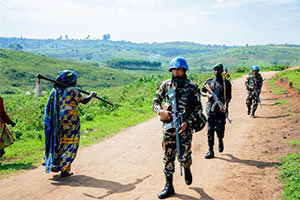 MONUSCO Peacekeepers and FARDC Soldiers Patrol Fataki Area. Credit: UN Photo/Jorkim Jotham Pituwa
Conflict, human rights violations, natural disasters, and famine have been at the forefront of concerns for humanitarian organizations. The escalation of humanitarian crises has led to over 239 million people in need of humanitarian assistance at the start of 2026, as estimated by OCHA’s Global Humanitarian Overview. The 2025 humanitarian appeal received only $12 billion, the lowest funding in over a decade, which has left 24 million fewer people reached in comparison to 2024. Conflict has remained the primary driver of crisis.
Humanitarian emergencies massively impact progress towards the Sustainable Development Goals (SDGs), adversely affecting economic development, inequality, education, planetary well-being, and poverty. Millions of people are faced with reduced access to essential services, including shelter, food, healthcare, and access to clean drinking water. UN Organizations such as UNHCR and the United Nations Children’s Fund (UNICEF) are committed to providing direct relief to affected communities when state governments cannot.
The United Nations 2024 Summit of the Future discussed measures that will be taken to reduce global inequality and promote peacekeeping efforts around the world. The recent UN Climate Change Conference (COP30) in Belém, Brazil, agreed to mobilize $1.3 trillion annually for climate action by 2035, operationalize the loss and damage fund, and triple adaptation finance. However, a fossil fuel transition commitment was not secured, despite climate change and the greenhouse effect being major contributors to humanitarian crises worldwide.
Countries across the world have also rallied to end humanitarian crises, as witnessed in conflicts such as Palestine and Ukraine. IPS is committed to providing relevant and in-depth reports of humanitarian emergencies around the world and their implications.

The Week with IPS

NEXT STOP - SDGs
Tracking global progress towards a sustainable world
Tracking global progress towards a sustainable world