Languages
Wednesday, October 14, 2026



News and Views from the Global South
Development & Aid

Invest in Girls’ Education: Invest in Our Future
On today’s International Day of the Girl Child, Education Cannot Wait (ECW) and our strategic partners call for substantial new funding to ensure every girl impacted by crises is able to access 12 years of quality education.
Darjeeling’s Wake-Up Call: Expert at IUCN Congress Calls for Agile Climate Finance
As global conservation leaders gather in Abu Dhabi for the IUCN World Conservation Congress, communities in the hills of Darjeeling, thousands of kilometers away, are still counting their losses. In early October, heavy rains triggered deadly landslides that buried homes, blocked key roads, and left several people dead. The destruction has once again exposed how vulnerable India’s mountain regions are to extreme weather.
Parliamentarians Seek Solutions to Protect Children from Digital Abuse
Vulnerable children are being targeted online faster than parliamentarians and law enforcers can act, a conference convened by the Asian Population and Development Association (APDA) heard. Yet, with international cooperation and sharing of ideas, lawmakers believe the scourge of online abuse can be addressed.
Guiding Disaster Risk-Reduction Investments Through AI-Powered Tools
The theme of this year’s International Day for Disaster Risk Reduction, “Fund Resilience, Not Disasters,” called for the urgent need to shift from reactive spending on recovery to proactive investment in disaster risk reduction.
Breaking the Silence in Tokyo: A Kazakh Filmmaker Confronts the Nuclear Scars Through Her Documentary “Jara”
[caption id="attachment_192574" align="alignleft" width="300"]Aigerim Seitenova stepped forward in a black T-shirt and green skirt to introduce her 31-minute documentary, “Jara – Radioactive Patriarchy: Women of Qazaqstan.” The screening event was co-organized by the Kazakh Nuclear Frontline Coalition (ASQAQQNFC), the Soka Gakkai Peace Committee, and Peace Boat, with support from Japan NGO Network for Nuclear Weapons Abolition (JANA).

Abusive Governments Set to Win Seats in Human Rights Council
Egypt and Vietnam are on track to secure seats on the United Nations Human Rights Council despite being woefully unfit for membership. The UN General Assembly will elect members to the UN’s premier rights body in a noncompetitive vote on October 14, 2025.
Education Cannot Wait Interviews Mohamed M. Malick Fall, UN Resident and Humanitarian Coordinator in Nigeria
Mohamed M. Malick Fall was appointed as the United Nations Resident Coordinator in Nigeria in February 2024. He has more than 20 years of experience in the development, humanitarian and peacebuilding fields. Prior to his appointment, he served as the UNICEF Regional Director for Eastern and Southern Africa, where he provided oversight and guidance to 21 UNICEF Countries Offices, including on the formulation and implementation of the Country Programme Documents, the UN Reform process, and the engagement with the Regional and Economic Commission and African Union and the private sector.

Science-Informed Policy Action Key to Biodiversity Conservation
Global biodiversity is disappearing at breakneck speed and, in the process, threatening the future of humanity. The loss is not a future threat but a present crisis that Dr. Luthando Dziba, the new Executive Secretary of the Intergovernmental Platform on Biodiversity and Ecosystem Services (IPBES), believes can be tackled with science-based policy action.
Moldova’s Democratic Defiance
Democracy was the winner and Russia the loser in Moldova’s 28 September election. The incumbent pro-Europe Party of Action and Solidarity (PAS) won a parliamentary majority on just over half of the vote, while support for a pro-Russia coalition collapsed to a record low. The result came in the face of Russia’s most intense attempt yet to influence an election, with a propaganda and disinformation operation allegedly orchestrated by Ilan Shor, a disgraced Moldovan oligarch who fled to Russia to escape jail time for his role in a massive fraud.
Civil Society on the Edge
The collapse of aid architecture is one of the greatest dangers for civic space. This shift is not accidental but systemic, reflecting deliberate policy choices – not only by the US but accelerated by its decisions- that prioritize security agendas over human rights and solidarity.
UNGA80: Climate and Health in the Mix of Hope and Despair
The Intergovernmental Panel on Climate Change (IPCC), the UN's body on climate science, has over the years, repeatedly and steadily reported on the science of global warming leading to the changing climate with visible impacts.
Wealthy Nations Urged to Curb Climate Finance Debt For Developing Countries
In recent years, international climate financing has declined sharply, leaving billions of people in developing nations increasingly vulnerable to natural disasters and unable to adapt effectively. With major cuts in foreign aid, these communities are expected to face the brunt of the climate crisis, while wealthier nations continue to reap economic benefits.
Two-Thirds of Climate Funding for Global South are Loans as Rich Nations Profiteer from Escalating Climate Crisis
New research by Oxfam and the CARE Climate Justice Centre finds developing countries are now paying more back to wealthy nations for climate finance loans than they receive—for every USD 5 they receive, they are paying USD 7 back, and 65 percent of funding is delivered in the form of loans.
Explainer: COP30’s ‘Granary of Solutions’ Will Be Showroom of World’s Best Climate Fixes
Once a year, the COP presidency or the role held by the Minister of Environment from the host government at a Conference of the Parties (COP) meeting, sets out on an ambitious, year-long journey in hopes of delivering the climate deal of a lifetime.
Urban Food Insecurity Is Surging – Here’s How Cities Can Respond
Millions of people in the United States and around the world continue to face food insecurity, meaning they cannot access safe and nutritious food necessary for living their fullest lives, and they often do not know where their next meal will come from. According to Feeding America, 47 million people in the United States are food insecure. Worldwide, 673 million people experience food insecurity.
Belarus Prisoner Release a Diversion, Say Rights Activists
As Belarusian president Alexander Lukashenko continues to pardon political prisoners in an apparently increasingly successful attempt to improve diplomatic relations with the US, rights groups have warned the international community must not let itself be ‘tricked’ into thinking repressions in the country are easing.
‘The Government Was Corrupt and Willing to Kill Its Own People to Stay in Power’
CIVICUS discusses recent protests that led to a change of government in Nepal with Dikpal Khatri Chhetri, co-founder of Youth in Federal Discourse (YFD). YFD is a youth-led organisation that advocates for democracy, civic engagement and young people’s empowerment.

No African Development from Western Trade Policies
The World Bank’s 1981 Berg Report provided the blueprint for structural adjustment, including economic liberalisation in Africa. Urging trade liberalisation, it promised growth from its supposed comparative advantage in agriculture.
World War II Era Weapons Still Threatening Lives and Development in the Solomon Islands
Last century the remote Solomon Islands was the stage for some of the most intense battles fought during the Pacific campaign of the Second World War. But while Allied troops departed on the heels of victory, the military forces of both sides left a massive legacy of unexploded ordnance (UXO) which is still scattered across the country and others in the region.
Our Teachers, Our Heroes
1 calls on people everywhere to provide teachers and the communities they serve with the resources they need to succeed in their crucial profession.
From Storm to Strength: Odisha’s “Zero Casualty” Model for Community-Centered Disaster Resilience
South Asia is home to nearly two billion people and ranks among the most disaster-prone subregions in Asia and the Pacific. Every year, millions face exposure to floods, cyclones and other extreme events. The Bay of Bengal alone accounts for nearly 80 per cent of global cyclone-related deaths, with storms striking Bangladesh, India and Sri Lanka with growing frequency.« Previous Page — Next Page »





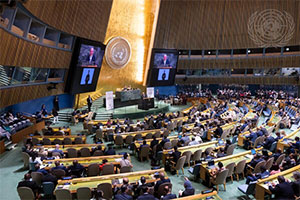 2026 High-level Political Forum on Sustainable Development. Credit: UN Photo/Eskinder Debebe
In 2015, the United Nations and its Member States adopted the Sustainable Development Goals (SDGs) in an effort to make the world a more sustainable and peaceful place for future generations. Progress on the 17 SDGs has been uneven, and inequality persists across the globe. 10 years after adoption, the 2025 UN SDGs Report revealed that only 35% of the SDG targets are on track, with more than half moving too slowly, and 18% moving backwards from the 2015 baseline. Poverty remains one of the world’s most pressing issues, with hunger, violence, and inequality impeding the opportunities for all people to achieve success. In September 2024, the United Nations Summit of the Future introduced a new goal: to eradicate global poverty by 2030, ensure universal rights to basic services, and increase the overall standard of living in terms of industrialization, economic well-being, citizen health, and literacy. Furthermore, recent shifts in United States foreign aid policy – notably, major budget cuts to USAID and the termination of thousands of development programmes– have severely threatened vital lifelines of financial aid to impoverished communities around the world. Additionally, the United States’ withdrawal from the Paris Climate Agreement has undercut international efforts at sustainable development. With the upcoming 2030 deadline, the UN Secretary-General has called for urgent multilateralism across six priority areas: food systems, energy, digital connectivity, education, jobs and social protection, and climate and biodiversity. IPS sheds light on marginalized communities that struggle on a daily basis to survive and have their stories heard and respected.
Updated by Yilan Batista and Shuli Wong August 2026

The Week with IPS

NEXT STOP - SDGs
Tracking global progress towards a sustainable world
Tracking global progress towards a sustainable world
