Languages
Sunday, November 8, 2026



News and Views from the Global South
Population
Female Trafficking Soars in Iraq
Rania was 16 years old when officials raped her during Saddam Hussein’s 1991 crackdown in Iraq’s Shia south. "My brothers were sentenced to death, and the price to stop this was to offer my body," she says.Palestinians Thirsting for Justice in Water-Starved Occupied Territories
In the strife-stricken Middle East, oil has always been in the realm of politics. But in the Israeli-occupied territories of Gaza and the West Bank, oil has been supplanted by water.
Q&A: NGOs Must Play Key Role in Rio+20 Summit on Sustainable Development
As the United Nations readies for a major international conference on sustainable development next June in Brazil, non-governmental organisations (NGOs) are preparing to play a key role in the run-up to the summit meeting and are preparing a plan of action to be adopted by world leaders.
IRAQ: Trafficked to Baghdad’s Green Zone
Ukrainian and Bulgarian workers are currently camped out on a construction site of half-built luxury villas in Baghdad’s elite "Green Zone" – a vast security enclave housing government offices, embassies and international NGOs - demanding their salaries before being shipped back home.Africa Remains Hamstrung in Battle for Water and Sanitation
The statistics coming out of Africa are staggering: 40 percent of Africa’s 1 billion people live in urban areas and 60 percent live in slums, where water supplies and sanitation are "severely inadequate", according to the Nairobi-based U.N. Environment Programme (UNEP).
Refugees Tossed Between Iraq and Syria
At the height of Iraq’s sectarian war in 2006, 30-year-old Samer escaped his Baghdad neighbourhood to join a flood of refugees arriving in Syria. A young man of military age, he was at high risk of being targeted by armed forces that roamed the capital’s streets.
Haiti’s Earthquake Victims: ‘Abandoned Like Stray Dogs’
Eighty thousand tiny houses dot the countryside near this coastal city, located just west of the epicentre of the Jan. 12, 2010 earthquake that killed some 200,000 and displaced over one million.‘Sustainable Development Must Start with People’
When world leaders meet in Brazil next June for a U.N. Conference on Sustainable Development, the third since the landmark 1992 Earth Summit in Rio de Janeiro, the question lingering in the minds of many is: what really is "sustainable development" in the context of a fast-changing world of growing poverty, hunger, pollution, political repression and social unrest?PAKISTAN: Democracy Follows Drones
Along with the devastating drone strikes the United States-led ‘war on terror’ in Afghanistan is bringing changes to punitive laws imposed by British colonialism on Pakistan’s Pashtun areas more than a century ago.Mega Cities Could Trigger Water Shortages and Social Unrest
The rapid growth of urban population - described as one of the world’s major demographic trends - has triggered an explosion of "mega cities" in Asia, Latin America and Africa, causing a breakdown in basic services, including water supplies and sanitation facilities.OP-ED: Expanding Deserts, Falling Water Tables and Toxins Driving People from Homes
People do not normally leave their homes, their families, and their communities unless they have no other option. Yet as environmental stresses mount, we can expect to see a growing number of environmental refugees. Rising seas and increasingly devastating storms grab headlines, but expanding deserts, falling water tables, and toxic waste and radiation are also forcing people from their homes.PORTUGAL: Young Professionals Flee Crisis – to Former Colonies
Thousands of young people from Portugal are joining an emigration flow that never trickled to a stop but is turning into an exodus now due to the severe economic crisis plaguing this southern European country. And the main destinations of those looking for a better future abroad are former colonies, especially Brazil.Sri Lanka Ducks International Probe
Although the Sri Lankan government has evaded calls for an international probe into alleged excesses while militarily defeating Tamil separatism in 2009, it may yet be called to account at the September session of the United Nations Human Rights Council (UNHRC).
Q&A: Water Will Be Lifeblood of Smart Urban Expansion
The world's water map is being significantly redrawn due primarily to the mass migration of people into urban centres, threatening one of life's vital resources.
SOMALIA: City in Need of More Aid
The shelling and gunshots, once a common sound in Mogadishu, no longer ring out in the city's streets. The surprise withdrawal on Aug. 6 of the Islamist extremist group Al Shabaab from their stronghold in Mogadishu has meant that people now move about the city, for the first time in two years, without fear of constant attack.
Q&A: Climate-Driven Migrants Raise Thorny Legal Issues
As the effects of accelerating climate change ripple outward, pushing millions from their land and homes, experts warn that international human rights and refugee law needs to catch up to the reality on the ground if migrants are to be given adequate protection and support.EUROPE: ‘Rethink Rhetoric Against Islam’
Conservative governments and centre-right parties in Europe were attacking multiculturalism and denigrating Muslim immigrants long before Norwegian right-wing extremist Anders Behring Breivik used similar arguments to justify mass killings in Oslo and Utoya Island.JAPAN: Divorced Men Lose Children Along With Visas
Shahdul Huq, a Bangladeshi national living in Japan for more than 20 years, last saw his daughter almost three years ago when he lost his ‘spouse visa’ following divorce from his Japanese wife.TUNISIA: War Strangles Livelihoods on the Border
Tunisia’s border with Libya has been a major lifeline, keeping residents in Ben Guerdane economically afloat - so when the vital trade route is blocked by the municipality or by protestors, tempers flare.ARGENTINA: Needs Outstrip Efforts to Build Affordable Housing
The Argentine economy has grown steadily since 2003, and hundreds of thousands of social housing units have been built. Nevertheless, the protests and conflicts that periodically break out make it clear that the solutions have failed to keep up with the need for affordable housingCLIMATE CHANGE: “Last Straw” Pushes Millions from Their Homes
With political will to dramatically cut the world's greenhouse gas emissions failing to materialise, a multi-pronged approach is needed to protect the millions of people who are being displaced as a result of environmental factors driven largely by climate change, experts say.« Previous Page — Next Page »





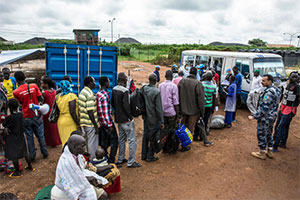 One Thousand Internally Displaced Persons (IDPs) Relocated from Tomping Camp in South Sudan. Credit: UN Photo/Isaac Billy
It took hundreds of thousands of years for the world’s human population to cross one billion in 1804. Approximately 200 years later, the population has multiplied sevenfold. In 2023, the global population crossed 8 billion, and is expected to reach 9 billion before 2050. With the planet more crowded than ever, it is essential to keep track of population trends, urbanization, migration, and reproduction across the world.
Life expectancy has seen significant strides in the past century, largely due to economic development and increased standards of living. On the contrary, trends in global fertility are shifting, with certain regions in Africa and Asia reporting higher rates, while parts of Europe and North America report stagnant or lower rates. This is in part due to differences in sexual and reproductive healthcare, as well as societal and economic conditions around the world. For example, child marriage is prevalent in certain societies, where childbearing is also considered a familial duty. Meanwhile, stagnating economies frequently experience lower marriage and childbearing rates.
The increase in migration and urban development around the world is also linked to global population trends. By 2050, it is expected that approximately 66 percent of all people will live in cities. Furthermore, global crises such as warfare and natural disasters also prompt transnational migration. Transnational migration is linked to a variety of socioeconomic issues in both host and receiving countries: migrants often leave developing countries with less access to educational and economic opportunities and arrive in developed countries where they are frequently the targets of ethnic, racial, and cultural discrimination, and economic exploitation. Recent crises in Europe and the United States demonstrate the importance of advocating for migrants worldwide. As migrants from the Global South are increasingly stripped of their legal and civic rights in unlawful deportations, or targeted in acts of identity-based violence, it is essential to keep track of population trends and protect the human rights of migrant populations. Climate-related disasters are now a major driver of displacement, with nearly half of all new internal displacements in 2025 being disaster-related.
IPS is devoted to covering issues surrounding population trends, migration, and reproduction through its compelling articles, which use both statistics and human stories to provide readers with robust and informative viewpoints.

The Week with IPS

NEXT STOP - SDGs
Tracking global progress towards a sustainable world
Tracking global progress towards a sustainable world
