Languages
Monday, November 9, 2026



News and Views from the Global South
Population
AGRICULTURE: Three-Quarters of Hungry Are Rural Poor
Climate change, associated with a four-fold increase in natural disasters in the last decade, and the growth of world population, which is expected to reach nine billion by 2050, pose new challenges for aid initiatives like those of the United Nations World Food Programme (WFP).DEVELOPMENT: Japan’s Rude Awakening: Poverty Hurts
Japan may be one the world' biggest economies, but it is not immune to poverty.PAKISTAN: War-Displaced Lament Poor Conditions
Wracked by intense violence in 2009, Pakistan has seen an unprecedented displacement of hundreds of thousands of people, which persists to this day.DEVELOPMENT-FIJI: Amid Economic Slump, Children Face Bleak Future
Shonal Chand, 16, has ditched school to work full time to assist his financially struggling family. He sells pineapples, watermelons and other local seasonal fruits by the roadside six days a week.ENVIRONMENT-INDIA: Creeping Deserts and Crouching Hunger
It is just the beginning of the year, but M. Manju Laxmi already feels anxious. In four months or so, she will be back to her old routine: stuffing the wide chinks under her weathered closed doors and windows with her old saris.POLITICS-NEPAL: Parties at Odds, Peace at Risk
Nepal’s walk to peace from a decade-long, Maoist-led bloody insurgency that ended four years ago could take longer than expected.POLITICS: Backlash against Rogue Chinese Investors Alarms Beijing
As China moves up in the world and the need for investment in its own infrastructure declines, Chinese investors and financiers are eyeing lucrative contracts in less developed countries, winning bids to build dams, power plants and highways from Burma to Uzbekistan and Angola.
HEALTH-INDIA: Hunger Haunts Hospitals
As a nurse, Amita Dhaka sees much suffering, but what she finds hard to handle is inadequate nutrition and even hunger among poor in-patients.MALAYSIA: Social Safety Nets Not Good Enough for Children
Malaysia may have been spared the worst effects of the economic slowdown due largely to its oil and gas reserves and other natural resources.POLITICS: Indonesia Mourns the Passing of a Beloved Leader
The news about fourth Indonesian president and cleric Abdurrahman Wahid being admitted to the hospital last week merited only a passing mention in the national media. It was overshadowed by reports on the country’s tumultuous political situation, such as allegations that President Susilo Bambang Yudhoyono was involved in a banking scandal and the controversies hounding the country’s corruption eradication agency.SRI LANKA: A Nation Struggles to Forget a Tragedy
Waves hitting a train and carriages half submerged in water. Scores of men, women and children leaping above the water, hands outstretched, bodies strewn all over.ENVIRONMENT-JAPAN: Solar Trend Catches Fire among Households
The global community may have been dismayed by the outcome of the recently concluded climate change talks in Copenhagen, but Mami Naito, 42, is not about to put off dealing with this global phenomenon in her own small way. "We very much like the idea of joining the efforts to prevent global warming," says the mother of two.
LEBANON: Hip-hop Kindles Hopes in Destroyed Refugee Camp
The hip-hop beats ringing through the muddy, unlit streets of this burnt-out Palestinian refugee camp seem incongruous. But the rhymes are camp-grown - and courageous.Q&A: ‘Children Need to Adjust to the Economic Crisis’
During the Asian financial crisis in 1997, Yaowapa Donsay was laid off from the Thai garments factory she was working in. Subsequently, she organised a group of jobless women workers – and that marked her transformation into a labour activist.CAMBODIA: Financial Crisis Forces More Teenage Girls into Labour
Until the global financial crisis hit, a journey out of poverty for women in rural Cambodia was assured by the vibrant garment sector that had taken root in the country’s capital. Tens of thousands of women in their twenties poured into Phnom Penh to secure jobs in the hundreds of export-oriented factories.RIGHTS-INDIA: Hi-Tech Beats Sex Selection Ban
When a magistrate in the western port city of Mumbai convicted two doctors in November for advertising sex selection services, it showed determination to enforce laws aimed at stopping gender determination tests linked to the mass abortion of female foetuses.JORDAN: Palestinian Refugees Live Out Lives in Limbo
Music enlivens the yellow taxi as it traverses the Jordanian capital. A small Palestinian flag hangs from the rearview mirror. Jihad, the cab driver, says his father fled here from the Palestinian West Bank in 1948.
JAPAN: Careers On Hold For Most Women
Tomoko Ando and her husband divorced because she refused to quit her job as a lawyer and start a family. The shortage of daycare centres has created a dilemma for women like Ando who want to continue working, but also start a family.
SOUTH KOREA: Low Birth Rate Blamed on Women
On Dec. 9, Sungshin Women’s University in Seoul organised an event titled, 'Happy Childbirth - Rich and Strong Future', aimed at trying to raise awareness about the country's very low birth rate.PHILIPPINES: Belt-tightening by Migrant Workers Unfelt at Home
The global financial crisis may have dealt a severe blow to Filipino migrant workers, thousands of whom lost their jobs and fell into debt. But public schoolteacher Melinda Mendoza does not see this impact at all -- at least not within the four walls of her classroom.HEALTH-EUROPE: ‘Czech Attitudes to HIV/AIDS Risky’
Complacency and ignorance over the risks posed by HIV and AIDS are threatening to send infection rates soaring in the Czech Republic, health authorities.« Previous Page — Next Page »





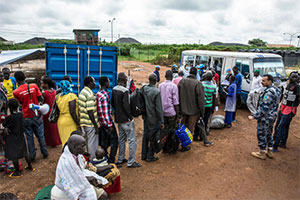 One Thousand Internally Displaced Persons (IDPs) Relocated from Tomping Camp in South Sudan. Credit: UN Photo/Isaac Billy
It took hundreds of thousands of years for the world’s human population to cross one billion in 1804. Approximately 200 years later, the population has multiplied sevenfold. In 2023, the global population crossed 8 billion, and is expected to reach 9 billion before 2050. With the planet more crowded than ever, it is essential to keep track of population trends, urbanization, migration, and reproduction across the world.
Life expectancy has seen significant strides in the past century, largely due to economic development and increased standards of living. On the contrary, trends in global fertility are shifting, with certain regions in Africa and Asia reporting higher rates, while parts of Europe and North America report stagnant or lower rates. This is in part due to differences in sexual and reproductive healthcare, as well as societal and economic conditions around the world. For example, child marriage is prevalent in certain societies, where childbearing is also considered a familial duty. Meanwhile, stagnating economies frequently experience lower marriage and childbearing rates.
The increase in migration and urban development around the world is also linked to global population trends. By 2050, it is expected that approximately 66 percent of all people will live in cities. Furthermore, global crises such as warfare and natural disasters also prompt transnational migration. Transnational migration is linked to a variety of socioeconomic issues in both host and receiving countries: migrants often leave developing countries with less access to educational and economic opportunities and arrive in developed countries where they are frequently the targets of ethnic, racial, and cultural discrimination, and economic exploitation. Recent crises in Europe and the United States demonstrate the importance of advocating for migrants worldwide. As migrants from the Global South are increasingly stripped of their legal and civic rights in unlawful deportations, or targeted in acts of identity-based violence, it is essential to keep track of population trends and protect the human rights of migrant populations. Climate-related disasters are now a major driver of displacement, with nearly half of all new internal displacements in 2025 being disaster-related.
IPS is devoted to covering issues surrounding population trends, migration, and reproduction through its compelling articles, which use both statistics and human stories to provide readers with robust and informative viewpoints.

The Week with IPS

NEXT STOP - SDGs
Tracking global progress towards a sustainable world
Tracking global progress towards a sustainable world
