Languages
Tuesday, September 22, 2026



News and Views from the Global South
Poverty & SDGs

Beware UN Food Systems Summit Trojan Horse
Undoubtedly, the world needs to reform existing food systems to better serve humanity and sustainable development. But the United Nations World Food Systems Summit (UNFSS) must be consistent with UN-led multilateralism. For the first time ever, the World Economic Forum (WEF), a partnership of some of the world’s most powerful corporations, is partnering the UN in launching the Summit, now scheduled for September, with its ‘Pre-Summit’ beginning today.
Violence Casts Shadow Over South Africa’s Post-Apartheid Democratic Gains
Twenty-seven years after South Africa’s first democratic elections, the country finds itself reflecting on the catalysts of a week of looting and destruction of property resulting in more than 200 deaths and US$ 1.3 billion in damage.
Rwandan Farmers Pin Hopes on New Tech to Tackle Food Losses
Rwanda is trying to reduce post-harvest loss by relying on new technologies to increase the amount of food available for consumption and help smallholder farmers confront some challenges caused by the overproduction of staple crops.
The Future of Food is in Our Hands
With its political and economic clout, the G20 should lead in delivering sustainable food systems as the world grapples with rising hunger, malnutrition and inequality.
Striving for Sustainability in Global Food Systems
As the global community gears up for the 2021 UN Food Systems Summit in September, it is significant that preparations are also underway by Global Reporting Initiative to deliver a new sector reporting standard for agriculture, aquaculture, and fishing.
Fighting COVID-19, But Thinking About the Post-COVID-19 World
Europe, the United States and other countries have made important progress in reducing the dramatic impact of COVID-19 in key sectors of the economy and population. However, in some parts of Africa, Latin America, Asia and the Middle East, the devastating effects of the pandemic continue to severely affect these sectors. One sector in particular, the food and agriculture sector, has been deeply impacted.
At the UN, Climate Change & Security Must Be Tackled Together
Could the next wars be triggered by climate change? Until recently, the question might have seemed like science fiction, but now it is very real. Ethiopia and Egypt are locked in an upward spiral of tensions over the Nile, as a combination of dams and shifting weather patterns pose existential risks to both countries.
Pacific Islands Making the Move to Electronic Data Collection
Between 2010 and 2020, many Pacific Islands and Territories have updated their traditional data collection processes, embracing new technologies. The island nations Kiribati and Vanuatu, among others, successfully switched to computer-assisted personal interviewing (CAPI), a new data management system and a survey monitoring dashboard. The innovations implemented with support from the Pacific Community helped to weather the impact of the pandemic on census activities and to become fit for the purpose of tracking the Sustainable Development Goals (SDGs).
Combating COVID-19 and Ensuring No One is Left Behind
If the world wants to beat back the COVID-19 pandemic and ensure no one is left behind in the recovery, two issues thrown into sharp relief by the pandemic need attention: digitalization and regional cooperation.
Reflections on South Sudan’s Ten Years of Independence
The declaration of independence of South Sudan was a great historic moment that gave hope to South Sudanese on July 9, 2011. It brought a sense of satisfaction, indicating achievement of a life-time dream for which millions of our people across generations paid the ultimate price.
Bridging the Gap and Crossing the Bridge
It may be a challenge, but it is also an absolute necessity: bridging the gap between international law and reality and quickly crossing the bridge to reach all crisis-affected children and youth left furthest behind. Inclusive and equitable quality education is the right of every girl and boy and the objective of Sustainable Development Goal 4.
Q&A: UN Food Systems Summit Opportunity for the World to Unite on Healthy, Fair & Sustainable Food Systems
Before the COVID-19 pandemic upended every sphere of life, the world was lagging on a goal to end hunger by 2030. According to the United Nations, more than 820 million people had already been categorised as food insecure, meaning they lacked access to reliable and sufficient amounts of affordable, healthy food.
“The Critical Importance of Ecosystem Restoration”
June 2021 marked the launch of UN Decade on Ecosystem restoration. This effort aims at reversing the damage that us humans have caused and are still causing to Nature. It is clear that we have to reverse course and spare no effort into making this ‘Decade on Ecosystem Restoration’ a success. Preserving Nature and maintaining its services are critical for our survival on this planet and for our livelihoods.
Agroecology as the Centrepiece of Sustainable Food Systems
In three weeks, the United Nations will bring together farmers, scientists, policymakers and civil society for the last major event ahead of the September UN Food Systems Summit.
Why we Need to Build Economies– not Walls– to Stop Migration
If you speak to farmers in El Salvador, many will tell you about the time they were driven to head north across Central America towards the US. The routes to the border are many, but the origins are so often the same: desperation and hope that better employment opportunities can be found elsewhere.
Stopping Marine Plastic Pollution: A Key IUCN Congress Goal
Documented images of albatross chicks and marine turtles dying slow deaths from eating plastic bags and other waste are being seared into our consciences. And yet our mass pollution of Earth’s seas and oceans, fuelled by single-use plastics and throw-away consumerism, just gets worse.
Water: A Matter of Survival in the World of Pandemics
The COVID-19 pandemic has undeniably amplified the existing vulnerabilities of billions of people worldwide. Marginalized communities in developing countries were excluded from social protection and support.
COVID-19 Pandemic Exacerbates Domestic Workers’ Plight in Bangladesh
Rani Akter, a mother of five, usually works as a domestic helper in Dhaka’s Zikatola area. When the coronavirus pandemic broke out in Bangladesh last March, her employers asked her not to come to their homes for fear of infection. “I lost my work in three houses one after the other, which became a nightmare for me. My rich employers did not allow me in their homes as they thought that I might carry the invisible virus,” Akter told IPS.UN Food Systems Summit Releases Potential Solutions for Local, Regional and Global Action
The UN Food Systems Summit has revealed the 15 action areas with more than 50 solution clusters that will inspire discussions at the Pre-Summit in Rome from July 26-28.
Climate Change: Your Choices Matter
Life is a series of choices. And choices have consequences. When it comes to climate change, some choices have bigger consequences than others, and there's a startling takeaway: your next "big" decision will play a meaningful role in our collective ability to reach Net-Zero by 2050.
Acceleration Rights Plan for Gender Equality Mooted at Equality Forum
As the global gathering for gender equality, the Generation Equality Forum, kicks off in Paris on June 30, 2020, IPS conducted an exclusive interview with Katja Iversen.« Previous Page — Next Page »


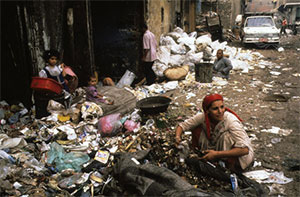 Romani people in Cairo, Egypt, forage through trash. Credit: UN Photo/Armineh Johannes
In 2015, the United Nations adopted the Sustainable Development Goals (SDGs) in an effort to promote “peace and prosperity for people and the planet.” To achieve that goal, it is essential to provide equal opportunities and access to basic services to all people. The 2025 UN SDG Report found that 35% of the 169 SDG targets are on track or making moderate progress, while 18% have reversed compared to the 2025 baseline. One in ten people still live in extreme poverty, one in eleven experience food insecurity, and over 1.1 billion people live in slums without access to clean water and sanitation. It is imperative to acknowledge the societal, technological, economic, and political issues that sustain poverty in countries around the world. Eradicating poverty will require significant frameworks in policy and governance on a national and international scale to ensure that all people will have equal access to basic services and economic opportunities by 2030. Furthermore, a dramatic reduction of United States foreign aid in 2025, including the termination of 83% of USAID programmes, threatens to erode years of fragile development gains.
Throughout the world, violent conflict and natural disasters also contribute to extreme poverty. The complete destruction of infrastructure and blockage of aid has significantly impoverished Palestine since October 7th. The destructive impact of Hurricane Maria in Puerto Rico left $91 billion in damage. An inadequate US government response also revealed significant and enduring questions within the issue of mitigating poverty: how do we rebuild infrastructure after its destruction? How do we restimulate economic development and bring in financial aid after disasters? Similar questions have been raised in the realm of regional cooperation, as devastating floods have wrecked hundreds of thousands of homes across multiple Southeast Asian nations in the past few years. Furthermore, the COVID-19 pandemic has greatly exacerbated the global poverty crisis, particularly in developing countries, setting back the United Nations goal of eradicating poverty by 2030.
IPS is committed to providing comprehensive features that focus on the persisting environmental, sociopolitical, and systemic issues that sustain poverty, and the steps taken worldwide towards poverty eradication.

The Week with IPS

NEXT STOP - SDGs
Tracking global progress towards a sustainable world
Tracking global progress towards a sustainable world

