Languages
Thursday, September 24, 2026



News and Views from the Global South
Poverty & SDGs

Weaponizing Science in Global Food Policy
In July, the United Nations will convene “Science Days”, a high-profile event in preparation for the UN Food Systems Summit later this year. Over the course of two days, the world will be treated to a parade of Zoom sessions aimed at “highlighting the centrality of science, technology and innovation for food systems transformation.”
Global Herd Immunity Remains Out of Reach Because of Inequitable Vaccine Distribution – 99% of People in Poor Countries Are Unvaccinated
In the race between infection and injection, injection has lost. Public health experts estimate that approximately 70% of the world’s 7.9 billion people must be fully vaccinated to end the COVID-19 pandemic. As of June 21, 2021, 10.04% of the global population had been fully vaccinated, nearly all of them in rich countries.
130 Countries Promise to Protect and Invest in Health Care Workers
One hundred and thirty countries have signed a statement recognising the efforts of health care workers, first responders and essential workers during the COVID-19 pandemic – "one of the greatest global challenges in the history of the United Nations".
Water Harvesting Strengthens Food Security in Central America
At the school in El Guarumal, a remote village in eastern El Salvador, the children no longer have to walk several kilometers along winding paths to fetch water from wells; they now "harvest" it from the rain that falls on the roofs of their classrooms.
Three Million in Three Years: Jamaica’s Tree-Planting to Tackle Climate Change
By the time he is finished, Dr. Satyanarayana Parvataneni expects he will be responsible for planting over 200,000 tree seedlings in Jamaica. It is an effort driven by a desire to preserve the planet for the next generation, as well as the one of the largest contributions to date to a national effort to plant three million trees in three years.
Sowing Water: A Cuban Farm’s Bid for Sustainability
Cuban farmer José Antonio Casimiro found in the ageold technique of sowing water an opportunity to meet his farm's water needs and mitigate the increasingly visible effects of climate change.
Central Sahel: Ground Zero in Tackling Climate Change Through Education
The climate crisis is amplifying the effects of instability and violence in the world’s poorest countries. Nowhere is this more visible than in Africa’s Central Sahel region, where increasing temperature, floods, droughts and other climate change-induced disasters are triggering conflicts, displacement, and pushing girls and boys into the shadows.
The Marginalisation of Africa
Is Africa marginalised in contemporary economics and politics, and in contemporary economic and political research? Impressions gathered over the years and a bit of evidence (much more could be assembled) indicate that it is. I would distinguish three types of marginalisation: objective, objectified and subjective marginalisation.
Charcoal Production Risks Future of Zimbabwe’s Native Forests
Once a week a tonnage of fresh charcoal is dropped off at Sibangani Tshobe's rugged, pit-stop stall by a hired, battered old Bedford lorry. Small, makeshift trolleys — nicknamed Scania's — quickly cart off small loads and disappear into Old Pumula, the oldest suburb in the country’s second-largest city of Bulawayo.
The Real Price of Marriage in South Sudan
August of this year will mark the one-year anniversary of the end of South Sudan’s civil war, yet recent surges of violence suggest that peace is far from being realized. These attacks by armed groups include instances of sexual violence against women and girls.
A Staggering 160 Million Are Victims of Child Labour
Among the many daunting issues leaders of the G7 will have to discuss in their upcoming summit in idyllic Cornwall on June 11-13, child labour won’t be on the official agenda.
Preventing Hunger While Building Peace
Acute hunger is expected to soar in over 20 countries in the next few months, warns a recent report on global “hunger hotspots” from the UN’s Food and Agriculture Organization (FAO) and the World Food Programme (WFP). An estimated 34 million people are “one step away from starvation”, pushed to the brink by climate shocks, conflict, and the Covid-19 pandemic.
Global Progress Against Child Labour “Ground to a Halt” – UN Report
Malleshwar Rao, 27, spent his early years as a child labourer in the southern Indian city of Hyderabad. Soon after finishing school at a local ashram, where the children of poor parents, sex workers and orphans studied, the 9-year-old would rush to a local construction site to join his parents who would be toiling in the harsh tropical sun to construct buildings as daily wage earners. The supervisor would assign Rao simpler tasks and his extra income would help his parents feed him and his younger brother.
Investing in Lives & Livelihoods of India’s Women Crucial to Nation’s Full Recovery
Thousands of Indians have been affected by the latest COVID-19 outbreak. Not only those suffering from the disease, but also those who care for them.
Time to End Generational Injustice with a ‘Global Blue New Deal’ to Protect Oceans
Increasingly, youth are rising up to declare that they've had enough of the cyclical exploitation of the environment that jeopardizes their own future.
Paltry International Support for Spending Needs Sets South Further Back
With the pandemic setting back past, modest and uneven progress, huge disparities in containing COVID-19 and financing government efforts are widening the North-South gap and other inequalities once again.
Is the UN Fighting a Losing Battle Against World’s Corrupt Leaders?
A hilarious anecdote, recounted in the New York Times years ago, related to the widespread corruption embedded in the political culture of a Southeast Asian country where crooked politicians were willing to provide receipts every time they received a bribe—big time bribes.
Why We Need More Women in Power
What is the first thing that comes to your mind when you read the words, women and power? The accepted wisdom is that women can be powerful, but not without the constant reference to their gender - which is often based on a set of unconscious biases towards them. Is she competent enough, effective, articulate without being too assertive or too aggressive. Is she a straightjacket, is she too emotional, will her family life impact her work or vice versa. Is she smart enough to camouflage her intelligence, is she ready for a key position, is it worth making her powerful?
Fresh Air, Clean Water
You want to breathe fresh air and have access to clean water? I guess you do, just like all of us. As populations in the so-called developed countries, we love to go for holidays in places where on high mountains you get to breathe deeply and enjoy the fresh air, where the oceans or lakes are clean and refreshing. And how do we arrive there? Mostly by airplanes or cars, polluting the air whilst travelling to the desired destinations, causing harm to people and the planet. Interestingly, many people today, calculate their flight’s CO2 footprint and pay a certain amount of money to invest in renewable energy projects, in order to feel better about their travelling and to receive tax deductibility (depending on regulations of their country).
The Pandemic Should Not Leave Developing Countries Without a Voice (or a Vote)
Requiring in-person voting to elect the governing bodies of UN agencies may exclude the countries most affected by travel restrictions derived from the pandemic
‘Let’s Talk About Sex’ Discussion Highlights Risks to Women
Every two minutes, a girl or woman dies from pregnancy or childbirth-related complications, including unsafe abortions. Every year, around 12 million girls are married while in their childhoods. An additional 10 million are now at risk of child marriage due to the Covid-19 pandemic.« Previous Page — Next Page »


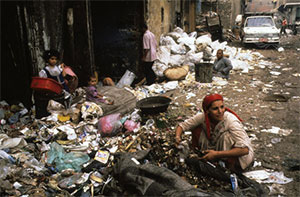 Romani people in Cairo, Egypt, forage through trash. Credit: UN Photo/Armineh Johannes
In 2015, the United Nations adopted the Sustainable Development Goals (SDGs) in an effort to promote “peace and prosperity for people and the planet.” To achieve that goal, it is essential to provide equal opportunities and access to basic services to all people. The 2025 UN SDG Report found that 35% of the 169 SDG targets are on track or making moderate progress, while 18% have reversed compared to the 2025 baseline. One in ten people still live in extreme poverty, one in eleven experience food insecurity, and over 1.1 billion people live in slums without access to clean water and sanitation. It is imperative to acknowledge the societal, technological, economic, and political issues that sustain poverty in countries around the world. Eradicating poverty will require significant frameworks in policy and governance on a national and international scale to ensure that all people will have equal access to basic services and economic opportunities by 2030. Furthermore, a dramatic reduction of United States foreign aid in 2025, including the termination of 83% of USAID programmes, threatens to erode years of fragile development gains.
Throughout the world, violent conflict and natural disasters also contribute to extreme poverty. The complete destruction of infrastructure and blockage of aid has significantly impoverished Palestine since October 7th. The destructive impact of Hurricane Maria in Puerto Rico left $91 billion in damage. An inadequate US government response also revealed significant and enduring questions within the issue of mitigating poverty: how do we rebuild infrastructure after its destruction? How do we restimulate economic development and bring in financial aid after disasters? Similar questions have been raised in the realm of regional cooperation, as devastating floods have wrecked hundreds of thousands of homes across multiple Southeast Asian nations in the past few years. Furthermore, the COVID-19 pandemic has greatly exacerbated the global poverty crisis, particularly in developing countries, setting back the United Nations goal of eradicating poverty by 2030.
IPS is committed to providing comprehensive features that focus on the persisting environmental, sociopolitical, and systemic issues that sustain poverty, and the steps taken worldwide towards poverty eradication.

The Week with IPS

NEXT STOP - SDGs
Tracking global progress towards a sustainable world
Tracking global progress towards a sustainable world

