Languages
Tuesday, September 22, 2026



News and Views from the Global South
Poverty & SDGs
How Market Knowledge is Powering Africa’s Solar Irrigation Sector
‘Know your customers’ is arguably the first rule of marketing. By identifying and segmenting customer groups, companies can target their products and services to the right people, in the right way. This can open-up opportunities for growth, inform product development and improve customer retention.
Code Red for Humanity and the Planet
UN Secretary General Antonio Guterres is absolutely right to call the latest UN climate report a “Code Red for Humanity.” Without immediate and serious action, we are condemning future generations to a dismal future.
Q&A: Why the World ‘Can’t Afford to Wait’ for Transparent, Equitable Food Systems
The world has been put on notice that there is no time to waste in achieving the goal of food systems transformation.
Child Protection Schemes Are Failing Children Orphaned by COVID-19 in India
The second wave of COVID-19 brought with it unimaginable grief, agony, and frustration. India saw a sharp increase in the number of deaths, especially among younger people, which meant that many children lost one or both parents. Reports of people seeking help for orphaned children as well as requests to ‘adopt’ these children emerged on social media.
5 Things To Watch For in the Latest IPCC Report on Climate Science
On Aug. 9, the Intergovernmental Panel on Climate Change (IPCC) will release its most comprehensive report on the science of climate change since 2013. It will be the first of four reports released under the IPCC’s latest assessment cycle, with subsequent reports coming in 2022.
Human Ingenuity Now Needed for Our Survival
The scientific and other human accomplishments in my 90-year lifetime are not only amazing but also seem to have apparently made too many of us arrogant and feckless about our future human survival on Earth. Or, if not arrogant or feckless, at least largely or unknowingly ignoring the urgency of the onset of devastating environmental threats.
Hunger Will Not Be Defeated Without a Better Environment, Nutrition and Health
The UN Food Systems Pre-Summit, held from 26 to 28 July in Rome, highlighted, as perhaps never before, that hunger can be defeated if we also manage to protect the environment, promote better nutrition and health. This new mentality and comprehensive approach consist of considering higher levels of economic investment to stimulate trade in agriculture and food and pursue a path towards a sustainable future.
Suburban Living the Worst for Carbon Emissions – New Research
Work, education, entertainment, or simply better connectivity all draw people to cities. By the end of this century around 85% of the world population are predicted to live in cities.
Central Banks Must Address Pandemic Challenges
Hopes for an inclusive global economic recovery are fast fading. As rich countries have done little to ensure poor countries’ access to vaccines and fiscal resources, North-South “fault lines” will certainly widen. Enhancing relief, recovery, transformation While the International Monetary Fund (IMF) has revised rich countries’ recovery prospects upward, the United Nations (UN) notes formidable challenges, especially for developing countries, due to the pandemic.
Increasing Revenue & Protecting Public Health During the COVID-19 Pandemic
The COVID-19 pandemic has taken its toll on millions of families and damaged the economy of countries around the globe. Rich countries with higher vaccination rates have opened up their economy ahead of poor countries that are still struggling to fight the pandemic.
WTO Inches Closer To Agreement on Harmful Fishing Subsidies
After more than 20 years of negotiations, the World Trade Organization (WTO) has moved a step closer to an agreement on ending harmful fishing subsidies. The deal would set new rules for the global fishing industry and limit government funding that contributes to unsustainable fishing and the depletion of global fish stocks.
When Branded as a Born Criminal: The Plight of India’s De-Notified Tribes
Branded as being born ‘criminal’ 150 years ago under British colonial rule, De-Notified Tribes (DNTs) continue to bear the brunt of the various laws that stigmatised them since 1871.
Are UN’s Sustainable Development Goals in the Doldrums Due to the Corona Virus?
A short answer to this question is yes, but it is obvious and predictable failure was visible for some time. This debate started before 2015, the year in which the Sustainable Development Goals (or SDGs) were adopted as successors to the Millennium Development Goals (MDGs) agreed in 2000. The 8 MDGs were expanded to 17 massive goals and 169 targets.
Alarming Crisis of Impunity for Crimes Against Journalists in DRC
The Democratic Republic of Congo is one of the most hostile and dangerous regions for journalists. A complex conflict, deeply rooted in the country’s past, allows very little freedom, both movement and the press.
Revamped UN System Crucial for a Changing World
From an international humanitarian perspective, the first half of 2021 has been disappointing. We’re no further ahead in ending the conflict in Syria and Yemen. From the fledgling democracy that it had become, Myanmar has descended into what most of its people had hoped was a bygone era of military rule. And in Ethiopia, where its Prime Minister, Ably Ahmed, was awarded the Nobel Peace Prize in 2019, armed conflict in Tigray is preventing the 2020 winners of the very same prize, the World Food Programme, from delivering the food needed to stop at least 350,000 Ethiopians from starving to death.
Water Scarcity: Coming Soon
In 1995, a highly-respected water expert in South Africa, Bill Pitman, in very concise terms illustrated that the country, already battling a growing lack of water then, would likely run out in 25 years if it did not increase its supply.
Water Poverty: The Political Connection
The water we drink and the air we breathe are the basis of life. With universal access to clean water and sanitation, we will be healthier, our economies will be stronger, gender equality will be more achievable, and more children will stay in school.
Child Rights’ Experts Warn that Displaced Children and Young People Risk Being Wiped Out of the Education System
The difficulties in accessing education faced by children and young people forcibly displaced from their homes were today laid bare in a virtual high-level roundtable convened by UNHCR, the UN Refugee Agency, Education Cannot Wait (ECW), the UK and Canada.
Stepping Up to Meet Low-Income Countries’ Pandemic Recovery Needs
Low-income countries have been hard hit by the pandemic. Their large financing needs are only likely to grow as they deal with the crisis and its economic aftermath.
Protecting Plants Will Protect People and the Planet
Back-to-back droughts followed by plagues of locusts have pushed over a million people in southern Madagascar to the brink of starvation in recent months. In the worst famine in half a century, villagers have sold their possessions and are eating the locusts, raw cactus fruits, and wild leaves to survive.
Beware UN Food Systems Summit Trojan Horse
Undoubtedly, the world needs to reform existing food systems to better serve humanity and sustainable development. But the United Nations World Food Systems Summit (UNFSS) must be consistent with UN-led multilateralism. For the first time ever, the World Economic Forum (WEF), a partnership of some of the world’s most powerful corporations, is partnering the UN in launching the Summit, now scheduled for September, with its ‘Pre-Summit’ beginning today.« Previous Page — Next Page »


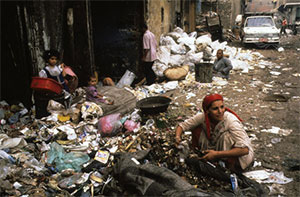 Romani people in Cairo, Egypt, forage through trash. Credit: UN Photo/Armineh Johannes
In 2015, the United Nations adopted the Sustainable Development Goals (SDGs) in an effort to promote “peace and prosperity for people and the planet.” To achieve that goal, it is essential to provide equal opportunities and access to basic services to all people. The 2025 UN SDG Report found that 35% of the 169 SDG targets are on track or making moderate progress, while 18% have reversed compared to the 2025 baseline. One in ten people still live in extreme poverty, one in eleven experience food insecurity, and over 1.1 billion people live in slums without access to clean water and sanitation. It is imperative to acknowledge the societal, technological, economic, and political issues that sustain poverty in countries around the world. Eradicating poverty will require significant frameworks in policy and governance on a national and international scale to ensure that all people will have equal access to basic services and economic opportunities by 2030. Furthermore, a dramatic reduction of United States foreign aid in 2025, including the termination of 83% of USAID programmes, threatens to erode years of fragile development gains.
Throughout the world, violent conflict and natural disasters also contribute to extreme poverty. The complete destruction of infrastructure and blockage of aid has significantly impoverished Palestine since October 7th. The destructive impact of Hurricane Maria in Puerto Rico left $91 billion in damage. An inadequate US government response also revealed significant and enduring questions within the issue of mitigating poverty: how do we rebuild infrastructure after its destruction? How do we restimulate economic development and bring in financial aid after disasters? Similar questions have been raised in the realm of regional cooperation, as devastating floods have wrecked hundreds of thousands of homes across multiple Southeast Asian nations in the past few years. Furthermore, the COVID-19 pandemic has greatly exacerbated the global poverty crisis, particularly in developing countries, setting back the United Nations goal of eradicating poverty by 2030.
IPS is committed to providing comprehensive features that focus on the persisting environmental, sociopolitical, and systemic issues that sustain poverty, and the steps taken worldwide towards poverty eradication.

The Week with IPS

NEXT STOP - SDGs
Tracking global progress towards a sustainable world
Tracking global progress towards a sustainable world

