Languages
Monday, September 21, 2026



News and Views from the Global South
Poverty & SDGs

End Vaccine Apartheid
Vaccine costs have pushed many developing countries to the end of the COVID-19 vaccination queue, with most low-income ones not even lining up. Worse, less vaccinated poor nations cannot afford fiscal efforts to provide relief or stimulate recovery, let alone achieve Agenda 2030.
The Future of Food & Water Systems in Pakistan & Central Asia?
An intense monsoon season in Pakistan means the country’s food system faces the challenge of both extreme floods and extended droughts. In an effort to address these challenges through cross-sectoral collaboration, Dr. Mohsin Hafeez, IWMI’s Country Representative for Pakistan and Regional Representative for Central Asia, convened a regional dialogue in advance of the UN Food Systems Summit (which is scheduled to take place at the United Nations, September 23) .
South Korea’s Women Fire Back
A strong movement of feminism is sweeping South Korea. While women feel empowered to stand their ground, the men are retaliating. When South Korean archer An San won two gold medals in just two days during the recent Tokyo Olympics, the response the 20-year-old received at home was a mixed. Some men were angered and said her medals should be taken away. Why? Because her short hair was a sign that she was a ‘man-hating’ feminist.
Fiddling in Nairobi While Africa Goes Hungry
As the United Nations gears up for its Food Systems Summit September 23, the urgent need for structural changes in how we grow, harvest, distribute, and consume food has never been more apparent.
Data Platform Helps Pacific Island Countries Collect, Analyse and Act on Information
Do you know if midwife services are available at the Saupia Health Centre in Paunangisu, on the island of Efate in Vanuatu, in the Pacific Islands? I do, and I’ve never been within 1,000 kilometres of the facility — I found the information online within seconds thanks to a data platform called Tupaia.
Social Protection at a Crossroad—and Poverty On the Rise
How can we ensure a resilient and inclusive recovery from COVID-19? How can we hold on to the target of eradicating poverty and hunger by 2030, with the pandemic still ongoing?
Advancing the Rights of Women Manual Scavengers in India
Manual scavenging is a caste-based profession that leads to discrimination and atrocities against those engaged in it. Generations of families from marginalised communities in India have been forced to continue in this profession because of social ostracism and a lack of alternatives.
Digital Tech can Help African Island States Cope with Climate Change
Investing in digital technologies can help African small island developing states (SIDS), vulnerable to extreme weather events, cope with growing impacts of climate change, says the United Nations (UN) Economic Commission for Africa (ECA).
Eastern Caribbean Youth Join Calls for Resilient Global Food Systems
As the international community prepares for the landmark United Nations Food Systems Summit, a pivotal gathering as part of a global goal to tackle food insecurity, hunger, biodiversity loss, and climate change through sustainable food production, Caribbean youth say the successful transformation of food systems must include young innovators.
Cuba, a Small Island State Seeking to Manage Its Vulnerability
Cuba, already beset by hurricanes, floods, droughts that deplete its main water sources, among other natural disasters, has seen its socioeconomic difficulties, similar to those faced by other Caribbean island nations, aggravated by the COVID-19 pandemic.
As Climate Disaster Migration Rises, Girls Get Married Off
When 11-year-old Mitali Padhi hugged her childhood friends to say goodbye, she felt a deep-seated foreboding.
Southern African Migrants Excluded as COVID-19 Pandemic Grows
Migrants across the Southern Africa region are massively disadvantaged as they find themselves excluded from vaccine programmes – even when the global vaccine initiative COVAX often funds these programmes.
Salvadoran Migrants Still Look to the U.S. to Lift Themselves Out of Poverty
The Joe Biden administration's call for undocumented Central American migrants not to go to the United States, as requested by Vice President Kamala Harris during a June visit to Guatemala, appears to have fallen on deaf ears.
How to Feed the World Without Starving the Planet is a $15 Billion Question
A population of more than 9 billion people, hotter temperatures, decaying ecosystems and increasingly severe natural disasters. That is what our world is facing by 2050 because of climate change.
Community-Based Solutions Alleviate Water Shortages in Central America – In Pictures
Access to water is a constant struggle in Central America, a region with more than 60 million people, many of whom live in rural areas where conditions for good quality water and enough for food production are becoming increasingly difficult.
Building Water Resilience Needs a Holistic Approach
Even as COVID-19 ravages communities across the continent, climate change is widening the gap between those who have access to water and sanitation - key elements in fighting the pandemic.
Community Inclusion Currencies: Money for the People – Podcast
 Do you think it’s possible to transform communities that are stagnating from a lack of currency into places where people’s income-generating activities create a vibrant, self-sustaining circular economy? It is in parts of Kenya that are using the community currency Sarafu, according to today’s guest.
How Many More Innocent Lives Must be Lost in Tigray, asks Adama Dieng
Despite a June 30 unilateral ceasefire declaration by Ethiopian President Abiy Ahmed, United Nations agencies say a recent escalation in fighting has been ‘disastrous’ for children, amid reports of over 100 children being killed in an attack on displaced families.
Solar Energy Revitalises Indigenous and Farming Communities in Chile
Communities in Arica y Parinacota, the region in the extreme north of Chile, are using solar energy and are being empowered by projects for shrimp and trout farming, the production of yarn from camelid wool, the production of tomatoes and cheese, and even the sale of surplus solar power to the national electric grid.
Indigenous Peoples Need Recognition, Reciprocity & a New Social Contract
The coronavirus pandemic has invited the world to reflect on relationships – between people within and across countries and communities, and between people and nature around the planet.
Digitisation Boosts Mechanised Farming Among Kenyan Farmers
When 33-year-old Kimani Mwaniki, an Irish potato farmer in Elburgon, Nakuru County in Kenya’s Rift Valley, heard about a farmer’s virtual school, he didn’t hesitate to enrol. He was keen to learn how the programme will enable him to get higher crop yields for his market in the capital city Nairobi and elsewhere.« Previous Page — Next Page »


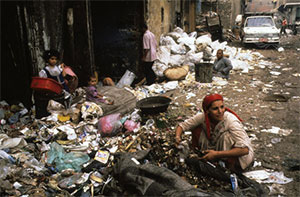 Romani people in Cairo, Egypt, forage through trash. Credit: UN Photo/Armineh Johannes
In 2015, the United Nations adopted the Sustainable Development Goals (SDGs) in an effort to promote “peace and prosperity for people and the planet.” To achieve that goal, it is essential to provide equal opportunities and access to basic services to all people. The 2025 UN SDG Report found that 35% of the 169 SDG targets are on track or making moderate progress, while 18% have reversed compared to the 2025 baseline. One in ten people still live in extreme poverty, one in eleven experience food insecurity, and over 1.1 billion people live in slums without access to clean water and sanitation. It is imperative to acknowledge the societal, technological, economic, and political issues that sustain poverty in countries around the world. Eradicating poverty will require significant frameworks in policy and governance on a national and international scale to ensure that all people will have equal access to basic services and economic opportunities by 2030. Furthermore, a dramatic reduction of United States foreign aid in 2025, including the termination of 83% of USAID programmes, threatens to erode years of fragile development gains.
Throughout the world, violent conflict and natural disasters also contribute to extreme poverty. The complete destruction of infrastructure and blockage of aid has significantly impoverished Palestine since October 7th. The destructive impact of Hurricane Maria in Puerto Rico left $91 billion in damage. An inadequate US government response also revealed significant and enduring questions within the issue of mitigating poverty: how do we rebuild infrastructure after its destruction? How do we restimulate economic development and bring in financial aid after disasters? Similar questions have been raised in the realm of regional cooperation, as devastating floods have wrecked hundreds of thousands of homes across multiple Southeast Asian nations in the past few years. Furthermore, the COVID-19 pandemic has greatly exacerbated the global poverty crisis, particularly in developing countries, setting back the United Nations goal of eradicating poverty by 2030.
IPS is committed to providing comprehensive features that focus on the persisting environmental, sociopolitical, and systemic issues that sustain poverty, and the steps taken worldwide towards poverty eradication.

The Week with IPS

NEXT STOP - SDGs
Tracking global progress towards a sustainable world
Tracking global progress towards a sustainable world

