Languages
Saturday, September 19, 2026



News and Views from the Global South
Poverty & SDGs

Zero Hunger Campaign in Vietnam Targets Remote Areas and Cities
Amidst the verdant hills and remote corners of Vietnam’s rural regions, the growth that has transformed the economy in this part of Southeast Asia in recent decades can be hard to see. Undernourishment among children still results in stunting – even in cities too where overweight/obesity is also on the rise.
Rwanda’s Rainforest Conservation Wins Praise from Indigenous Community
Laurent Hategekimana, a villager from Nyabihu, a district from Western Rwanda, recalls the terrible condition of the Gishwati natural forest a few years ago when it was overrun by illegal loggers and invading farmers.
Delivering On the Promise of Health For All Must Include Gender Equality and SRHR
Gender-responsive universal health coverage (UHC) has the proven potential to transform the health and lives of billions of people, particularly girls and women, in all their intersecting identities. At tomorrow’s kick-off to the 2023 UN High-Level Meeting (HLM) on UHC, Member States and stakeholders will review progress made on the 2019 HLM’s commitments and set a roadmap to achieve UHC by 2030. We, as the co-convening organizations of the Alliance for Gender Equality and UHC, call on Member States to safeguard gender equality and sexual and reproductive health and rights (SRHR) as part of UHC implementation, especially in light of the gendered impacts of the COVID-19 pandemic.
The End of World Bank’s “Doing Business Report”: A Landmark Victory for People & Planet
The September 16, 2021 announcement from the World Bank that it had discontinued publication of the Doing Business Report (DBR) marked a major victory for people and planet.
Young Migrant Workers Bear Brunt of COVID-19 Pandemic
Most families in the Republic of Tajikistan were affected when economic migrants were caught up in the COVID-19 pandemic abroad, Dr Vazirov Jamshed, research consultant for Asian Forum of Parliamentarians on Population and Development (AFPPD), told a webinar on the impact of the pandemic on youth.
With the World Bank’s “Doing Business” Out of Business, What Should Come Next?
Last week the World Bank announced it was “discontinuing” its “Doing Business” report, which ranks countries on the ease of opening and operating a company.
On the Verge of Change
Current food systems are no longer fit for the 21st century. Inequitable distribution, poor nutritional habits, and climate change are three issues breaking down our global food systems today, forcing us to look for solutions to transform them. Food aid – very much part of our global food systems – needs to be responsive to the challenges that lie ahead.
How Transforming Food Systems Could Unlock a $12 Trillion Global Windfall
With the world still counting the social and economic costs of the Covid-19 pandemic, amid a fresh “code red” on the climate crisis, food may not seem like the most pressing threat to humanity.
Climate Finance Can Transform Food Systems
September 23, 2021 is the first-ever UN Food Systems Summit, convened to mobilize the highest-priority transformations needed to end hunger through the sustainable production and distribution of food. Transforming food systems to ensure food security for all has never been so urgent.
From “We the Peoples” to “Our Common Agenda”, the United Nations is a Work in Progress
When the UN Charter was being drafted in the closing days of the Second World War in 1945, a debate ensued on what its opening words should be. Jan Smuts, representative of colonial South Africa, had originally suggested that the UN Charter begin with the words, ‘The High Contracting Parties.’
For Healthier Food Systems: Turn the Tide Against Ultra-Processed Products
COVID-19 has exposed serious vulnerabilities in how people around the world access and consume food. One of the more alarming trends is the significant increase in the consumption of foods that may be tasty and convenient, but harm our heath. These ultra-processed products include sugary drinks, snack foods, frozen meals, packaged breads and frozen desserts.
Progressive Taxation for Our Times
As developing countries struggle to cope with the pandemic, they risk being set back further by restrictive fiscal policies. These were imposed by rich countries who no longer practice them if they ever did. Instead, the global South urgently needs bold policies to ensure adequate relief, recovery and reform.
Food Experts’ Expectations for Global Food Systems Transformation
Dubbed ‘the People’s Summit, the United Nations Food Systems Summit (UNFSS) hopes to put the world back on a path to achieve the Sustainable Development Goals by 2030, through food systems overhauling. From the tempered to the extremely optimistic, experts in various food system sectors share their expectations of transformation.
Fundamental Changes Needed at UN Summit to Tackle Global Food Insecurity
COVID-19 has exposed numerous fractures in global food systems that leave millions at risk of food insecurity. Like the numerous political failures in dealing with COVID, the repercussions of food system failings are experienced by rich and poor countries alike, with the poorest and most marginalised paying the greatest price.
Indigenous Peoples in Mexico Defend Their Right to Water
In the San Lorenzo Huitzizilapan Otomí indigenous community, in the state of Mexico –adjacent to the country’s capital–, access to water has been based on collective work.
Barilla Foundation Report Highlights Need for Food Companies to Align with Sustainable Development Goals
In the backdrop of rising hunger, half of the world’s population living on unhealthy diets, a third of agricultural produce lost to postharvest events, and waste, poverty in farming communities, a pandemic that laid bare the vulnerability of food systems to external shocks and unsustainable food production, the Barilla Foundation for Food and Nutrition has published a report which introduces guidelines for the private sector to fulfil its role in transforming global food systems.
COVID-19 Recovery Requires Justice Beyond Rhetoric
Policy responses to the COVID-19 pandemic and resulting economic crisis have exacerbated rather than reduced global inequalities. On the one hand, the net wealth of billionaires has risen to record levels since the outbreak of the pandemic (increasing by more than US$ 5 trillion to US$ 13.1 trillion from 2020 to 2021), on the other hand, the number of people living in extreme poverty has also increased massively (by approx. 100 million to 732 million in 2020).
The Covid-19 Youth Employment Crisis in Asia & the Pacific
A pre-pandemic report published by the International Labor Organization, ILO, the Global Employment Trends for Youth 2020, offered a sober analysis on the job market prospects for youth.
Food Systems Summit’s Scientistic Threat
Timely interventions by civil society, including concerned scientists, have prevented many likely abuses of next week’s UN Food Systems Summit (UNFSS). The Secretary General (UNSG) must now prevent UN endorsement of what remains of its prime movers’ corporate agenda.
South-South & Triangular Cooperation to Help Achieve UN’s Development Goals
The 2021 high-level commemoration of the United Nations Day for South-South Cooperation, organized ahead of the opening of the seventy-sixth session of the United Nations General Assembly, provided an opportunity to discuss Southern solidarity in support of a more inclusive, resilient and sustainable future while effectively responding to the global COVID-19 crisis across the global South.
A Regional Agreement for Healthy Eco-Systems in Latin America & the Caribbean
In August 31st 2021, five Nations including Costa Rica - the country where the Escazú Agreement was adopted - announced publicly working towards a proposal for UN Human Rights Council to recognize globally the right to a clean, safe, healthy and sustainable environment at its 48th session in September.« Previous Page — Next Page »


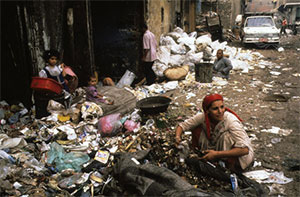 Romani people in Cairo, Egypt, forage through trash. Credit: UN Photo/Armineh Johannes
In 2015, the United Nations adopted the Sustainable Development Goals (SDGs) in an effort to promote “peace and prosperity for people and the planet.” To achieve that goal, it is essential to provide equal opportunities and access to basic services to all people. The 2025 UN SDG Report found that 35% of the 169 SDG targets are on track or making moderate progress, while 18% have reversed compared to the 2025 baseline. One in ten people still live in extreme poverty, one in eleven experience food insecurity, and over 1.1 billion people live in slums without access to clean water and sanitation. It is imperative to acknowledge the societal, technological, economic, and political issues that sustain poverty in countries around the world. Eradicating poverty will require significant frameworks in policy and governance on a national and international scale to ensure that all people will have equal access to basic services and economic opportunities by 2030. Furthermore, a dramatic reduction of United States foreign aid in 2025, including the termination of 83% of USAID programmes, threatens to erode years of fragile development gains.
Throughout the world, violent conflict and natural disasters also contribute to extreme poverty. The complete destruction of infrastructure and blockage of aid has significantly impoverished Palestine since October 7th. The destructive impact of Hurricane Maria in Puerto Rico left $91 billion in damage. An inadequate US government response also revealed significant and enduring questions within the issue of mitigating poverty: how do we rebuild infrastructure after its destruction? How do we restimulate economic development and bring in financial aid after disasters? Similar questions have been raised in the realm of regional cooperation, as devastating floods have wrecked hundreds of thousands of homes across multiple Southeast Asian nations in the past few years. Furthermore, the COVID-19 pandemic has greatly exacerbated the global poverty crisis, particularly in developing countries, setting back the United Nations goal of eradicating poverty by 2030.
IPS is committed to providing comprehensive features that focus on the persisting environmental, sociopolitical, and systemic issues that sustain poverty, and the steps taken worldwide towards poverty eradication.

The Week with IPS

NEXT STOP - SDGs
Tracking global progress towards a sustainable world
Tracking global progress towards a sustainable world

