Languages
Sunday, November 22, 2026



News and Views from the Global South
Poverty & SDGs
ENVIRONMENT-ARGENTINA: Scarce Water Threatened by Gold Mine
For nearly a year and a half, local residents in the northwestern Argentine province of La Rioja have been blocking the road that climbs up to the Nevados de Famatina mountain to protest a gold mining project that they say will pollute the water in the country’s driest district.
ETHIOPIA: Choosing Among One's Own Amid Food Crisis
The global food crisis has forced families to make grievous choices. When Mulu Baboche travelled from the Ethiopian capital to visit her home town in the drought-stricken southern countryside, she found her brother weakened, his animals emaciated and his nine children wilting from hunger.
SOUTHERN AFRICA: Free Trade Deal Full of Potential – And Danger
The launch of a free trade area (FTA) within the Southern Africa Development Community (SADC) has brought the region one step closer to a regional customs union by 2010. But the launch of the FTA at the recent SADC heads of state summit was met with mixed reaction.
TRADE-SOUTHERN AFRICA: FTA Will ‘‘Choke’’ Small Business
The Free Trade Agreement (FTA) that Southern African Development Community (SADC) governments agreed to will boost large South African companies’ reach in the region at the expense of small-scale producers and shops.PERU: Indigenous Groups Win Major Battle in Congress
The Peruvian Congress voted Friday to repeal two decrees that opened up communally owned native lands to private investment and that triggered a wave of protests this month by indigenous people in Amazon jungle provinces.DEVELOPMENT: Food, Fuel and Water Crises Converging
A spectre is haunting the cities and villages of most developing nations, warns a senior official of a World Bank-affiliated organisation.
DEVELOPMENT: Wasted Food Is Also Wasted Water
The world's growing food crisis - which triggered riots and demonstrations in over 30 developing nations early this year - is being aggravated primarily by wastage and overconsumption.
BRAZIL: Setting an Important Precedent for Indigenous Lands
An imminent decision by Brazil’s Supreme Court on the demarcation of the Raposa Serra do Sol indigenous reservation in the Amazon jungle region has the country’s native communities on edge, because of the precedent it will set.
CULTURE-SOUTH AFRICA: Crafts That Steal Hearts All Over the World
It is early on a Monday morning and Margret Woermann is late for her interview with IPS. The owner and creative force behind the Heartworks shops is at a meeting discussing a project with a clothing designer.
KENYA: Gathering Storm of Expectations in Nairobi Slum
For the first time in its 60 years of existence, there is a ray of hope for the one million inhabitants of Kibera, one of the world's most densely-populated slums. After spending most of his life on opposition benches - or in prison - as a champion of the poor, the member of parliament for this desperately poor constituency is now the prime minister of Kenya.HEALTH: Global Agenda Increasingly Disease-Driven
At the end of last month, U.S. President George W. Bush signed a global health package that effectively tripled U.S. spending over the next five years to fight HIV/AIDS, malaria and tuberculosis in poor countries, to 48 billion dollars.DEVELOPMENT: South Africa Beats Deadline on Water, Sanitation
South Africa and Madagascar, two African nations participating in the Stockholm International Water Conference currently underway in the Swedish capital, provide a contrasting picture of where they stand - or fall - in achieving the U.N.'s heavily-trumpeted Millennium Development Goals (MDGs).
TRADE-TANZANIA: Cheap Imitation Goods Are Flooding Markets
The mishmash of shops in Tanzania's central Kariakoo market in Dar es Salaam stock an infinite array of brand name fakes. Throngs of customers snap up mobile phones, designer gear, high-tech electronics and gadgets - all imitations being sold at unbelievably low prices.DEVELOPMENT: Wastewater Crops Feeding Millions
Vegetables, rice and other cereals in at least 53 cities in Asia, Africa and Latin America may someday come with warning labels that read "this is a byproduct of raw sewage".
ZIMBABWE: Farmers Can't Afford to Leave Markets – Literally
It is a wintry Tuesday evening at one of the tobacco auction floors in the Zimbabwean capital Harare. A group of small-scale tobacco farmers are preparing food for the night.
DEVELOPMENT: Water Progresses, Sanitation Regresses
The world's poorest nations are making halting progress in water, but little or no tangible improvement in sanitation - two of the basic necessities of life.DEVELOPMENT-UGANDA: Looming Problems With Kampala's Water
The water supply for two million residents of the Ugandan capital Kampala is threatened by a combination of ill-planned urbanisation and changing rainfall patterns.
TRADE-AFRICA: ‘‘An Injury To One Market Is an Injury to All’’
Southern African non-governmental organisations have put forward demands to their governments in resistance to the continuing talks on economic partnership agreements (EPAs) between the European Union and the African, Caribbean and Pacific (ACP) states.
DEVELOPMENT-AFRICA: Retailer Creates Jobs With Green Practices
Seven years ago, 54 subsistence farmers in the Umbumbulu district on the KwaZulu-Natal coast of South Africa were struggling to feed their families. They could barely pay their children’s school fees.
DEVELOPMENT: Escaping the Poverty Trap
What do they have in common - the landless widow with a deaf son in Bangladesh, the 12-year-old miner in Kyrgyzstan, the Ugandan farming couple with 12 children and the South African domestic worker who loses her home when her husband dies and her job when she breaks a leg? They, and their children, are trapped in chronic poverty, even as their countries show economic growth.
CUBA: Putting Their Houses in Order
In Cuba, when talk turns to the housing problem, the personal anecdotes that pour out are as large in number as the country's housing deficit, accumulated over years during which building efforts have not kept up with the need, while the existing houses and buildings continue to crumble.« Previous Page — Next Page »


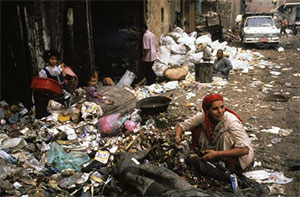 Romani people in Cairo, Egypt, forage through trash. Credit: UN Photo/Armineh Johannes
In 2015, the United Nations adopted the Sustainable Development Goals (SDGs) in an effort to promote “peace and prosperity for people and the planet.” To achieve that goal, it is essential to provide equal opportunities and access to basic services to all people. The 2025 UN SDG Report found that 35% of the 169 SDG targets are on track or making moderate progress, while 18% have reversed compared to the 2025 baseline. One in ten people still live in extreme poverty, one in eleven experience food insecurity, and over 1.1 billion people live in slums without access to clean water and sanitation. It is imperative to acknowledge the societal, technological, economic, and political issues that sustain poverty in countries around the world. Eradicating poverty will require significant frameworks in policy and governance on a national and international scale to ensure that all people will have equal access to basic services and economic opportunities by 2030. Furthermore, a dramatic reduction of United States foreign aid in 2025, including the termination of 83% of USAID programmes, threatens to erode years of fragile development gains.
Throughout the world, violent conflict and natural disasters also contribute to extreme poverty. The complete destruction of infrastructure and blockage of aid has significantly impoverished Palestine since October 7th. The destructive impact of Hurricane Maria in Puerto Rico left $91 billion in damage. An inadequate US government response also revealed significant and enduring questions within the issue of mitigating poverty: how do we rebuild infrastructure after its destruction? How do we restimulate economic development and bring in financial aid after disasters? Similar questions have been raised in the realm of regional cooperation, as devastating floods have wrecked hundreds of thousands of homes across multiple Southeast Asian nations in the past few years. Furthermore, the COVID-19 pandemic has greatly exacerbated the global poverty crisis, particularly in developing countries, setting back the United Nations goal of eradicating poverty by 2030.
IPS is committed to providing comprehensive features that focus on the persisting environmental, sociopolitical, and systemic issues that sustain poverty, and the steps taken worldwide towards poverty eradication.

The Week with IPS

NEXT STOP - SDGs
Tracking global progress towards a sustainable world
Tracking global progress towards a sustainable world

