Languages
Tuesday, November 24, 2026



News and Views from the Global South
Poverty & SDGs
ECONOMY-US: Rural Poverty Stagnates as Uninsured Multiply
Record numbers of people lack health insurance and poverty remains largely unchanged five years after the U.S. economy began clawing its way back from recession.DEVELOPMENT: EU Parliament May Insist on Health Aid
The European Union's only directly elected body is demanding increased aid for basic health and education in poor countries before it approves next year's budget for the 27-nation bloc.TRADE-CAMEROON: New Study to Bridge Finance Gap of Small Business
Caught in a limbo between larger firms with access to traditional banking-sector finance and micro-credit initiatives designed to help the small enterprises of the very poor, African businesses in the middle have historically been on the wrong side of both extremes when it comes to accessing finance.TRADE-SENEGAL: Finding Opportunities Through Cheap Chinese Goods
Allées du Centenaire, a neighbourhood in the heart of Senegal’s capital Dakar, may be lacking the trademark red lanterns but in the eyes of locals it is fast becoming the city’s unofficial Chinatown.HEALTH-INDIA: Activists Will Continue to Push Boycott of Novartis
Activist groups campaigning for affordable drugs will continue their boycott campaign against Swiss pharma major Novartis AG, whose controversial petition arguing that Indian patent laws violated World Trade Organisation (WTO) provisions was rejected by the Madras High Court in southern Chennai city.VENEZUELA: A New Life for At-Risk Kids, and Music Too!
On tour in Germany after performing to rave reviews at the BBC Promenade Concerts in London, the members of Venezuela’s Simón Bolívar Youth Symphony Orchestra and its wild-haired conductor, Gustavo Dudamel, have made a remarkable journey from their less than promising social origins.COLOMBIA: Campaign Seeks to Make Water a Constitutional Right
Sixty environmental, indigenous, labour and social organisations in Colombia are carrying out a campaign for a constitutional amendment that would make access to clean water a fundamental right.DEVELOPMENT: Farewell to "Flush and Forget"
In urban settings, the one-time use of water to disperse human and industrial wastes is becoming an outmoded practice, made obsolete by new technologies and water shortages.HEALTH: Doctors from the Developing South Helping the North
There are not enough doctors in Portugal’s public health system, because too many have left to enter the private sector. This has forced socialist Prime Minister José Sócrates’ administration to seek rapid and drastic solutions, one of which is to attract doctors from the developing world.
SOUTH AFRICA: Copper Thieves, an Abattoir and Coal Mining Threaten Lake District
Raw sewage flowing into Lake Chrissie is threatening to turn South Africa’s largest natural freshwater body into a massive cesspool. Environmentalists claim that for seven years, local authorities ignored their pleas to upgrade water treatment facilities; officials only took action, they say, when local revenue was affected by the closure of tourism routes such as biking trails, as a result of pollution.
HEALTH-SRI LANKA: Lessons From Int'l AIDS Meet
For Padma, a sociology graduate from a Sri Lankan university, the three-day International Congress on AIDS in Asia and the Pacific (ICAAP) that ended Thursday was nothing short of an enlightening experience in her life.
ENVIRONMENT-ARGENTINA: Sad Tale of the Tercero River
Argentina's polluted rivers are not limited to Buenos Aires. Wastewater dumping is devastating the second largest river of the central province of Córdoba, the Ctalamochita, or Tercero River.TRADE-MALAWI: Government Joins Chorus of Concern about EPA
Manufacturers, exporters and even government officials in Malawi are jittery about January 1, 2008. On that day the economic partnership agreements (EPAs), currently being negotiated between the European Union (EU) and six groupings of African, Caribbean and Pacific (ACP) countries, will come into force.
Q&A: “I Have Ideas for Things That Need To Be Done in All Social Sectors”
It's a long way from the north of France to West Africa - and from studying mathematics at the University of Lille to becoming a mayor in central Cameroon. But Marie-Hélène Ngoa has successfully undertaken both these journeys.HEALTH-SOUTH-EAST ASIA: Fortified Flour – Key Nutrition Strategy
When Indonesian women and children tuck into cups of ‘Indomie’, a popular brand of instant noodles, they are assured a tasty staple healthier than most other brands sold across South-east Asia.PERU: Anti-Poverty Plan Shrouded In Mystery
Peruvian President Alan García says that one of the pillars of his strategy to radically reduce poverty in his country is a new plan which, although it is fully operational, remains a mystery to the majority of Peruvians.
HEALTH: Sanitation the World's Silent Humanitarian Crisis
The topic of toilets often makes people uncomfortable, says the U.N. children's agency UNICEF, and the subject of human wastes is rarely aired in public.BRAZIL: Controversial Bill to Sterilise Younger Women
A draft law to reduce the minimum age for women to undergo voluntary sterilisation in Brazil’s public hospitals from 25 to 18 is vigorously opposed by the government.TRADE-EAST AFRICA: Learning From Past Glories
East African scholars are delving into history for clues on cultivating economic ties and dealing with challenges in a new era of expanding trade with China and India.HEALTH-BURMA: HIV Rates Falling As Funds Dry Up – Experts
Burma is seen as a reclusive country whose real HIV and AIDS situation is a deep, dark secret. But top Burmese officials, independent experts and AIDS researchers here painted a picture of a country that is making some progress, despite what some called its "unethical" abandonment by international AIDS organisations.HEALTH-CENTRAL ASIA: Intravenous Drug Use Feeds HIV Pandemic
The steep rise in HIV cases in recent years in Central Asia - at a pace faster than in other regions of the world - has set alarm bells ringing among government and non-government groups in the former Soviet republics.« Previous Page — Next Page »


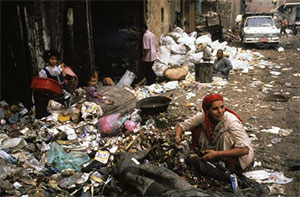 Romani people in Cairo, Egypt, forage through trash. Credit: UN Photo/Armineh Johannes
In 2015, the United Nations adopted the Sustainable Development Goals (SDGs) in an effort to promote “peace and prosperity for people and the planet.” To achieve that goal, it is essential to provide equal opportunities and access to basic services to all people. The 2025 UN SDG Report found that 35% of the 169 SDG targets are on track or making moderate progress, while 18% have reversed compared to the 2025 baseline. One in ten people still live in extreme poverty, one in eleven experience food insecurity, and over 1.1 billion people live in slums without access to clean water and sanitation. It is imperative to acknowledge the societal, technological, economic, and political issues that sustain poverty in countries around the world. Eradicating poverty will require significant frameworks in policy and governance on a national and international scale to ensure that all people will have equal access to basic services and economic opportunities by 2030. Furthermore, a dramatic reduction of United States foreign aid in 2025, including the termination of 83% of USAID programmes, threatens to erode years of fragile development gains.
Throughout the world, violent conflict and natural disasters also contribute to extreme poverty. The complete destruction of infrastructure and blockage of aid has significantly impoverished Palestine since October 7th. The destructive impact of Hurricane Maria in Puerto Rico left $91 billion in damage. An inadequate US government response also revealed significant and enduring questions within the issue of mitigating poverty: how do we rebuild infrastructure after its destruction? How do we restimulate economic development and bring in financial aid after disasters? Similar questions have been raised in the realm of regional cooperation, as devastating floods have wrecked hundreds of thousands of homes across multiple Southeast Asian nations in the past few years. Furthermore, the COVID-19 pandemic has greatly exacerbated the global poverty crisis, particularly in developing countries, setting back the United Nations goal of eradicating poverty by 2030.
IPS is committed to providing comprehensive features that focus on the persisting environmental, sociopolitical, and systemic issues that sustain poverty, and the steps taken worldwide towards poverty eradication.

The Week with IPS

NEXT STOP - SDGs
Tracking global progress towards a sustainable world

