Languages
Wednesday, November 25, 2026



News and Views from the Global South
Poverty & SDGs
LATIN AMERICA: Political Parity for Women Still a Long Way Off
Legislation in the countries of Latin America and the Caribbean has not succeeded in ending discrimination against women in political and public life, say participants at the 10th Regional Conference on Women being held in the Ecuadorean capital.HEALTH: India Verdict Welcomed by Advocates for Affordable Medicines
Non-governmental organisations that advocate poor countries’ access to affordable medicines applauded an Indian court’s dismissal of a challenge brought by Swiss-based drug-maker Novartis.
POLITICS-SIERRA LEONE: Making a Voting Right a Voting Reality
Having the right to vote is one thing; using it properly, or indeed at all, is quite another, as Sierra Leone has shown ahead of general elections this Saturday.BOLIVIA: Work Comes First for Women
The role of self-sacrificing wife and mother who stays at home is no longer the main goal of many Bolivian women.BRAZIL: Amazon Fruit Gatherers Face Biofuel Dilemma
The babaçú, an abundant native palm tree in the eastern Amazon and in the north and northeast of Brazil, has great potential for the production of "biodiesel" and biomass fuel, but the women who make their living from gathering its fruit fear the loss of their traditional source of income.WEST AFRICA: Stock Farmers Migrate From Difficulties, To Difficulties
No more grass for livestock to graze on. No more water, either. More than 50 stock animals dead. For farmer Samba Diallo, staying in Burkina Faso was no longer an option.BOLIVIA: Requiem for Land in the Hands of the Few
Bolivian President Evo Morales announced new regulations and financing for a land reform law aimed at expropriating idle or ill-gotten land in the hands of large estate owners in eastern and northeastern Bolivia and redistributing it to indigenous farmers.DEVELOPMENT-BURKINA FASO: A Province Too Popular For Its Own Good
Kompienga, in eastern Burkina Faso, is the country's most verdant province - but for how long?
BRAZIL: ‘I’m the Only Gang Member Alive and Free’
Most of them were 15 or 16 years old when they created the gang "Falta de Deus" (Lack of God), a name chosen because "we were all against Christ." Of the 25 members, 10 are dead and 14 are in jail. "I'm the only one still alive and free," says 22-year-old Elias da Silva.CHILE: Arica Residents Tired of ‘Undrinkable’ Tapwater
Residents of the city of Arica, in northern Chile, are demanding regulations to limit the amount of boron in their drinking water, while the authorities are waiting for the results of a study to determine whether it has a harmful effect on human health.
ENVIRONMENT-CUBA: Reforestation Renews a Barrio
Every morning Mario Véliz makes his way through the streets of Pogolotti, a low-income neighbourhood in the Cuban capital, to the milk shop. Those who only know him because he works there are unaware that this thin, wiry man with a face seamed with age is the life and soul of local reforestation.DEVELOPMENT-MAURITIUS: ”Our Sea and Lagoon Are Not For Sale”
‘‘We are selling everything in this country: from our bodies to our land and now our sea and lagoons. Is there anything left for us?’’ asked Jack Bizlall, spokesperson for a nongovernmental network of organisations called Kalipso.TRADE-EGYPT: Out With ‘‘The Pyramids’’, In With Liberalisation
Earlier this year, a group of prominent Egyptian business leaders had gathered at a downtown Cairo hotel to discuss building a successful export industry. A presenter opened the discussion by asking for a show of hands to indicate who was wearing Egyptian-made shirts or shoes.DEVELOPMENT-ZIMBABWE: The City of “Passport Size” Ablutions
The City Council of Bulawayo, Zimbabwe’s second largest city, has issued a warning to residents of a possible outbreak of disease following a massive cut in the city’s water supply. This is the first time in Bulawayo's history such a health warning has been issued.
DEVELOPMENT-ZIMBABWE: Water Shortages in Capital Leave Residents Desperate
Taps in the Zimbabwean capital, Harare, are running dry even though the city’s main supply dams are more than 60 percent full, according to figures from the Zimbabwe National Water Authority (ZINWA). With more than half of Harare's three million inhabitants now experiencing water shortages, residents are resorting to desperate measures to find supplies.
DEVELOPMENT-UGANDA: A Dam That Activists Simply Can’t Make Peace With
As preparations for construction of the Bujagali dam on the Nile River in Uganda gain momentum, a local civil society coalition is calling on the World Bank and the African Development Bank (AfDB) to reconsider their decision to release funds for this hydro-electric project - which the World Bank estimates will cost 799 million dollars.
RIGHTS-KENYA: A Moment of Joy Turned to Ashes
Josephine, young and pregnant, had just felt her water break. She arrived at the doors of St. Mary's Hospital in Langata, Kenya ready to give birth to her first child. But the throbbing pain of delivery was just the start of her troubles.TRADE-ZIMBABWE: Multilateral Still Better Than Bilateral Talks
Kumbirai Katsande, the managing director of a top Zimbabwean horticultural company, is in a buoyant mood. He hopes that his firm, Ariston Holdings, will make a big break in the lucrative European horticultural market where it sells its products.
SRI LANKA: Civilians Pay for Civil War in Supply Shortages
Sri Lankan government forces and Tamil Tiger rebel leaders are gearing up for a massive face-off along the line of control in the north of the island. The rhetoric has already been replaced by mounting body counts - in the last three weeks of July, more than 50 combatants died along the forward defences that separate areas held by the two sides in the north.
EGYPT: Desert Reclamation the Country’s Best Hope – Or a Mirage?
"You can grow anything here," says 76-year-old Mohamed Ahmed, spreading his arms wide to point to the cascading bougainvilleas and an orchard of mango trees drooping with fruit. But, "When I first came here, there was nothing here but sand and more sand."
SOUTHERN AFRICA: Blind, Translucent, Vulnerable – And Important For Your Health
An unexpectedly rich variety of organisms can be found in groundwater, a source that more than 37 percent of people in Southern Africa are dependent on, according to the Southern African Development Community's Water Sector Co-ordinating Unit. And, an Australian scientist visiting South Africa believes these tiny animals should be studied more intensively to monitor the quality of groundwater.« Previous Page — Next Page »


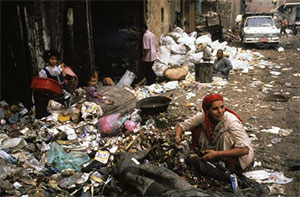 Romani people in Cairo, Egypt, forage through trash. Credit: UN Photo/Armineh Johannes
In 2015, the United Nations adopted the Sustainable Development Goals (SDGs) in an effort to promote “peace and prosperity for people and the planet.” To achieve that goal, it is essential to provide equal opportunities and access to basic services to all people. The 2025 UN SDG Report found that 35% of the 169 SDG targets are on track or making moderate progress, while 18% have reversed compared to the 2025 baseline. One in ten people still live in extreme poverty, one in eleven experience food insecurity, and over 1.1 billion people live in slums without access to clean water and sanitation. It is imperative to acknowledge the societal, technological, economic, and political issues that sustain poverty in countries around the world. Eradicating poverty will require significant frameworks in policy and governance on a national and international scale to ensure that all people will have equal access to basic services and economic opportunities by 2030. Furthermore, a dramatic reduction of United States foreign aid in 2025, including the termination of 83% of USAID programmes, threatens to erode years of fragile development gains.
Throughout the world, violent conflict and natural disasters also contribute to extreme poverty. The complete destruction of infrastructure and blockage of aid has significantly impoverished Palestine since October 7th. The destructive impact of Hurricane Maria in Puerto Rico left $91 billion in damage. An inadequate US government response also revealed significant and enduring questions within the issue of mitigating poverty: how do we rebuild infrastructure after its destruction? How do we restimulate economic development and bring in financial aid after disasters? Similar questions have been raised in the realm of regional cooperation, as devastating floods have wrecked hundreds of thousands of homes across multiple Southeast Asian nations in the past few years. Furthermore, the COVID-19 pandemic has greatly exacerbated the global poverty crisis, particularly in developing countries, setting back the United Nations goal of eradicating poverty by 2030.
IPS is committed to providing comprehensive features that focus on the persisting environmental, sociopolitical, and systemic issues that sustain poverty, and the steps taken worldwide towards poverty eradication.

The Week with IPS

NEXT STOP - SDGs
Tracking global progress towards a sustainable world

