Languages
Wednesday, November 25, 2026



News and Views from the Global South
Poverty & SDGs
RIGHTS-MOZAMBIQUE: Law to Stop Human Trafficking
Over 1,000 Mozambicans, including children, are trafficked to South Africa every year where they are forced into prostitution or to provide free or cheap labour. In response, Mozambique’s government last week approved a new law which will make human trafficking a crime punishable with long prison sentences.ARGENTINA: Groups Lobby Congress for Changes to Mining Laws
People from 14 Argentine provinces visited Congress this week to call for changes in the country’s mining code, which grants substantial tax incentives that have drawn foreign corporations with poor environmental records.
MOZAMBIQUE: Agriculture Input Fairs – A Chance to "Live in Dignity"
Despite a chain of misfortunes, 75-year-old Gonçalves Mandlate faithfully works his plot soon after sunrise each day, hoping that his life, and those of the five grandchildren who live with him, will improve.MEDIA: Poverty, Development Goals Hard Subjects to Tackle
Water used to be carried home, usually by women, in large jugs, as is still the case in many poor countries. But now that many people around the world have piped water, they go to the supermarket to buy bottled water.DEVELOPMENT-NAMIBIA: No Water In Babylon
Cardboard and rickety tin structures jostle for space on a barren outcrop in the sprawling suburb of Katutura in Namibia’s capital Windhoek. A putrid smell hangs in the still, afternoon air as flies wing their way over the debris.TRADE: Italian Delegation Finds More Than Big Five in S. Africa
‘‘Italians used to think of Africa in terms of safari and animals, especially the Big Five. Now they are realising that there’s business potential in South Africa,’’ says Giovanna Roma, secretary general of the Italian South African Chamber of Commerce and Industry of Northern, Eastern and Western Cape.LATIN AMERICA: Enterprising Women Network for Support and Success
Martha Elena González worked hard to make a success of her small family bakery, like many other women in Tegucigalpa, the capital of Honduras. But she only got the support she needed when she met another woman over the Internet, who was carrying out a project of her own thousands of kilometres to the south.
HEALTH: A New Weapon in the Fight Against Anaemia
A nutritional supplement known as Sprinkles, which is a simple powder that parents can easily add to their children's food, reduces childhood anaemia by more than half, according to a recent study published in the Journal of Nutrition.
SRI LANKA: Not All Tsunami Reconstruction Is Equal
It has been 30 months since the waves struck the coasts of Sri Lanka in the morning hours of Dec. 26, 2004. Since then, in a pattern that has become symbolic of the divided nature of the South Asian island, parts of the country have motored ahead with the reconstruction effort, while others have lagged woefully behind.BRAZIL: In Search of Sustainable Ethanol
To curb international criticism of its cane alcohol industry, the Brazilian government announced that it will ban new sugarcane fields in the Amazon region and in the vast Pantanal wetland.
SOUTHERN AFRICA: Unequal Water Resources Present a Challenge
Water resources are unevenly distributed throughout the countries of Southern Africa. The region boasts of some of the world’s largest lakes and rivers, but is also a land of vast deserts.EDUCATION-NICARAGUA: Down, Down with Adult Illiteracy
An adult education programme beginning this month in Nicaragua is part of one of the Sandinista government's most ambitious social projects: to declare this country free from illiteracy in 2009.
HEALTH: ‘Protect Our Future’ – AIDS Drugs Needed for Children
The 4th International AIDS Society (IAS) Conference on HIV Pathogenesis, Treatment and Prevention concluded here Wednesday with a call for antiretroviral drugs developed specifically for HIV-infected children.HEALTH: HIV/AIDS Experts Swear by Circumcision
Male circumcision could prevent millions of new HIV infections a year, delegates at the 4th International AIDS Society (IAS) Conference on HIV Pathogenesis, Treatment and Prevention were told here on Tuesday.
ENVIRONMENT-GREECE: Recycling Begins, At Last
Household waste recycling is on the rise in Greece but there is still a long way to go before the cleanup is complete.CHILE: State Upholds Gender Discrimination Within Marriage
Discrimination against married women under the law providing for joint ownership of marital property led Sonia Arce Esparza to take the Chilean state to the Inter-American Commission on Human Rights (IACHR) in 2001. An amicable agreement reached in March this year has not been implemented.ENVIRONMENT-NIGERIA: Rich in Oil, Dependent on Firewood
It is a paradox of note: the fact that while Nigerians live in the world's sixth-largest oil producer, most of them still rely on wood for their fuel.POLITICS-MALI: Bracing for “Zero to Six” in Parliamentary Elections
A fear has been voiced that the number of women in Mali's parliament could be more than halved during legislative elections that wrapped up Sunday.HEALTH-AUSTRALIA: Focus on Drug Access at HIV/AIDS Meet
Delegates at a major international conference on HIV and AIDS, set to unfold here on Sunday, are expected to urge the developed countries to help guarantee the supply of affordable drugs to combat the virus and the syndrome.LABOUR-PERU: Strike Ends as Teachers and Gov’t Sit Down to Talks
Peru's teachers' union, which has been giving the Alan García administration its worst headache, decided to suspend its protests after 15 days of violence that resulted in three deaths and dozens of wounded across the country. But its battle with the government has barely begun.DEVELOPMENT: EU Confronts Its Unhealthy Policy
The European Union's only directly elected institution is at loggerheads with the bloc's 27 governments over a measure officially designed to ensure that poor countries have access to affordable medicines.« Previous Page — Next Page »


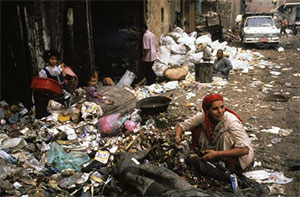 Romani people in Cairo, Egypt, forage through trash. Credit: UN Photo/Armineh Johannes
In 2015, the United Nations adopted the Sustainable Development Goals (SDGs) in an effort to promote “peace and prosperity for people and the planet.” To achieve that goal, it is essential to provide equal opportunities and access to basic services to all people. The 2025 UN SDG Report found that 35% of the 169 SDG targets are on track or making moderate progress, while 18% have reversed compared to the 2025 baseline. One in ten people still live in extreme poverty, one in eleven experience food insecurity, and over 1.1 billion people live in slums without access to clean water and sanitation. It is imperative to acknowledge the societal, technological, economic, and political issues that sustain poverty in countries around the world. Eradicating poverty will require significant frameworks in policy and governance on a national and international scale to ensure that all people will have equal access to basic services and economic opportunities by 2030. Furthermore, a dramatic reduction of United States foreign aid in 2025, including the termination of 83% of USAID programmes, threatens to erode years of fragile development gains.
Throughout the world, violent conflict and natural disasters also contribute to extreme poverty. The complete destruction of infrastructure and blockage of aid has significantly impoverished Palestine since October 7th. The destructive impact of Hurricane Maria in Puerto Rico left $91 billion in damage. An inadequate US government response also revealed significant and enduring questions within the issue of mitigating poverty: how do we rebuild infrastructure after its destruction? How do we restimulate economic development and bring in financial aid after disasters? Similar questions have been raised in the realm of regional cooperation, as devastating floods have wrecked hundreds of thousands of homes across multiple Southeast Asian nations in the past few years. Furthermore, the COVID-19 pandemic has greatly exacerbated the global poverty crisis, particularly in developing countries, setting back the United Nations goal of eradicating poverty by 2030.
IPS is committed to providing comprehensive features that focus on the persisting environmental, sociopolitical, and systemic issues that sustain poverty, and the steps taken worldwide towards poverty eradication.

The Week with IPS

NEXT STOP - SDGs
Tracking global progress towards a sustainable world

