
Saturday, October 10, 2026



News and Views from the Global South
SRI LANKA: Civilians Pay for Civil War in Supply Shortages
Amantha Perera
- Sri Lankan government forces and Tamil Tiger rebel leaders are gearing up for a massive face-off along the line of control in the north of the island. The rhetoric has already been replaced by mounting body counts – in the last three weeks of July, more than 50 combatants died along the forward defences that separate areas held by the two sides in the north.
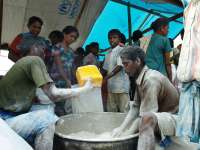
War-displaced families receive World Food Programme flour distributed by Red Cross and Sri Lanka government. Credit: Brennon Jones/IRIN
At least five northern districts with a combined population over one million face supply shortages and rising prices due to the fighting, as well as new security measures. Relief agencies and civilian authorities in the districts of Jaffna, Mullaithivu, Mannar, Kilinochchi and Vavuniya have warned that any further escalation of violence would translate to adding more pressure on an already precarious humanitarian situation.
“The brutality of the conflict is appalling and major violations of international humanitarian law are perpetrated in a climate of impunity. Thousands of civilians are caught up in the conflict, with barely any chance of escape from the violence and massacres,” Louis Michel Commissioner of the European Commission Humanitarian Aid department (ECHO) said soon after the commission released 21 million U.S. dollars to ease the humanitarian crisis situation.
Of that amount, four million is set aside for food aid. Even before the current crisis arose, since last August almost 3,500 people have been killed in resurgent violence and 300,000 forced out of their homes, according to the UN Office of the Coordinator for Humanitarian Affairs.
The irony is that the fighting has taken place during the longest ceasefire in the country’s history. In February 2002, the Sri Lankan government and the Liberation Tigers of Tamil Eelam (LTTE), as the Tigers are officially known, signed a truce. It held till December 2005, and since has come off at the seams with the country now bracing for more confrontations.
The Jaffna Peninsula, the cultural and the political nerve centre of the country’s minority Tamils, was cut off from the rest of the island a year ago when the only land link, the A9 highway, was closed by the government after the Tigers attacked forward positions last August.
Though the supply situation was eased soon after the closure, food and fuel prices are higher than normal. Supplies are now moved on government chartered ships and the few UN charter flights.
When security forces discovered several cargo trucks laden with explosives trying to reach the southern areas from the northeast recently, the government initiated strict security measures. Now no trucks based in the northern Mannar, Kilinochchi, Mullaithivu and Vavuniya can travel to the south. Instead they have to pick up goods at the central town of Madavachchiya where everything is unloaded, checked and reloaded at a newly created security point.
“There is unloading, loading and cross-loading taking place in the facility; traders undergo many problems such as extra costs in loading and unloading, providing security to goods in the parked lorry,” according to a source from the government Peace Secretariat.
“Now it takes a lot longer for trucks to get here. There are also restrictions on fuel and construction items,” said Nagalingam Vedanayagam, the government agent for Kilinochchi. Both Kilinochchi and Mullaithivu districts are under the control of the Tigers.
Areas under Tiger rule also have to deal with scaled down opening of the crossover points. The International Committee of the Red Cross pulled out its staff from the points in June when fighting broke out nearby, they have since returned but the points are only open three days of the week.
The limited functioning means fewer trucks can clear the points, according to Vedanayagam, who said that number of trucking days per month for Kilinochchi and Mullaithivu have now gone down to six from a previous high of 15.
“It is very bad, and because of the fighting it will not get any better soon,” Vedanayagam said.
The restrictions, security checking and fighting has forced huge price hikes in the districts. Petrol was selling at 550 Sri Lanka rupees (about five dollars) a litre, over five times its market value in late June, and diesel prices were four times the market price.
Vedanayagam said that severe shortages have been avoided thus far due to harvests and products from areas under Tiger rule. However, if fighting intensifies along the forward defences, the north-western Mannar island is running the risk of being cut off.
Like the Jaffna Peninsula, Mannar survives on one access road through which all supplies flow.
Residents of the island said that since the new security set-up came into effect, trucks take three times longer to get to the island. Unlike Jaffna, Mannar does not have an airport or large harbour, thus the bulk of the supplies have to move by road.
Fighting close to the main road and targeted attacks on it have also delayed supplies. When fighting erupted in the second week of July, the Sri Lanka Monitoring Mission (SLMM), which is in place to track the five-year truce that now exists only on paper, classified the Mannar road as too dangerous travel on.
“It was decision taken due to the fighting in the area,” SLMM spokesperson Steinar Sveinsson said.
A week after the SLMM decision, a remotely controlled claymore mine targeted an army convoy travelling on the road. It killed 12 soldiers and left 14 injured, including eight civilians.
There is no indication that fighting will ease any time soon. The Peace Secretariat said that it was looking at the option of installing a scanner at the new checkpoint to streamline and expedite vehicle inspections. The suggestion is indicative that the stringent security would remain in place until fighting and attacks in the south de-escalate.
Instead of rapprochement, both sides have adopted a tone of “bring it on”. Military spokesperson Brig Prasad Samarasinghe last week said that the military had no option but to crush the Tigers if attacks continue. His counterpart with the Tigers, Rasiah Illanthariyan, matched the wordplay: “We are ready, let them come.”
 Print
|
Print
|




