Languages
Thursday, November 26, 2026



News and Views from the Global South
Poverty & SDGs
POLITICS: Caribbean Embraces Cuba, Chastises U.S.
The summit was the second in three years, and for Cuban President Fidel Castro, dressed in a business suit rather than his usual olive fatigues, it was the ideal opportunity to salute the Caribbean Community for its "unflinching" opposition to the decades-old United States trade embargo against the only Communist state in this hemisphere.DEVELOPMENT: IPS Honours Anti-Poverty Alliance
The Inter Press Service news agency presented its 2005 International Achievement Award to the Global Call to Action Against Poverty (GCAP) at the United Nations Wednesday.TRADE: Will Agriculture Reform Work for the Poor?
There is little hope that the World Trade Organisation (WTO) ministerial conference set to start next Tuesday in Hong Kong will make significant progress towards the elimination of trade barriers in agriculture, say observers.DEVELOPMENT: Microcredit Poised to Reach 100 Million Families
Last year, more than 92 million families - most of them living on less than a dollar a day - benefitted from small loans known as "microcredit", marking a bright spot in international development efforts too often frustrated by missed targets and broken promises.WTO-SPECIAL: New Talks, Same (Empty) Promises?
Groups advocating fair global trade say next week's World Trade Organisation talks in Hong Kong will not help lift up poor people in developing nations, as has been promised by officials in industrialised nations and their allies at international financial institutions.RIGHTS: China Awarded ‘Housing Raspberry’
Just how many people have to be thrown out of their homes in the name of 'economic progress' to arouse the interest of a regional United Nations body that claims to care for Asians living marginal existences?EDUCATION-LATIN AMERICA: School Is Not a Cure-All for Inequality
Education alone will not solve the huge inequalities that afflict Latin America and the Caibbean, authorities and researchers warned at the first meeting convened by UNESCO to evaluate the progress of an educational project agreed by the countries of the region in 2002.TRADE: Activists Take Issue with WTO Decision on Cheap Drugs
A decision by the World Trade Organisation (WTO) to make a provisional 2003 agreement allowing poor countries to import affordable generic drugs permanent has drawn criticism from activists.BRAZIL: Looking for Unlost Electoral Causes
Brazil's economic slowdown has joined forces with the corruption scandals to threaten President Luiz Inácio Lula da Silva's chances of re-election in October 2006, leaving progress in the fight against social inequality as his only electoral banner still waving.CENTRAL AMERICA: Stan – a Blow to the Poor, but Not GDP
Although the thrashing that Hurricane Stan dealt the poor in El Salvador and Guatemala was brutal, the main macroeconomic indicators in the two countries are hardly showing a scrape.PAKISTAN: Small Loans Pull Women Out of Poverty Trap
A small loan of 8,000 rupees, about 160 dollars, has enabled 35-year-old seamstress Laila to expand her business and escape the glass ceiling of rural Pakistan's patriarchal culture.WTO-SPECIAL: Does Foreign Equal Cheaper, Better, More?
"Look at how we live here: the garbage heaps, the sewers, the polythene bags with human waste littered all over the area! There is no adequate running water. This is harmful for our children and us," complains James Isaye, a resident of Kibera.HEALTH-INDIA: HIV/AIDS Messages Reach Communities Via Classrooms
Across India, from the densely-populated western metropolis of Mumbai to the conservative southern temple city of Madurai, students are taking messages to end the stigma and discrimination around HIV/AIDS from classrooms to communities.WTO-SPECIAL: Disillusion in Southern Africa Ahead of Trade Summit
Campaigners from Southern Africa are bracing for the World Trade Organisation (WTO) talks to be held in Hong Kong later this month. Some plan to send representatives to the meeting, to protest against unfair trade legislation – particularly as this relates to agriculture.WORLD AIDS DAY: Helping Children to Help Themselves
Millions of children around the world received a lesson, Thursday, in how to deal with something that many will inevitably confront: the AIDS pandemic.WORLD AIDS DAY: How Many Millions More Will Die?
Millions of people living with HIV/AIDS in poor parts of the world could lose their lives in the next few years if governments fail to keep their promises to fight the deadly pandemic, warn U.N. officials and health advocacy groups./ARTS WEEKLY/CUBA: Restoring Old Havana – With a Social Twist
Colonial era houses converted into hostels, pharmacies that double as museums, concerts in colonial era courtyards, taverns and coffee shops: all of these have sprung up from the ruins of the historic city centre in the Cuban capital.HEALTH-BRAZIL: Well on the Way to Eliminating Maternal Transmission of HIV
Brazil is pushing ahead with its widely-praised anti-AIDS programme by setting itself the goal of reducing vertical transmission of HIV, the AIDS virus, to less than one percent within three years.DEVELOPMENT: France Begins to Tax Flights for Aid
The French government approved a small levy this week on all commercial flights from France in order to fund development aid.IVORY COAST: The Kindest Cut of All – Severing a Harmful Tradition
Thirty practitioners of female circumcision in the Ivorian financial capital, Abidjan, have publicly laid aside their blades, knives and scissors. This is the result of an ongoing campaign in the West African country to eradicate the practice, estimated by the United Nations Children's Fund (UNICEF) to affect 40 percent of women living there.POLITICS: The Mother of All Coalitions
The idea of a "World Coalition Government" has often been portrayed as sinister and authoritarian, but a group of scientists and scholars are trying to revive the concept as a dramatic alternative to the movement to "reform" the United Nations.« Previous Page — Next Page »


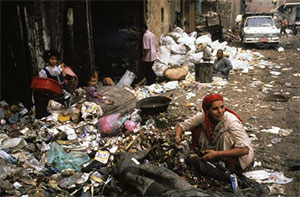 Romani people in Cairo, Egypt, forage through trash. Credit: UN Photo/Armineh Johannes
In 2015, the United Nations adopted the Sustainable Development Goals (SDGs) in an effort to promote “peace and prosperity for people and the planet.” To achieve that goal, it is essential to provide equal opportunities and access to basic services to all people. The 2025 UN SDG Report found that 35% of the 169 SDG targets are on track or making moderate progress, while 18% have reversed compared to the 2025 baseline. One in ten people still live in extreme poverty, one in eleven experience food insecurity, and over 1.1 billion people live in slums without access to clean water and sanitation. It is imperative to acknowledge the societal, technological, economic, and political issues that sustain poverty in countries around the world. Eradicating poverty will require significant frameworks in policy and governance on a national and international scale to ensure that all people will have equal access to basic services and economic opportunities by 2030. Furthermore, a dramatic reduction of United States foreign aid in 2025, including the termination of 83% of USAID programmes, threatens to erode years of fragile development gains.
Throughout the world, violent conflict and natural disasters also contribute to extreme poverty. The complete destruction of infrastructure and blockage of aid has significantly impoverished Palestine since October 7th. The destructive impact of Hurricane Maria in Puerto Rico left $91 billion in damage. An inadequate US government response also revealed significant and enduring questions within the issue of mitigating poverty: how do we rebuild infrastructure after its destruction? How do we restimulate economic development and bring in financial aid after disasters? Similar questions have been raised in the realm of regional cooperation, as devastating floods have wrecked hundreds of thousands of homes across multiple Southeast Asian nations in the past few years. Furthermore, the COVID-19 pandemic has greatly exacerbated the global poverty crisis, particularly in developing countries, setting back the United Nations goal of eradicating poverty by 2030.
IPS is committed to providing comprehensive features that focus on the persisting environmental, sociopolitical, and systemic issues that sustain poverty, and the steps taken worldwide towards poverty eradication.

The Week with IPS

NEXT STOP - SDGs
Tracking global progress towards a sustainable world

