Languages
Friday, November 27, 2026



News and Views from the Global South
Poverty & SDGs
POPULATION: A Giant Leap From Rhetoric to Reality?
The largest gathering of world leaders meeting at the United Nations last month declared that the international community must keep gender equality, HIV/AIDS and reproductive health at the top of the global agenda over the next decade.POPULATION: In Tamil Nadu, Women Lead the War Against HIV
When a group of HIV-positive women dared go public with their health status at a modest function in early October, it was a revolution for this conservative town, famed for its ancient granite pagodas that speak of development in another millennium.SOUTH AFRICA: Putting Gender Equality at the Forefront of Local Government
A ground-breaking gender equality training course for local government officials has wrapped up in South Africa's financial capital, Johannesburg.POLITICS: Developing Nations Blast U.N. for Appeasing U.S.
The 132-member Group of 77, the largest single coalition of developing nations, has sent a letter of protest to Secretary-General Kofi Annan implicitly decrying the U.N. Secretariat's efforts to appease U.N.-bashing right-wing conservatives, both inside and outside the U.S. Congress.VIETNAM: Water Wars Aplenty as Taps Run Dry or Dirty
Living amidst glistening wet paddies, marshes, lagoons and rivers, Vietnamese may be said to be leading an amphibious existence. Yet, access to safe drinking water is a concern for many citizens.ENVIRONMENT-ARGENTINA: From Floods to Drought
The expansion of the agricultural frontier at the expense of Argentina's native forests is posing serious environmental challenges in the northeastern province of Chaco, whose inhabitants - among the country's poorest - go from severe flooding to lengthy droughts in the same year.DEVELOPMENT: Cameroon Adds Famine to Its List of Woes
As a result of two decades of decreasing economic activities, Cameroon is now in a serious financial crisis that is threatening the United Nations Millennium Development Goals (MDGs).DEVELOPMENT: ‘Almost Half the Goals Getting Forgotten’
Almost half the Millennium Development Goals are not even getting talked about enough, a leading Pakistani doctor engaged in maternal health says.ENVIRONMENT: The Mediterranean Sea Is Sick
Non-governmental organisations are seeking ways of doing their bit to save the Mediterranean Sea. They say it can do with some saving.POPULATION: Youth Unemployment Hits All-Time High
With nearly half the world's population of six billion people under 25 years old, the U.N. warned this week that poverty and lack of education is creating a new generation of marginalised youth.EDUCATION-NIGERIA: Making School a Tasty Experience
A government programme to provide primary school children with free lunches has been launched in Nigeria, to encourage parents to educate their children - and to ensure that pupils learn effectively.NEPAL: On The Road to Failed State?
When does a conflict become a crisis? In Nepal's case it could be very soon, says the United Nations.DEVELOPMENT: Voluntary Work as Industry
In the Philippines, non-profit and volunteer organisations are a 1.2 billion US dollar industry, with expenditures reaching 1.5 percent of GDP. They employ five times more people than huge utility companies and have many more employees than in the country's biggest companies, including the food and beverage giant San Miguel Corp.KENYA: “In a Situation Like This, Who Cares About Human Rights?”
Behind a dilapidated store in a dusty field at Athi River, an export processing zone (EPZ) on the outskirts of Kenya's capital, Nairobi, a group of textile factory workers has gathered for a mid-afternoon break. The heat is searing, and the hastily purchased cool drinks quench thirsts.MILLENNIUM GOALS: US-Japan Aid Tie-up to Push Private Role
Japan and the United States have begun discussions to collaborate on their aid budgets and make international assistance more effective, said officials here.LABOUR-BOLIVIA: Childhood in the Pits
He looks like he is around 60 years old, but he just turned 35. Valentín Condori was only 15 in 1985 when the Bolivian government closed the tin mines it owned and left him - and 30,000 other miners - without work.ENVIRONMENT-URUGUAY: Pulp Mills and the Clean Technology Debate
The construction of two pulp mills in Uruguay has put this small South American country at the centre of the global debate among environmentalists, scientific researchers and large corporations on what is the most effective and cleanest technique for producing paper.PAKISTAN: Cheap, Clean Energy Blowing in the Wind
Till about seven months back, the village of Ghulam Muhammad Goth, north of this port city, had no electricity. ''Now our village seems alive even after sunset, till almost midnight,'' says a beaming 18-year old Perween.HEALTH: Universal Vaccination Key to Anti-Poverty Goals
Despite the proven safety and effectiveness of immunisation programmes, only half of all children living in West and Central Africa are vaccinated against the leading childhood diseases, contributing to 1.4 million totally needless deaths each year, according to a new report by the U.N. children's agency UNICEF.HEALTH-MOZAMBIQUE: Poverty and Stigma Ensnare Children With AIDS
At the tender age of 12, Pedro Moniz* is already a veteran when it comes to observing the regimen of anti-retroviral drugs that keeps AIDS-related illnesses at bay.HEALTH-THAILAND: Cheap Generics Bring Hope for HIV-Infected
When the thousands of people living with HIV in Thailand mark World AIDS Day on Dec.1, they will have reason to smile. No more will the threat of early death for lack of anti-HIV drugs haunt them.« Previous Page — Next Page »


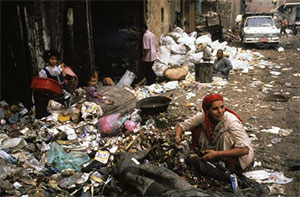 Romani people in Cairo, Egypt, forage through trash. Credit: UN Photo/Armineh Johannes
In 2015, the United Nations adopted the Sustainable Development Goals (SDGs) in an effort to promote “peace and prosperity for people and the planet.” To achieve that goal, it is essential to provide equal opportunities and access to basic services to all people. The 2025 UN SDG Report found that 35% of the 169 SDG targets are on track or making moderate progress, while 18% have reversed compared to the 2025 baseline. One in ten people still live in extreme poverty, one in eleven experience food insecurity, and over 1.1 billion people live in slums without access to clean water and sanitation. It is imperative to acknowledge the societal, technological, economic, and political issues that sustain poverty in countries around the world. Eradicating poverty will require significant frameworks in policy and governance on a national and international scale to ensure that all people will have equal access to basic services and economic opportunities by 2030. Furthermore, a dramatic reduction of United States foreign aid in 2025, including the termination of 83% of USAID programmes, threatens to erode years of fragile development gains.
Throughout the world, violent conflict and natural disasters also contribute to extreme poverty. The complete destruction of infrastructure and blockage of aid has significantly impoverished Palestine since October 7th. The destructive impact of Hurricane Maria in Puerto Rico left $91 billion in damage. An inadequate US government response also revealed significant and enduring questions within the issue of mitigating poverty: how do we rebuild infrastructure after its destruction? How do we restimulate economic development and bring in financial aid after disasters? Similar questions have been raised in the realm of regional cooperation, as devastating floods have wrecked hundreds of thousands of homes across multiple Southeast Asian nations in the past few years. Furthermore, the COVID-19 pandemic has greatly exacerbated the global poverty crisis, particularly in developing countries, setting back the United Nations goal of eradicating poverty by 2030.
IPS is committed to providing comprehensive features that focus on the persisting environmental, sociopolitical, and systemic issues that sustain poverty, and the steps taken worldwide towards poverty eradication.

The Week with IPS

NEXT STOP - SDGs
Tracking global progress towards a sustainable world

