Languages
Monday, September 28, 2026



News and Views from the Global South
Financial Crisis
Civil Society Unifies Position Ahead of Aid Summit
Civil society groups say they want to have a stronger voice in setting the development agenda ahead of a key global summit on aid effectiveness later this year.Syria’s Once Profoundly Secular Society Shaken Up
Since pro-democracy protests began last March, Syria’s once profoundly secular society has been shaken up, with deep divides splitting up communities along sectarian lines.
GREECE: Public Outrage over Austerity Plan
The mass protests in Greece swelled by the hour as parliament voted this Thursday to implement the social and economic adjustment plan approved Wednesday, including measures for privatisation, tax hikes, spending cuts and mass lay-offs in the state sector.U.S.: Public Workers Fight to Preserve Pensions
Municipal workers across the United States are fighting to preserve their pensions amidst a concerted campaign by corporate interests coupled with budget shortfalls facing all urban areas in the current recession.SYRIA: Ongoing Unrest Threatening Economy
As protests persist in Syria, the economy is becoming an increasing concern for many, who wonder if it will eventually falter in light of the recent unrest.Greek Parliament Passes Austerity Bill
The Greek parliament has passed an austerity package by a slim majority to slash 40 billion dollars off the national debt.SUDAN: Feeling the Economic Impact Before Secession
Amira Amer* becomes very picky the minute she reaches the bus station. One by one she lets the new air-conditioned busses pass her by. She is waiting for a cheaper bus. They are limited in the expensive city of Khartoum and are constantly packed to the point of overflowing.
AFRICA: Poor Excluded From Benefits of High Economic Growth
The high economic growth enjoyed by many African states during the 2000s have not led to poverty elimination. This is because the growth did not happen in the sectors where poor people work, as in agriculture, or in the rural areas where poor people live, or simply did not involve labour provided by poor people.Greek PM Talks Tough Amid Worsening Crisis
George Papandreou, the Greek prime minister, has vowed to pursue reforms aimed at tiding over the country's crippling debt crisis, despite popular resentment.OP-ED: G20 Ministers of Agriculture Must Focus on Smallholder Farmers
The first-ever official meeting of Ministers of Agriculture from G20 countries, to be held in Paris Jun. 22-23, presents an extraordinary opportunity. Tasked with developing an action plan to address price volatility in food and agricultural markets and its impact on the poor, the ministers are uniquely positioned to not only tackle the immediate price volatility problems, but also to take on a more fundamental and long-term challenge - extreme poverty and hunger.Women’s Groups Unite Ahead of Busan Aid Forum
Twenty women from four continents consider the words discussion leader Anne Schoenstein, of the Association for Women’s Rights in Development (AWID), has written on a flip chart. She strikes out in blue ink a previous sentence. She begins writing a new one - a demand aimed at aid donors - dictated by Nurgul Djanaeva.Q&A: Universal Energy Access is Possible With the Right Support
Providing electricity and modern cooking technology to billions of ‘energy poor’ people worldwide is one of the priorities of the U.N.’s Millennium Development Goals (MDGs) - one that experts say is achievable over the next few decades.India Looking to South Africa to Anchor its Involvement in Africa
Some Indians and Africans believe Africa is on the verge of becoming a world economic power, but changes are needed to ensure that the continent takes up its rightful place in the global economy. From India’s perspective, South Africa is vital to its engagement with the continent.SPAIN: Protest Movement Spreads to Neighbourhoods, Small Towns
The May 15 Movement (15-M) which sprang up as huge rallies in public squares in Spain's largest cities to protest against the political, economic and social system, is multiplying as assemblies in local neighbourhoods in provincial capitals and other municipalities.BELARUS: Despite Crackdown, Opposition is Defiant
President Alexander Lukashenko has locked most of his rivals in jail, but the Belarus opposition continues to work diligently to isolate the dictator.Egypt Sounds Alarm on Economy
Egyptian officials are warning that the country, just emerging from a popular uprising that ousted the regime of former President Hosni Mubarak, could be facing a major economic crisis with lagging international aid and foreign investment.ELECTIONS-PORTUGAL: Rubberstamping IMF Prescriptions
Voters in crisis-stricken Portugal will go to the ballot boxes next Sunday to choose not a government, but something more like delegates who will administer decisions already taken by the International Monetary Fund and the European Union.Arab Spring Wary of Economic Lifelines
Governments and international institutions that once bankrolled the authoritarian regimes of Tunisia’s Zine El-Abidine Ben Ali and Egypt’s Hosni Mubarak have begun floating aid packages to speed up the economic recovery and transition to democracy in these countries. Arab revolutionaries have reason to be wary.Politics Could Dominate G8 Summit of World Leaders
When leaders of the Group of 8 (G8) industrialised nations meet in Deauville, France later this week, there is a strong possibility that politics will take precedence over traditional socioeconomic issues like food security and development aid, which are being overshadowed by the Arab revolution and Palestinian statehood.NGOs Call for IMF Head to Be Chosen by Double Majority
More than 100 civil society groups called Monday for the next managing director of the International Monetary Fund (IMF) to be approved by a majority of its 187 member countries, as well as a majority of the voting shares that are heavily weighted in favour of the world's wealthiest countries.
DEVELOPMENT: Women Leading Bangladesh Away from the LDC Tag
Women entrepreneurs and workers will soon help Bangladesh shake off the Least Developed Country (LDC) label, business leaders say.« Previous Page — Next Page »


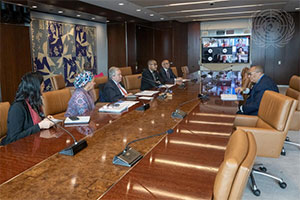 Secretary-General Meets with Members of Debt Expert Group. Credit: UN Photo/Eskinder Debeb
Financial crises are often defined by banking panics, recession, loss of market value, and deflation. Various financial crises at the turn of the 20th century, such as the Asian Crisis of 1997-1998 and the 2007-2008 Global Financial Crisis, have had immense impacts on the world economy. The COVID-19 pandemic also caused a financial crisis when mass lockdowns triggered staggering unemployment rates, a stagnation of economic growth, and led to the 2020 stock market crash. With the Russian invasion of Ukraine, the world has also witnessed a global energy crisis with shortages and increased prices in oil, gas, and electricity markets. According to UNCTAD’s World of Debt 2025, global public debt surpassed $100 trillion in 2024, with developing country debt growing twice as fast as developed economies since 2010. Burdens of debt servicing come with economic slowdowns and demands of austerity from lenders, with some economists arguing that this will lead to a new “lost decade” for the Global South. IPS brings you worldwide coverage of these financial developments and how we should manage these crises.

The Week with IPS

NEXT STOP - SDGs
Tracking global progress towards a sustainable world
Tracking global progress towards a sustainable world
