Languages
Wednesday, September 9, 2026



News and Views from the Global South
Financial Crisis
ECONOMY-MEXICO: A Tough Year Ahead
Steep price hikes for goods and services and higher taxes foreshadow a new year fraught with economic difficulties for most Mexicans.ECONOMY-BRAZIL: Going Up in the World
Brazil's economic achievements are being enthusiastically recognised abroad as never before. "Brazil takes off" was the Nov. 12 cover title of the British weekly The Economist.MALAYSIA: Social Safety Nets Not Good Enough for Children
Malaysia may have been spared the worst effects of the economic slowdown due largely to its oil and gas reserves and other natural resources.CHINA: What Price Young Lives?
As more and more rural Chinese bid farewell to their impoverished home villages in their pursuit of a better life in bigger cities, leaving behind their young children in the care of relatives or aging parents seems only a small price to pay, especially in times of financial crisis.Q&A: ‘Children Need to Adjust to the Economic Crisis’
During the Asian financial crisis in 1997, Yaowapa Donsay was laid off from the Thai garments factory she was working in. Subsequently, she organised a group of jobless women workers – and that marked her transformation into a labour activist.U.S.: Poorest Families Face Widening Housing Gap
The number of housing units affordable to extremely low-income (ELI) families in the U.S. has declined over the last year, even as the number of families needing those units has increased, according to a new report by the National Low-Income Housing Coalition (NLIHC).CAMBODIA: Financial Crisis Forces More Teenage Girls into Labour
Until the global financial crisis hit, a journey out of poverty for women in rural Cambodia was assured by the vibrant garment sector that had taken root in the country’s capital. Tens of thousands of women in their twenties poured into Phnom Penh to secure jobs in the hundreds of export-oriented factories.RIGHTS-US: Death Sentences Hit 30-Year Low in 2009
The global recession has brought pain to many, but good news for at least one group - opponents of the death penalty in the United States.
RIGHTS-FRANCE: Homeless Prefer Streets to Gov’t Shelter
They huddle in the doorways of buildings with their few belongings, trying to keep warm. Or they sleep in covered shopping centres, accompanied by their pets - usually dogs. Some, reluctantly, make their way to government-run shelters.ECONOMY: Meltdown Brings Poverty Back to East Europe
As former communist states in Eastern Europe transformed their economies from command to capitalist, over the last 20 years, economists praised the adoption of western-style economic models that created middle classes able to enjoy new levels of wealth and comfort.US-SRI LANKA: Senate Report Urges Warmer Ties
Despite ongoing concern about the country’s human-rights situation, the United States should seek a more positive relationship with strife-torn Sri Lanka, primarily for geo-political reasons, according to a new report released here Monday by the Senate Foreign Relations Committee.TRADE: A Lost Decade for the WTO?
Ten years ago, the Seattle Ministerial of the World Trade Organisation (WTO) flashed over into a ‘Battle of Seattle' before the eyes of a startled world.U.S.: Public Most Inward-Looking in 40 Years, Poll Finds
Despite President Barack Obama's emphasis on diplomatic engagement, the U.S. public has become more inward-looking and unilateralist than at any time since the early stages of the Vietnam War, according to the latest in a series of quadrennial surveys on foreign policy attitudes released Thursday by the Pew Research Center for the People & the Press.
AUSTRALIA: Children, Youth Feel the Heat of the Financial Crisis
Once a week lunch order from the school canteen was something Emily and Damien’s children looked forward to, but since the global financial crisis began last year, little treats and outings are an absolute ‘No’.DEVELOPMENT: Global Challenges Require Innovative Partnerships
The High-level United Nations Conference on South-South Cooperation kicked-off here Tuesday, with U.N. Deputy Secretary-General Asha Rose Migiro calling for practical solutions and reinforced South-South and North-South partnerships to address the demands of our "deeply interconnected world."ECONOMY: Neo-liberalism Preys on Nordic Welfare Systems
Nordic welfare state systems, often held up as model in the developed world, are crumbling under the assault of neo-liberal economic policies, say economic experts.
Q&A: Forging New Paths to Sustainable South-South Cooperation
Countries from the South are assuming leading roles in decisions on global issues ranging from economic recovery to food security, climate change and HIV/AIDS.LABOUR-MEXICO: Manufacturing Poverty for Women
A group of workers in Honduras managed to prevent the closure of an assembly plant manufacturing sportswear for the U.S.-based sports apparel maker Russell Athletic, thereby saving 1,200 jobs.CHINA: Postscript to Obama Visit: When Beijing Blinked
The jury is still out on what Beijing and Washington achieved during President Barack Obama's first state visit to China last week. But one trait has emerged more strongly than anything else.ECONOMY: Government Failures Feeding Next Financial Bubble
Numerous failures by industrialised countries’ governments and central banks in managing the financial crisis are feeding the next bubble, which most likely will again provoke economic woes such as recession, unemployment, and poverty, according to economists and analysts.
Q&A: Impact of Crisis in Latin America Less Severe than in the Past
Thanks to effective social policies and measures that have strengthened the economy, most of the countries of Latin America and the Caribbean have managed to weather the impact of the global recession, although poverty has risen slightly for the first time since 2002.« Previous Page — Next Page »


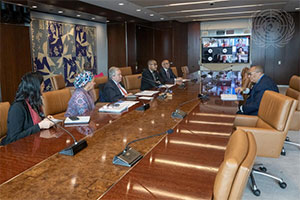 Secretary-General Meets with Members of Debt Expert Group. Credit: UN Photo/Eskinder Debeb
Financial crises are often defined by banking panics, recession, loss of market value, and deflation. Various financial crises at the turn of the 20th century, such as the Asian Crisis of 1997-1998 and the 2007-2008 Global Financial Crisis, have had immense impacts on the world economy. The COVID-19 pandemic also caused a financial crisis when mass lockdowns triggered staggering unemployment rates, a stagnation of economic growth, and led to the 2020 stock market crash. With the Russian invasion of Ukraine, the world has also witnessed a global energy crisis with shortages and increased prices in oil, gas, and electricity markets. According to UNCTAD’s World of Debt 2025, global public debt surpassed $100 trillion in 2024, with developing country debt growing twice as fast as developed economies since 2010. Burdens of debt servicing come with economic slowdowns and demands of austerity from lenders, with some economists arguing that this will lead to a new “lost decade” for the Global South. IPS brings you worldwide coverage of these financial developments and how we should manage these crises.

The Week with IPS

NEXT STOP - SDGs
Tracking global progress towards a sustainable world
Tracking global progress towards a sustainable world
