Languages
Thursday, September 10, 2026



News and Views from the Global South
Financial Crisis
FINANCE: Icelanders Question IMF Loan
After eight months of waiting, Iceland is finally back on the agenda of the IMF. The second instalment of the IMF loan was agreed at the end of last month and has now been transferred to Iceland.U.S.: Nearly One in Six Citizens Went Hungry in 2008
As the World Food Security Summit got under way in Rome Monday, the U.S. Department of Agriculture (USDA) disclosed that nearly one in six U.S. households went hungry at some time during 2008, the highest level since it began monitoring food security levels in 1995.ECONOMY-US: “Green” Jobs Should Be Black and Brown Too
The Barack Obama administration's drive to promote a "green" economy is not working in the interest of poor people in the United States, especially those who belong to minority communities, according to a new study by a leading think tank.RIGHTS-US: U.N. Investigator Probes Housing Crisis
The U.N. body responsible for monitoring human rights violations is investigating why hundreds of thousands - and possibly millions - of people in the United States are condemned to live on the streets.DEVELOPMENT: South-South Unity to Get Boost at U.N. Meet
As the global financial crisis continues to ravage the fragile economies of the world's poorer countries, the United Nations is hosting a high-level international conference next month to boost South-South cooperation.U.S.: Secret Bailouts for Giant Failing Banks of the Future?
Big banks will not be forced to downsize and the public will be the last to know when they fail, a controversial bill unveiled by U.S. Treasury Secretary Timothy Geithner and Congressman Barney Frank proposes.EASTERN EUROPE: Loans Make the Middle Class Poor
Low-income Eastern Europeans contracting easy consumer loans in the mid- 2000s are now falling below poverty lines.WORLD: IMF Has Long Way to Go – Even After "Istanbul Decisions"
The International Monetary Fund (IMF) may be performing better during the current economic crisis than during the Asian crisis of the late 1990s, but it still has "a long way to go".
JAPAN: Death from Overwork Persists Amid Economic Crunch
One morning nine months ago, Kenji Hamada's colleagues were surprised to find him in their Tokyo office slumped over his desk. They thought he was sleeping, but when he did not wake up after two hours, they realised he was dead.RIGHTS: Women Still Sidelined in Economic Decision-Making
Gender equality contributes to economic growth, but economic growth does not always contribute to gender equality, says the United Nations World Survey on the Role of Women in Development launched Tuesday, a message well timed in the context of the current financial crisis.
US-ECUADOR: Luring Migrants Home an Uphill Battle
Ecuadorian President Rafael Correa has a Ph.D. in economics, though it may not have prepared him for the recent financial turmoil that beset his coastal country.U.S.: Cities Use Inclusionary Zoning as Housing Costs Climb
With most U.S. cities facing a severe shortage of affordable housing, more and more are beginning to turn to so-called inclusionary zoning (IZ).AFRICA: Broken Promises Litter the Aftermath of Global Crisis
It seems that, once again, Africa and the rest of the developing world have been short-changed, given the broken promises in the wake of the global economic implosion.ECONOMY-US: Deep Cuts Push Californians to Edge
They call it Tortilla Flats - a haphazard cluster of tents and tarps sprawling across a sidewalk and a vacant lot smack in the middle of Fresno, a city of 500,000 in California's Central Valley.CHINA: Too Many Graduates, Very Few Jobs
Feng Danya studied foreign languages. She had hoped to be part of a growing local company and grow with them, she says. But her timing was wrong. She graduated in the summer of uncertainty for the global economy and many Chinese start-ups.TRADE: Govt’s May Need to Do for Workers What They Did for Banks
The finding by the World Trade Organisation (WTO) and the International Labour Organisation (ILO) that the dropping of trade tariffs leads to jobs being lost in the formal sector while informal jobs grow is another confirmation of the adverse consequences of forced trade liberalisation.ECONOMY-CUBA: Cutting Subsidies to Balance the Budget
Cuban President Raúl Castro is willing to risk unpopular measures to free the state from its excessive burden of subsidies and for-free services, as part of a programme to adjust public expenditure to shrunken government revenues and balance the budget.LABOUR-EUROPE: This Job Is Killing Me
A spate of suicides in France is raising new questions about precarious working conditions imposed by authoritarian management models.ECONOMY: ‘It’s Smart to Invest in Girls’
Sending more girls to school may help poor countries get out of the economic slump faster, the NGO Plan International says in a new report. Just a one percent rise in the number of girls attending secondary school boosts a country's annual per capita income growth by 0.3 percent.FINANCE: IMF Rebuts Critical Report on Lending
The International Monetary Fund is on the defensive over a recent study which charged that a majority of countries with IMF agreements have been subjected to pro-cyclical fiscal or monetary policies during the global economic downturn, exacerbating the effects of the recession and harming some of the world's poorest economies.AFRICA: "Grasp the Benefits of Trade with BRIC Emerging Markets"
While economists at a prominent South African bank are excited about burgeoning investment by Brazil, Russia, India and China (BRIC) in Africa, they are vague on the question of the extent to which it will benefit the majority of Africans. Ensuring this, they believe, is the responsibility of African states themselves.« Previous Page — Next Page »


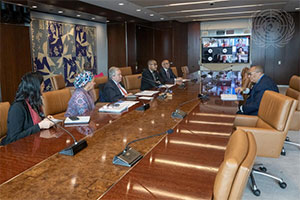 Secretary-General Meets with Members of Debt Expert Group. Credit: UN Photo/Eskinder Debeb
Financial crises are often defined by banking panics, recession, loss of market value, and deflation. Various financial crises at the turn of the 20th century, such as the Asian Crisis of 1997-1998 and the 2007-2008 Global Financial Crisis, have had immense impacts on the world economy. The COVID-19 pandemic also caused a financial crisis when mass lockdowns triggered staggering unemployment rates, a stagnation of economic growth, and led to the 2020 stock market crash. With the Russian invasion of Ukraine, the world has also witnessed a global energy crisis with shortages and increased prices in oil, gas, and electricity markets. According to UNCTAD’s World of Debt 2025, global public debt surpassed $100 trillion in 2024, with developing country debt growing twice as fast as developed economies since 2010. Burdens of debt servicing come with economic slowdowns and demands of austerity from lenders, with some economists arguing that this will lead to a new “lost decade” for the Global South. IPS brings you worldwide coverage of these financial developments and how we should manage these crises.

The Week with IPS

NEXT STOP - SDGs
Tracking global progress towards a sustainable world
Tracking global progress towards a sustainable world
