Languages
Tuesday, September 22, 2026



News and Views from the Global South
Financial Crisis
RECESSION AND RECOVERY: Diamonds Are for the Poor – Part 3
Diamonds haven't been among the first concerns at the World Social Forum these last 10 years. But through the recession and the still tottering recovery, a new sparkle in that business is pointing the way to a brighter world that is also better in a WSF sort of way.RECESSION AND RECOVERY: Cities Going One Way, Nations Another – Part 2
Some signs are emerging of a new trend shown up by the recession: local governments (and the people) are going one way, national ones another.RECESSION AND RECOVERY: The Lucky Are Unemployed – Part 1
The agreed, if dubious, solution to the financial crisis was to get people and governments - in the richer countries - to borrow more in order to spend more. What is not in doubt is the growing numbers of people who will be able to neither borrow nor spend.ASIA: As Economy Turns, Turning Off Stimulus Tap Is a Challenge
As the global financial crisis triggered alarms across Asia, Singapore responded with a government programme to aid its vulnerable workforce. The affluent city- state pumped in three billion U.S. dollars in an employment protection programme.U.S.: Obama Unveils Broad Banking Industry Reforms
U.S. President Barack Obama has delivered his plans for far-reaching banking and financial industry reforms, which mark a noticeable shift to the left in the administration's domestic policy and an acknowledgement of the public anger at Wall Street for its role in the financial crisis.PAKISTAN: Home-Based Workers Struggle to Climb Out of Poverty
Razia Khatoon, 36, crouches over a huge wooden frame, her eyes squinting in the dimly lit room inside a squatter settlement in Orangi town in Karachi, Pakistan’s largest city.
WORLD SOCIAL FORUM: Back Seat Driver of Social Change
The World Social Forum (WSF) is only "a tool" and must not be confused with the global movement for another world, says Chico Whitaker, one of the founders of this meeting which is celebrating its tenth year with a seminar to assess its track record Jan. 25-29, in its southern Brazilian place of origin, Porto Alegre.
LABOUR-ICELAND: Centre Gives Leg Up to Listless Youth
For young Icelanders at a loose end the Fjolsmidjan (multi-workshop) can prove to be a turning point.SRI LANKA: Amid Furore, Central Bank Drops Plan to Relax Forex Rules
Under pressure over accusations that ill-gotten money would be siphoned out, Sri Lanka’s Central Bank has put the lid on a plan to allow a free flow of foreign currency in and out of the country.EGYPT: Economists Blame ‘Neo-liberalism’ for Region’s Woes
Egypt embarked on "neo-liberal" economics more than three decades ago reorienting its socialist-oriented policies towards those of the "free market." Now, however, many critics call the strategy a failure and blame it for the country's rampant poverty and unemployment.WORLD SOCIAL FORUM: New and Old, US Groups Forge Broad Alliances
With civil society gearing up for the 2010 World Social Forum, and later this summer, the 2010 U.S. Social Forum in Detroit, Michigan, activists here say new alliances created at the first USSF in 2007 are going strong.ECONOMY: Dubai Debts Prompt Review of Islamic Finance
'The World’, a manmade archipelago off the coast of Dubai, developed by the Nakheel real estate company - which partly relied on the issuance of Islamic bonds, or sukuk, to finance the ambitious project - has come to symbolise for many the vulnerability of the Islamic financial market.
Q&A: Sweden Vows to Sustain Aid Levels to Poorer Nations
Sweden has pledged to maintain its current level of development aid to the world's poorer nations - roughly at about one percent of gross national product (GNP) - despite the global financial crisis.SRI LANKA: ‘Job Losses Could Have Been Worse’ – Industry Sources
When the global financial crisis struck in 2008, expectations were high that the Sri Lankan economy would be severely affected. But as it turned out, the number of job losses was not as bad as anticipated.BALKANS: ‘Econoslavia’ Makes Sense If Yugoslavia Does Not
Politicians from the former Yugoslavia often speak about integration with the European Union (EU) as their major goal in this decade and possible salvation from the economic hardships the region faces.Q&A: ‘Small Government Equals More Personal Responsibility’
As president of an independent think tank advocating minimal government, Bienvenido Oplas, Jr. believes that a society will be more peaceful and dynamic if people will assume more individual and voluntary responsibilities over their lives, their families and their communities.BOLIVIA: Evo Morales, the Best Ally of the Middle Class
Just five years ago, an alliance between an indigenous leader and Bolivia's small but influential middle class seemed virtually impossible.AGRICULTURE: Three-Quarters of Hungry Are Rural Poor
Climate change, associated with a four-fold increase in natural disasters in the last decade, and the growth of world population, which is expected to reach nine billion by 2050, pose new challenges for aid initiatives like those of the United Nations World Food Programme (WFP).ECONOMY-JORDAN: Dubai Crisis Casts Shadow On 2010
Surrounded by oil-rich nations Jordan has been able to make do with its modest resources over the years. In 2010, however, the country will have to face challenges associated with global economic slowdown and the crisis in Dubai.DEVELOPMENT: Japan’s Rude Awakening: Poverty Hurts
Japan may be one the world' biggest economies, but it is not immune to poverty.ECONOMY-ARGENTINA: The Worst Is Over
The year that has just ended was the worst for the Argentine economy since the 2002 and 2003 economic collapse. However, both government officials and economic analysts say the worst of the present crisis is over and that growth will return this year, in the light of improved internal and external conditions.« Previous Page — Next Page »


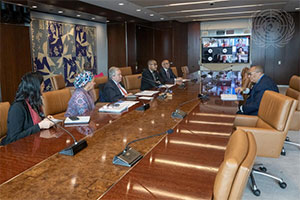 Secretary-General Meets with Members of Debt Expert Group. Credit: UN Photo/Eskinder Debeb
Financial crises are often defined by banking panics, recession, loss of market value, and deflation. Various financial crises at the turn of the 20th century, such as the Asian Crisis of 1997-1998 and the 2007-2008 Global Financial Crisis, have had immense impacts on the world economy. The COVID-19 pandemic also caused a financial crisis when mass lockdowns triggered staggering unemployment rates, a stagnation of economic growth, and led to the 2020 stock market crash. With the Russian invasion of Ukraine, the world has also witnessed a global energy crisis with shortages and increased prices in oil, gas, and electricity markets. According to UNCTAD’s World of Debt 2025, global public debt surpassed $100 trillion in 2024, with developing country debt growing twice as fast as developed economies since 2010. Burdens of debt servicing come with economic slowdowns and demands of austerity from lenders, with some economists arguing that this will lead to a new “lost decade” for the Global South. IPS brings you worldwide coverage of these financial developments and how we should manage these crises.

The Week with IPS

NEXT STOP - SDGs
Tracking global progress towards a sustainable world
Tracking global progress towards a sustainable world
