Languages
Tuesday, September 15, 2026



News and Views from the Global South
Financial Crisis
FINANCE: Congress, Activists Push for Conditions on IMF Funding
Development groups and some U.S. lawmakers are urging the administration of U.S. President Barack Obama to use its power on the governing board of the International Monetary Fund (IMF) to make the global financial body more transparent, democratic and responsive to the needs of its poorest borrowers.ECONOMY-AFRICA: The State Is Back, Announces UNCTAD
The state is back; neo-liberal policies have failed; and the liberalisation of trade should be halted. These are some of the findings and recommendations from the United Nations Conference on Trade and Development (UNCTAD) for the poorest countries, most of which are in Africa.ALBANIA: Short on Homework for Joining EU
Membership of the EU will be the principal target of the re-elected government in Albania.
ECONOMY: Accountability To Women Could Upset Business-As-Usual
A public presentation of the "Progress of the World's Women" report by the United Nations Development Fund for Women (UNIFEM) in Pretoria, South Africa this week suggests that one of the most powerful constraints on realising women's rights and achieving the Millennium Development Goals is a lack of accountability to women's needs.
Q&A: Tax Havens, Bank Secrecy, and Tricks
At a recent conference in Miami organised by Offshore Alert, a specialised media organisation focused on financial crime, IPS correspondent Lucy Komisar sat down with veteran investigator Bob Roach to discuss the hurdles facing regulators trying to crack down on tax havens, which cost the U.S. alone an estimated 100 billion dollars annually.EUROPE: A Year On, Sarkozy’s Euromed Struggles
A year ago Monday, French President Nicolas Sarkozy launched the Union for the Mediterranean, or Euromed, a grouping of European Union nations plus 16 non- EU Mediterranean states. Since then, critics say, the initiative has made little tangible progress.FINANCE: Remittances to Poor Countries Plunge up to 10 Percent
The amount of money immigrants from poor countries send to their families back home is expected to decline between seven and 10 percent in 2009 compared to 2008 levels, according to a new report released here Monday by the World Bank.
Q&A: Geopolitics Antithetical to Human Development
Sam Worthington is the president and CEO of InterAction, a coalition of 175 U.S.-based non-governmental organisations (NGOs) that focus on aiding the world's most poor and vulnerable people.EUROPE: Bringing Up a ‘Lost Generation’
A "lost generation" of children vulnerable to crime and exploitation is growing up in Eastern Europe as their parents migrate abroad for work and leave them behind, migration watchdogs warn.G8: Some Aid Can be Hard to Stomach
As numbers go, and as expectations went, 20 billion dollars would be a fair bit for the G8 to produce to fight the food crisis and bring down hunger. Certainly, it was more than most expected.BOTSWANA: Controversy over Government Loan to Fund Privatisation
Controversy has erupted over a decision by Botswana’s government to accept a loan from the African Development Bank, a departure from over two decades of running Africa’s "model economy" without borrowing.ECONOMY-PHILIPPINES: Migrant Workers Use Remittances as Investment Tools
George Detubio, once an Overseas Filipino Worker (OFW) is enjoying his new career as an entrepreneur. The 47-year-old owns a thriving business – distributing liquefied petroleum gas (LPG) products in this town, 200 kilometers north of Manila.
Q&A: “Massive Transfer of Power to the Poor” Needed In Crisis
Innovative solutions at a time of crisis, extending services and technology to the poor and building democracy around the initiatives of ordinary citizens are the prescription to combat poverty that Roberto Haudry, head of IFAD for the Andean subregion, would suggest to Latin American governments.WORLD: Trade Cannot Be Relied Upon to Reduce Poverty
Trade is positively linked to economic growth but trade policies alone cannot be relied upon to meet a country’s poverty reduction objectives, admits a review of aid for trade that was compiled for the World Trade Organisation (WTO) and the Organisation for Economic Cooperation and Development (OECD).
G8: ‘Just Invest in Women’
Investment in the health and the rights of girls and women can help economic recovery, civil society groups are telling G8 leaders.
TRADE: Crisis Pushing Emerging Markets to Move Beyond the Dollar
The global economic crisis is pushing countries in regions with emerging markets, such as Russia and South Africa, to together move beyond the dollar-based economic model. Given their politico-economic similarities, these two countries should build on opportunities to share expertise and technology.
Q&A: "It’s Wrong to Burn Food of the Poor to Drive Cars of the Rich"
The world needs to overcome "the bizarre irony that rural areas, where food is grown, is home to cruel poverty and hunger," says Ismail Serageldin, former chair of the Consultative Group on International Agricultural Research (CGIAR).G8: Not Everyone Is Following the Leaders
Many civil society organisations are staying on in Sardinia island in support of a region severely affected by the economic crisis, after the G8 leaders summit was moved from there to the city of L'Aquila.HUNGARY: Slipping Further to the Right
The rise of the anti-gypsy Hungarian far right has revealed deep failures in the country's political system and its civil society.ECONOMY: Migrant Miseries Will Trickle Down Worldwide, U.N. Warns
At least 150 million migrant workers - out of an estimated total of 200 million in the world today - fit the "demographic characteristics of workers who are the most vulnerable" during the current global financial crisis, the U.N. says.
ECONOMY-UGANDA: Traders Go Down as Prices Go Up
With the world economy in the grip of a credit crunch, traders and consumers in Uganda are struggling with price inflation and the depreciation of the country’s currency, the Ugandan shilling, against the dollar. Especially importers have not been able to bring goods in which were ordered when prices were lower.« Previous Page — Next Page »


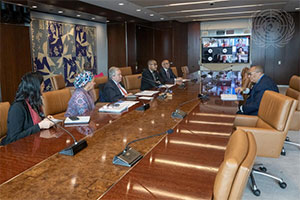 Secretary-General Meets with Members of Debt Expert Group. Credit: UN Photo/Eskinder Debeb
Financial crises are often defined by banking panics, recession, loss of market value, and deflation. Various financial crises at the turn of the 20th century, such as the Asian Crisis of 1997-1998 and the 2007-2008 Global Financial Crisis, have had immense impacts on the world economy. The COVID-19 pandemic also caused a financial crisis when mass lockdowns triggered staggering unemployment rates, a stagnation of economic growth, and led to the 2020 stock market crash. With the Russian invasion of Ukraine, the world has also witnessed a global energy crisis with shortages and increased prices in oil, gas, and electricity markets. According to UNCTAD’s World of Debt 2025, global public debt surpassed $100 trillion in 2024, with developing country debt growing twice as fast as developed economies since 2010. Burdens of debt servicing come with economic slowdowns and demands of austerity from lenders, with some economists arguing that this will lead to a new “lost decade” for the Global South. IPS brings you worldwide coverage of these financial developments and how we should manage these crises.

The Week with IPS

NEXT STOP - SDGs
Tracking global progress towards a sustainable world
Tracking global progress towards a sustainable world
