Languages
Monday, October 12, 2026



News and Views from the Global South
Green Economy

Africa at the Crossroads: Time to Abandon Failing Green Revolution
As COVID-19 threatens farming communities across Africa already struggling with climate change, the continent is at a crossroads. Will its people and their governments continue trying to replicate industrial farming models promoted by developed countries? Or will they move boldly into the uncertain future, embracing ecological agriculture?
Nono the Carbon Footprint Bear—Part of Peru’s Ambitious Work on Climate Action
On the eve of its bicentennial, Peru is addressing climate change with the needed sense of urgency and ambition. Our inclusive, ‘whole society’ approach aims to awaken new opportunities that are within reach of all of our citizens. Like COVID-19, climate change is a landmark which will have a clearly established before and after period. Without a doubt, it is paving a path towards sustainable development that will improve the well-being of all Peruvians.
‘Waste is only Waste when you Waste it’ – Could Ecobricks be the Solution to Uganda’s Housing and Pollution Problem?
About 40 kilometres out of Uganda’s capital, Kampala, in the Mpigi area, you can find an entire village hill with houses that have plastic bottles walls and car tyre rooftops.
Financing Economic Recovery
As the socio-economic impacts of the COVID-19 pandemic spread across the length and breadth of Asia and the Pacific, finance ministries are continuing their relentless efforts to inject trillions of dollars for emergency health responses and fiscal packages. With continued lockdown measures and restricted borders, economic rebound seems uncertain.
Energy Cooperatives Swim Against the Tide in Mexico
A Mexican solar energy cooperative, Onergia, seeks to promote decent employment, apply technological knowledge and promote alternatives that are less polluting than fossil fuels, in one of the alternative initiatives with which Mexico is seeking to move towards an energy transition.
Semiarid Regions of Latin America Cooperate to Adapt to Climate
After centuries of poverty, marginalisation from national development policies and a lack of support for positive local practices and projects, the semiarid regions of Latin America are preparing to forge their own agricultural paths by sharing knowledge, in a new and unprecedented initiative.
Warming Temperatures & Decades of Oil Spills Cause Irreversible Damage to the Persian Gulf
The Persian Gulf is one of the most strategic waterways in the world and is also one of the most polluted. According to estimates by experts, pollution levels in the Persian Gulf are 47 times higher than the world’s average and are steadily increasing.
Address Malnutrition with Food Insecurity
The 2020 State of Food Security and Nutrition in the World, issued by the Food and Agriculture Organization and its United Nations partners in mid-July, reports that chronic hunger continued to increase to 690 million worldwide in 2019, 60 million more than in 2014.
Can Private Finance Really Serve Humanity?
The recent explosion of private finance has nursed the hope, dream or illusion that it can be mobilized for the public good, e.g., to achieve the Sustainable Development Goals, associated with Agenda 2030. However, such hopes ignore how changes in financial investing have deeply transformed corporations, national economies and prospects for the world economy and social progress.
Electrification of Transport: A Challenge for Urbanised Latin America
Electric transport, still limited in Latin America despite its urban benefits, could expand during the post-pandemic economic recovery, says Adalberto Maluf, president of the Brazilian Association of Electric Vehicles (ABVE).
GGGI signs a Contribution Agreement with the European Union to provide support in accelerating Greening Uganda’s Urbanization and Industrialization Agenda
The European Union (EU) represented by the European Commission in Uganda and the Government of Uganda through the Global Green Growth Institute (GGGI) have signed a contract today to cooperate on advancing the Greening Uganda’s Urbanization and Industrialization agenda. This project is part of the European Union’s Inclusive Green Economy Uptake Programme (GreenUP) financed under the 11th European Development Fund (EDF) and will be implemented for a 36 months period with a total cost estimated of just under EUR 5mln. The MoU was signed by European Union in Uganda and Ms. Dagmar Zwebe, Country Representative of the GGGI Uganda office.
Building Back Greener in Africa
COVID-19 continues to race across the African continent. People are dying, and even more are being pushed into hunger and poverty, in many cases risking to overturn years of development gains.
The Goan Village Women Helping Mitigate Plastic Pollution by Making Eco-friendly Sanitary Pads
Jayashree Parwar has not traveled much outside of her village of Bicholim in the western coastal Indian state of Goa. But the homemaker-turned-social-entrepreneur has been reaching women in dozens of cities across the country with a hygiene product she makes at home along with women from her community. Called Sakhi (friend in Hindi), the plastic-free sanitary pad is Goa’s first menstrual hygiene product made with organic materials.
Put Climate at the Heart of COVID-19 Economic Recovery Plans
Cast your mind back. Six months ago—it seems like a lifetime—the world’s attention was on Madrid. The United Nations was meeting to take stock of international progress in fighting climate change. Headlines were dominated by young people pointing out—rightly—that governments were still not doing enough. They demanded urgent and ambitious action to cut emissions and help the most vulnerable.
We Should Not Aim to Return to Normal
The world before COVID-19 looks very attractive right now. In light of the disease, mass unemployment and social distancing, a return to pre-pandemic normality seems appealing. Yet we should remember what normal was.
Why Rwanda is a Great Green Growth Investment
In its effort to accelerate Rwanda's green growth development initiative, its local businesses encouraged their Italian counterparts to invest in the East Africa region.
Falling Clean Energy Costs Create Opportunity to Boost Climate Action in COVID-19 Recovery Packages
As COVID-19 hits the fossil fuel industry, a new report shows that renewable energy is more cost-effective than ever - providing an opportunity to prioritize clean energy in economic recovery packages and bring the world closer to meeting the Paris Agreement goals.
We Need to Slow down and Reconnect with Our Ocean for the Future of the Planet
 COVID19 has brought the world to a halt. The devastating impact of the global pandemic on people’s lives and the world’s economy is a jarring and historic turning point for all of us but it is also an opportunity to re-think many of our practices.

Post-COVID recovery should lock in ocean sustainability, says Commonwealth Secretary-General
The Commonwealth Secretary-General is urging governments to ensure their countries’ post-COVID economic recoveries are environmentally sustainable and safe for the ocean.
Beyond the Crisis
Looking back to the start of 2020, the world has changed almost beyond recognition. To protect public health, the global economy was put into stasis. Shops closed, factories were mothballed, and people’s freedom of movement was severely curtailed. No country has escaped the health, economic, and social impacts of the COVID-19 crisis. Tragically, more than 260,000 people have died and millions have been infected. The IMF is projecting global economic activity to decline on a scale not seen since the Great Depression. It is truly a crisis like no other.
Coronavirus Hasn´t Slowed Down Ecological Women Farmers in Peru’s Andes Highlands
It's eight o'clock in the morning and Pascuala Ninantay is carrying two large containers of water in her wheelbarrow to prepare with neighbouring women farmers 200 litres of organic fertiliser, which will then be distributed to fertilise their crops, in this town in the Andes highlands of Peru.« Previous Page — Next Page »





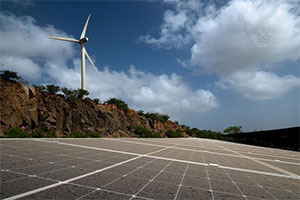 Renewable Energy in Cabo Verde. Credit: UN Photo/Mark Garten
A green economy is an economic model that aims to reduce environmental risks and build a sustainable future. Many of the UN SDGs seek to facilitate a green economy, such as ensuring access to affordable and reliable clean energy, building sustainable cities and communities, and implementing urgent action to combat climate change. Various key negotiations have strived to achieve a green economy, such as the Green New Deal and the Inflation Act of 2022. COP30, held in Belém, Brazil in 2025, agreed to mobilize $1.3 trillion annually for climate action and launched the Belém Mission to 1.5°C. However, the conference was not able to develop a fossil fuel reduction roadmap. Recent years have witnessed a sharp transformation in the geopolitical landscape of international sustainability cooperation. In March 2025, the United States stepped back from formal multilateral support for the SDGs, while China is on the rise as an international leader in renewable energy production. The actions of these global powers may shape shifting alliances on environmental governance. IPS is dedicated to sharing timely news on international developments in building a sustainable future.

The Week with IPS

NEXT STOP - SDGs
Tracking global progress towards a sustainable world
Tracking global progress towards a sustainable world
