Languages
Wednesday, September 23, 2026



News and Views from the Global South
Green Economy

Fourth Industrial Revolution & Its Dramatic Impact on Society
I am an engineer and, for the time being, I am also Secretary-General of the United Nations and we are all here because we believe in the force of Science, Innovation and Technology.
Why Water, Soap and Toilets are Keys to Ending Malnutrition
I started work this morning feeling disillusioned. A report had hit my desk that painted a very bleak picture of the state of the world’s health – and for a moment I was over-whelmed by just how much work there was left to do. Then I regrouped – and began making plans.
An Urgent Need to Transform World’s Energy Systems
When we discuss global interconnection in relation to energy, we are at the centre of the two key words that express our global concerns - sustainability and inclusivity.
Sustainable Water Management as a Lever for Green Growth in Ethiopia and the Region
Sustainable water supply is imperative for economic growth, but so often gets side-lined in the rush for development. The unanticipated consequence is a global economy that is increasingly stunted by water resource challenges, with worldwide predictions suggesting that global water demand will increase by approximately 75% more than global water supply in the next 30 years!
Impending Drought? There’s an App for That – Or Should Be
Fostering and harnessing innovative technologies could significantly reduce the negative impacts from climate change, including drought, water scarcity and food insecurity in African countries.
World Energy Day raises awareness about importance of ensuring safe and sustainable energy for everyone: DEWA CEO
World Energy Day is an opportunity to emphasise the importance of joint efforts among organisations and members of society to reduce practices that harm the environment and raise awareness about the importance of rationalising energy use and reducing carbon emissions, Saeed Mohammed Al Tayer, Vice Chairman of the Dubai Supreme Council of Energy and Managing Director and CEO of the Dubai Electricity and Water Authority, DEWA, said in a statement on World Energy Day.
The Future for Financing Africa’s Renewable Energy
Lack of energy access presents a formidable challenge to Africa and lack of access to financing has been singled out as the biggest reason why over 620 million people living on the continent are stuck in energy poverty.
Argentina’s Biodiesel Plagued by Commercial and Environmental Challenges
The Argentine biodiesel industry, which in the last 10 years has become one of the most powerful in the world, has an uncertain future, faced with protectionist measures in the United States and Europe and doubts in the international scenario about the environmental impact of these fuels based on agricultural products.
The IMF and Climate Change: Three Things Christine Lagarde Can Do to Cement Her Legacy on Climate
The International Monetary Fund (IMF) and climate change do not often appear in the same headline together. Indeed, environmental issues have been, at most, peripheral to the Fund's core functions. But now economists inside and outside the IMF are beginning to understand that climate change has significant implications for national and regional economies, and so it's worth reconsidering the Fund's role in addressing the climate challenge.
Alternative Financing Strategies to Boost Small Businesses in Africa
A few years ago, more than half a century after the concept was first proposed, the government of Côte d’Ivoire completed construction of the Henri Konan Bédié Bridge, a span over the Ébrié Lagoon linking the north and south of Abidjan, the country’s main city. The project became a reality after the government received development bank and private capital financing.
Making an Economic Case for Climate Action
Having faced a year of record temperatures and devastating hurricanes, the United States stands more to lose if it doesn't take steps to reduce the risk and impact of climate change, according to a new report.
Small Farmers in Brazil’s Amazon Region Seek Sustainability
The deforestation caused by the expansion of livestock farming and soy monoculture appears unstoppable in the Amazon rainforest in the west-central Brazilian state of Mato Grosso. But small-scale farmers are trying to reverse that trend.
Communities Can be Role Models for Sustainable Development
The United Nations, governments, civil society, business, thought leaders and media will gather in New York on September 17 to celebrate the winners of the Equator Prize 2017. The 15 prize winning communities successfully advance innovative solutions for poverty, environment, and climate challenges.
At Key Finance Meet, Mongolia Seeks Path to a Greener Economy
Rapid growth of a coal-fired economy often leads to environmental degradation, and Mongolia is a case in point.
Much more climate finance now!
Funding developing countries’ climate change mitigation and adaption efforts was never going to be easy. But it has become more uncertain with President Trump’s decision to leave the Paris Accord. As a candidate, he threatened not to fulfil the modest US pledge of US$3 billion towards the 2020 target of US$100 billion yearly for the Green Climate Fund (GCF).
Latin America Discusses How to Finance the Sustainable Development Agenda
Is it possible for the financial sector of Latin America and the Caribbean not only to think about earning money but also to contribute to the 2030 Agenda for Sustainable Development? The answer was sought in Buenos Aires, Argentina, at a regional roundtable on sustainable finance, the United Nations Environment Finance Initiative.
Scaling up Development Finance
The Business and Sustainable Development Commission has estimated that achievement of Agenda 2030 for the Sustainable Development Goals will require US$2-3 trillion of additional investments annually compared to current world income of around US$115 trillion. This is a conservative estimate; annual investments of up to US$2 trillion yearly will be needed to have a chance of keeping temperature rise below 1.5°C.
Towards a Resource Efficient and Pollution Free Asia-Pacific
Senior government officials from across Asia and the Pacific will meet in Bangkok this week for the first-ever Asia-Pacific Ministerial Summit on the Environment. The high-level meeting is co-convened by the United Nations Economic and Social Commission for Asia and the Pacific (UN ESCAP) and UN Environment and is a unique opportunity for the region’s environment leaders to discuss how they can work together towards a resource efficient and pollution-free Asia-Pacific.Climate Smart Crops: A Necessity for Future Food & Nutrition Security
Climate change is taking a severe toll on farmers, as they watch their livelihoods disappear with the onslaught of floods, droughts and rising sea levels and temperatures. With agriculture currently employing over 1.3 billion people throughout the world, or close to 40 percent of the global workforce, it is imperative that we incorporate climate resilience into all aspects of crop breeding and food innovation.
Women Play Key Role in Solar Energy Projects
Since weather affects everyone, the idea that women are more susceptible to the effects of climate change may strike some as puzzling.
Young Artists Get Passionate About Renewable Energy
Conversations about renewable and sustainable energy don't typically include artistic ideas on the subject. However, the Caribbean Community (Caricom) has chosen to engage the region's youth in the conversation by inviting them to create artistic works on sustainable energy for a regional competition.« Previous Page — Next Page »


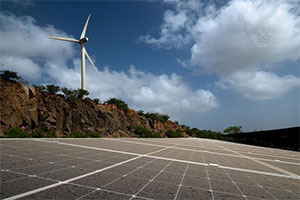 Renewable Energy in Cabo Verde. Credit: UN Photo/Mark Garten
A green economy is an economic model that aims to reduce environmental risks and build a sustainable future. Many of the UN SDGs seek to facilitate a green economy, such as ensuring access to affordable and reliable clean energy, building sustainable cities and communities, and implementing urgent action to combat climate change. Various key negotiations have strived to achieve a green economy, such as the Green New Deal and the Inflation Act of 2022. COP30, held in Belém, Brazil in 2025, agreed to mobilize $1.3 trillion annually for climate action and launched the Belém Mission to 1.5°C. However, the conference was not able to develop a fossil fuel reduction roadmap. Recent years have witnessed a sharp transformation in the geopolitical landscape of international sustainability cooperation. In March 2025, the United States stepped back from formal multilateral support for the SDGs, while China is on the rise as an international leader in renewable energy production. The actions of these global powers may shape shifting alliances on environmental governance. IPS is dedicated to sharing timely news on international developments in building a sustainable future.

The Week with IPS

NEXT STOP - SDGs
Tracking global progress towards a sustainable world
Tracking global progress towards a sustainable world
