Languages
Friday, September 25, 2026



News and Views from the Global South
Green Economy

Geothermal – a Key Source of Clean Energy in Central America
Energy from the depths of the earth - geothermal - is destined to fuel renewable power generation in Central America, a region with great potential in this field.
What Does “Climate-Smart Agriculture” Really Mean? New Tool Breaks It Down
A Trinidadian scientist has developed a mechanism for determining the degree of climate-smart agriculture (CSA) compliance with respect to projects, processes and products.
Will Renewable Energies Finally Get Their Chance in Argentina?
The first thing anyone who looks at any official document this year in Argentina will read is: “2017, the year of renewable energies.” This indicates the importance that the government gives to the issue, although translating the slogan into reality does not seem as easy as putting it in the headings of public documents.
Jordan Makes Strides Toward Inclusive Green Economy
Jordan may be one of the smallest economies in the Middle East, but it has high ambitions for inclusive green growth and sustainable development despite the fact that it lies in the heart of a region that has been long plagued with wars and other troubles, says the Director-General of the Global Green Growth Institute (GGGI) Dr. Frank Rijsberman.
Can Economic Growth Be Really Green?
The answer to this big question is apparently “yes” – Economic growth can be really green. How?
China Seeks to Export Its Green Finance Model to the World
Hand in hand with UN Environment and the Inter-American Development Bank (IDB), the People’s Bank of China (PBoC) disembarked in the Argentine capital to prompt this country to adopt and promote the agenda of so-called green finance, which supports clean or sustainable development projects and combats climate change.
UAE Leading the Way on Shifting to Greener Energy
Much of the world is moving away from oil for its electricity generation, according to the International Energy Agency (IEA), which says that globally the fossil fuel has dropped from a 25 percent share to 3.6 percent over the last four decades.
How to Achieve Universal Goals, Strategically
Discussion around the 2030 Agenda for Sustainable Development, a list of 17 goals listed by the UN, was all the buzz in the conference rooms of UN headquarters this week.
Civil Society on SDG Engagement: “We Are Not Guests”
Showing up in record numbers, civil society groups are urging greater inclusion and accountability in sustainable development processes at a UN high level meeting.
The Greater Caribbean Raises Funds to Protect its Sandy Coasts
Almost no Caribbean beach escapes erosion, a problem that scientific sources describe as extensive and irreversible in these ecosystems of high economic interest, that work as protective barriers for life inland.
IFAD’s President Houngbo Calls for Investment in Climate-Smart Agriculture for Poverty-Free Future
Implementing climate-smart agriculture is critical to reduce hunger and poverty, according to International Fund for Agricultural Development’s (IFAD) new president Gilbert Houngbo.
Renewing Commitment to SDGs: Private Sector Gets Active
Just last month business representatives from around the world joined the United Nations Sustainable Development Goals Fund commemorate their work as part of the Private Sector Advisory Group (PSAG).
Saving the Oceans, Saving the Future: Officials Tackle Marine Pollution
The oceans’ health is only getting worse and the cycle of decline must be reversed, said representatives at the opening of a high-level UN conference.
Charting a Course to a Blue Commonwealth
The United Nations Ocean Conference offers an historic opportunity to safeguard the ocean environment and support small island and vulnerable developing coastal states, who depend on the seas for national economic growth and sustainable development.
New Research to Unearth UAE’s Renewable Energy Potential
A report by World Wildlife Fund (WWF) states that supplying the world with 95 per cent renewable sources by 2050 will not only reduce 80 per cent of GHG emissions from the energy sector but also save four trillion euros annually.
Why We Need to Save Our Oceans Now—Not Later
What if the blue fades away as seawaters become brown and coral reefs become white as marine grasslands wither and life below water vanishes?
Mixed Reactions to U.S. Withdrawal from Climate Deal
The United States is expected to withdraw from the landmark Paris climate agreement, prompting mixed reactions from civil society and political representatives.
Valuing Water Beyond the Money
Amid the worst drought in a century, South Africans are kick-starting a global consultative process to agree on the values of water in a bid to ensure more equitable use of the finite resource.
Big polluting lobbyists may be forced to declare interests at UN talks
Is the presence of the fossil fuel industry necessary in global climate change negotiations, or does their presence in these talks represent a conflict of interest and undermine global progress?
The Ocean Conference: An Integrated Vision that must be Delivered
In March 2015 at the Sendai World Conference for Disaster Risk Reduction, the then President of Kirbati, Anote Tong, made it very clear how vulnerable his country was to climate and disaster risk, when he informed the room (which was sadly less than half full) that his country had purchased land in Fiji.
Gateway Portals and the Quest for Sustainable Urbanization
On a busy Friday afternoon, the number 1 subway train heading north through Manhattan’s Westside comes out of a dark tunnel --and if one takes a minute to release oneself from communication devices—one can catch sight of the approaching 125th street in the distance, the crosswalk buzzing with yellow cabs.« Previous Page — Next Page »


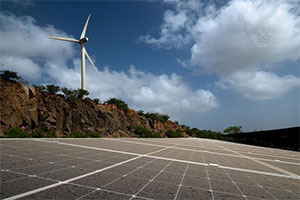 Renewable Energy in Cabo Verde. Credit: UN Photo/Mark Garten
A green economy is an economic model that aims to reduce environmental risks and build a sustainable future. Many of the UN SDGs seek to facilitate a green economy, such as ensuring access to affordable and reliable clean energy, building sustainable cities and communities, and implementing urgent action to combat climate change. Various key negotiations have strived to achieve a green economy, such as the Green New Deal and the Inflation Act of 2022. COP30, held in Belém, Brazil in 2025, agreed to mobilize $1.3 trillion annually for climate action and launched the Belém Mission to 1.5°C. However, the conference was not able to develop a fossil fuel reduction roadmap. Recent years have witnessed a sharp transformation in the geopolitical landscape of international sustainability cooperation. In March 2025, the United States stepped back from formal multilateral support for the SDGs, while China is on the rise as an international leader in renewable energy production. The actions of these global powers may shape shifting alliances on environmental governance. IPS is dedicated to sharing timely news on international developments in building a sustainable future.

The Week with IPS

NEXT STOP - SDGs
Tracking global progress towards a sustainable world
Tracking global progress towards a sustainable world
