Languages
Monday, September 21, 2026



News and Views from the Global South
Green Economy

Clean Energy Sources Manage to Cut Electricity Bill in Chile
A 75 percent drop in electricity rates, thanks to a quadrupled clean generation capacity, is one of the legacies to be left in Chile by the administration of Michelle Bachelet, who steps down on Mar. 11.
Policy Support Gap for “Climate-Smart” Agriculture
Conditioned that ploughing is the sure way to produce crops, Zimbabwean farmer Handrixious Zvomarima surprised himself by trying a different method. He planted cowpea seeds directly without tilling the land. It worked.
The Political Responsibility in the Collapse of Our Planet
On 20 December, Europe’s 28 Ministers of Environment met in Brussels, to discuss the plan for reducing emissions prepared by the Commission, to comply with the Paris Agreement on climate change. Well, it is now clear that we have lost the battle in keeping the planet as we have known it. Now, of course, this can be considered a personal opinion of mine, devoid of objectivity.
Production Diversity, Diet Diversity and Nutrition in Sub -Saharan Africa
Lack of diet diversity is viewed as the major cause of micronutrient malnutrition in Sub-Saharan Africa. Imbalanced diets resulting from consumption of mainly high carbohydrate based-diets also contribute to productivity losses and reduced educational attainment and income. Consequently, micronutrient malnutrition is currently the most critical for food and nutritional security problem as most diets are often deficient in essential vitamins and minerals. In Tanzania, for example, most rural and urban households consume mainly staples as their main food, which are high in carbohydrates, but low in micronutrients and vitamins. Staple food items increase energy availability but do not improve nutritional outcomes if not consumed together with micro-nutrient rich foods.
Money Talks at One Planet Summit in Paris
As funding to combat climate change has lagged behind lofty words, the One Planet Summit in France this week invited governments and business leaders to put money on the table.
Can Korea Power Past Coal? A New World in Which “Solar+Batteries” Becomes the Cheapest Form of Energy
Renewable energy became the cheapest form of electricity in 58 emerging economies last year. This year, the 11th Lazard’s Levelized Cost of Energy Analysis (LCOE 11.0) showed that solar and wind energy generation costs (at $46 to $53 per megawatt-hour of generation) easily beat coal and gas (at $60-68).
Central America Builds Interconnected Clean Energy Corridor
Countries in Central America are working to strengthen their regional electricity infrastructure to boost their exchange of electricity generated from renewable sources, which are cheaper and more environmentally friendly.
The Journey to Oslo
On December 10 in Oslo, the International Campaign to Abolish Nuclear Weapons (ICAN) was awarded the Nobel Peace Prize. ICAN started as a grassroots campaign in 2007. Its aim was to shift the paradigm of discussion about nuclear weapons from security and deterrence to the environmental and humanitarian effects of nuclear explosions. As the prize demonstrates, ICAN has succeeded brilliantly. But, as ICAN acknowledges, this is still only the beginning of the end of nuclear weapons.
Global Initiative to Relieve Pressure on Mountains
International Mountain Day and the Mountain Partnership’s 15th anniversary coincided on December 11, kicking off a three-day Mountain Partnership Global Meeting at the headquarters of the Food and Agriculture Organization of the United Nations (FAO) in Rome.
Are Rising Seas, Coastal Erosion & Powerful Storms a Wave of the Future for Small Island Nations?
The 44-member Alliance of Small Island States (AOSIS) represents some of the world’s most vulnerable island nations fighting a virtually losing battle against rising sea levels triggered by global warming and climate change.
Ecological Waste Management
The times call for active measures to combat climate change. People have again and again relayed the words: reuse, reduce, recycle. I would like to add—refuse. Refuse to add to the pollution, and refuse to commit unhealthy practices.
Pacific Islands Struggling to Meet SDG7 Energy Targets
The four Pacific Island nations who are amongst the Least Developed Countries (LDCs) may be falling behind in meeting energy access targets because they are too busy devoting resources towards climate change.
Q&A: “What Price Do We Put on Our Oceans?”
“Political resolve is the key for succeeding in our fight against oceans pollution,” Erik Solheim, head of UN Environment, who is leading hands-on the organisation’s global campaign to clean up seas and oceans of plastic litter, agricultural run‑off and chemical dumping, told IPS.
Coping with Foreign Direct Investment
Foreign direct investment (FDI) is increasingly touted as the elixir for economic growth. While not against FDI, the mid-2015 Addis Ababa Action Agenda (AAAA) for financing development also cautioned that it “is concentrated in a few sectors in many developing countries and often bypasses countries most in need, and international capital flows are often short-term oriented”.
Lobbying & Sponsorships at COP23 Corrupted Climate Talks
The world’s nations got together in Bonn, Germany, for the 23rd annual Conference of the Parties (COP) under the UN Framework Convention on Climate Change (UNFCCC), where nearly 200 countries and some 23, 000 delegates met to discuss and influence the negotiations over the rulebook of the Paris Agreement.
At Climate Summit, Two Global Energy Alliances Emerge
As the summit of governments known as COP23 reached its conclusion in Bonn, Germany this week, two clear alliances have emerged in the global energy landscape.
Financing Will Continue to be Key Issue in Battling Climate Change
“The Bonn climate talks were foundational, paving the way to finalize the rules that underpin the Paris Agreement next year and setting the stage for countries to commit to enhance their national climate plans by 2020. On both counts, the climate talks in Bonn were a success. However, negotiators have plenty of homework to do to get there.
Climate Change is Already Upon us & Will Only Worsen in Short Term
It is fitting that this year’s conference of parties (on climate change, COP 23) is led by Fiji, a nation on the frontlines. Last month I visited other small islands facing the impacts of a warming world: Antigua and Barbuda and Dominica. The hurricane damage was beyond belief. The catastrophic effects of climate change are upon us. Floods, fires, extreme storms and drought are growing in intensity and frequency.
On Gender Day at Climate Meet, Some Progress, Many Hurdles
“Five years ago, when we first started talking about including gender in the negotiations, the parties asked us, ‘Why gender?’ Today, they are asking, ‘How do we include gender?’ That’s the progress we have seen since Doha,” said Kalyani Raj.
Economic Development vs. Climate Action: Rebutting Deniers and Wafflers
As negotiators meet in Bonn to put together a deal to implement the Paris Agreement, John Holdren, a professor of environmental policy at the John F. Kennedy School of Government, Harvard University, stressed that economic development and climate change mitigation and adaptation are not ‘either-or’ but must be pursued together.
Fourth Industrial Revolution & Its Dramatic Impact on Society
I am an engineer and, for the time being, I am also Secretary-General of the United Nations and we are all here because we believe in the force of Science, Innovation and Technology.« Previous Page — Next Page »


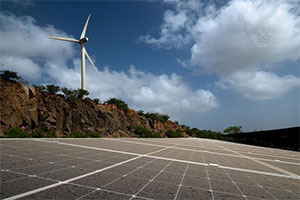 Renewable Energy in Cabo Verde. Credit: UN Photo/Mark Garten
A green economy is an economic model that aims to reduce environmental risks and build a sustainable future. Many of the UN SDGs seek to facilitate a green economy, such as ensuring access to affordable and reliable clean energy, building sustainable cities and communities, and implementing urgent action to combat climate change. Various key negotiations have strived to achieve a green economy, such as the Green New Deal and the Inflation Act of 2022. COP30, held in Belém, Brazil in 2025, agreed to mobilize $1.3 trillion annually for climate action and launched the Belém Mission to 1.5°C. However, the conference was not able to develop a fossil fuel reduction roadmap. Recent years have witnessed a sharp transformation in the geopolitical landscape of international sustainability cooperation. In March 2025, the United States stepped back from formal multilateral support for the SDGs, while China is on the rise as an international leader in renewable energy production. The actions of these global powers may shape shifting alliances on environmental governance. IPS is dedicated to sharing timely news on international developments in building a sustainable future.

The Week with IPS

NEXT STOP - SDGs
Tracking global progress towards a sustainable world
Tracking global progress towards a sustainable world
