Languages
Sunday, September 20, 2026



News and Views from the Global South
Green Economy

Mounting Debt Threatens UN’s Sustainable Development Goals
In 2015, 193 countries adopted the 17 Sustainable Development Goals (SDGs) as an overarching policy roadmap through 2030. These goals are predicated on the idea that for a sustainable future, economic growth must go hand-in-hand with social inclusion and protection of the environment.
Can Sustainable Bioeconomy be a Driver of Green Growth?
On April 19-20, I attended the second Global Bioeconomy Summit in Berlin. Bioeconomy is currently a hot topic for scientists and policymakers. Rapid advances in molecular biology combined with big data and artificial intelligence have resulted in big jumps in our understanding of living organisms as well as organic matter, the biomass produced by plants and animals, at the level of their DNA. That has gone hand in hand with technologies that allow scientists and industry to manipulate, easily, everything from enzymes to bacteria to plants and animals.
From Mega to Micro, a Transition that Will Democratise Energy in Brazil
An energy transition is spreading around the globe. But in Brazil it will be characterised by sharp contrasts, with large hydroelectric plants being replaced by solar microgenerators and government decisions being replaced by family and community decision-making.
Over to You, Children! Zambia’s ‘Plant a Million Trees’ Takes Root
Trees are a vital component in the ecosystem—they not only give oxygen, store carbon, stabilise the soil and give refuge to wildlife, but also provide materials for tools, shelter and ultimately, food for both animals and human beings.
Dreaming of A New Sustainable Economy
Officials from around the world came together to create and support a vision for a new, sustainable economy: a bioeconomy. Almost 1000 bioeconomy experts, from former heads of state to civil society leaders, convened in Berlin for the second Global BIoeconomy Summit to discuss best practices and challenges.
FAO and El País Launch Series of Books on “The State of the Planet”
Today the Food and Agriculture Organization (FAO) hosted an event at its headquarters in Rome, to present a set of eleven books jointly realized in collaboration with the Spanish newspaper El País.
Latin America Faces Uphill Energy Transition
Latin America is facing challenges in energy efficiency, transportation and power generation to move towards a low carbon economy and thus accelerate that transition, which is essential to cut emissions in order to reduce global warming before it reaches a critical level.
New GCF Project Signals Paradigm Shift for Water-Scarce Barbados
At the start of 2017, the Caribbean Drought and Precipitation Monitoring Network (CDPN) warned eastern Caribbean countries that they were facing “abnormal climate conditions” and possibly another full-blown drought.
Caribbean Eyes Untapped Potential of World’s Largest Climate Fund
The Caribbean Community Climate Change Centre (CCCCC) also known as the 5Cs, is looking for ways to boost the region’s access to the Green Climate Fund (GCF).
Former UN Chief Takes the Helm of Global Green Growth Institute
In the face of climate change and growing energy demand in developing countries, Ban Ki-moon, the new president and chair of the Global Green Growth Institute (GGGI), unveiled his vision for a more sustainable path by helping countries in their transition to greener economies and achieving the Sustainable Development Goals (SDGs).
A Breath of Fresh Air in India
With India’s citizens clamouring for breathable air and efficient energy options, the country’s planners are more receptive than ever to explore sustainable development options, says Frank Rijsberman, Director-General of the Global Green Growth Institute (GGGI).
Water Stress Poses Greatest Threat to MENA Region
This year, World Water Day, celebrated annually on 22 March, is themed “Nature for Water”, examining nature-based solutions (NBS) to the world’s water problems.
We Must Talk to Each Other to Solve Gender Inequality
The international community agreed on the global Goal of achieving gender equality and women’s empowerment by 2030. But we can’t reach it – not even by 2050 – until we talk to each other, rather than past each other. If we are serious about empowering women and girls, we have to bridge the huge chasm that exists between the advocates of gender equality, on the one hand, and advocates of other Goals, on the other.
Greening India for a Sustainable Tomorrow
Actions taken today in the pursuit of environmentally sustainable and socially inclusive growth path in India stand to benefit more than 17 percent of the world’s population. A sustainable future for India carries an impact for the subcontinent and the entire world.
Promoting Green Growth to Meet Global Aspirations for Gender Equality
The world has seen tremendous economic growth over the last decades, which has led to poverty reduction and increased welfare for millions of people. Environmental sustainability and social inclusiveness are key to the resilience of these gains and continued growth. “Leaving no one behind” as we navigate a shift towards green economies must be woven throughout the growth and development agendas.
Inclusive Green Growth Must Shape Thailand’s Future, Says GGGI Chief
Energy efficiency in industries presents a unique opportunity for Thailand’s environmental and economic policies as regional trends push towards more inclusive and sustainable green cities for the country and its neighbors, says the Director-General of the Global Green Growth Institute (GGGI) Dr. Frank Rijsberman.
Ban Ki-moon Elected President and Chair of GGGI
Ban Ki-moon, former Secretary General (SG) of the United Nations (UN) has been elected as President of the Assembly and Chair of the Council of the Global Green Growth Institute (GGGI) for a two-year term. He takes over from Gemedo Dalle, of the Federal Democratic Republic of Ethiopia.
Efficient Water Management in Central Asia
In Tajikistan and other countries of Central Asia, local water user associations have proved vital for efficient irrigation management, and reasonably prolonged training is the key for enabling the associations to perform well.
Women on the Front Lines of Halting Deforestation
In Zimbabwe, the bulk of rural communities and urban poor still get their energy supplies from the forests, leading to deforestation and land degradation.
Biodiversity and Food Security: the Dual Focus of the World Potato Congress
Potatoes were first taken out of Peru, where they originated, 458 years ago to feed the world. Half a millennium later, potatoes have spread throughout the planet but there are challenges to preserve the crop’s biodiversity as a source of food security, as well as the rights of the peasants who sustain this legacy for humanity.
Sustainable Energy Critical for Achieving Overall Goals of Paris Climate Agreement
The Paris Agreement ushered in a new global approach to climate change. At the core of this agreement are the Nationally Determined Contributions. We are now implementing these pledges.« Previous Page — Next Page »


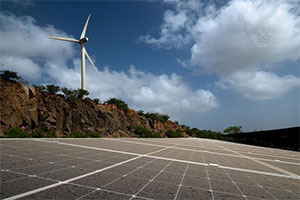 Renewable Energy in Cabo Verde. Credit: UN Photo/Mark Garten
A green economy is an economic model that aims to reduce environmental risks and build a sustainable future. Many of the UN SDGs seek to facilitate a green economy, such as ensuring access to affordable and reliable clean energy, building sustainable cities and communities, and implementing urgent action to combat climate change. Various key negotiations have strived to achieve a green economy, such as the Green New Deal and the Inflation Act of 2022. COP30, held in Belém, Brazil in 2025, agreed to mobilize $1.3 trillion annually for climate action and launched the Belém Mission to 1.5°C. However, the conference was not able to develop a fossil fuel reduction roadmap. Recent years have witnessed a sharp transformation in the geopolitical landscape of international sustainability cooperation. In March 2025, the United States stepped back from formal multilateral support for the SDGs, while China is on the rise as an international leader in renewable energy production. The actions of these global powers may shape shifting alliances on environmental governance. IPS is dedicated to sharing timely news on international developments in building a sustainable future.

The Week with IPS

NEXT STOP - SDGs
Tracking global progress towards a sustainable world
Tracking global progress towards a sustainable world
