Languages
Sunday, September 20, 2026



News and Views from the Global South
Green Economy

Q&A: Greening Colombia’s Energy Mix
Colombia is a global power in biodiversity and water resources, but at the same time it depends on exports of fossil fuels, coal and oil, to the world. But don't panic: in the green economy there are also incomes and jobs - says a world expert on the subject, Juhern Kim.
Plastic Tsunamis Threaten Coast in Latin America
Although Latin America produces just five percent of the world's plastic, it imports billions of tons annually for the use of all kinds of products, some of which end up in the sea as garbage.
Why Milk, Meat & Eggs Can Make a Big Difference to World’s Most Nutritionally Vulnerable People
As the world becomes increasingly aware of the growing demands being made of our planet, more and more of us are making lifestyle choices to reduce our negative environmental impact and carbon footprint.
Latin America Begins to Discover Electric Mobility
With 80 percent of the population living in urban areas and a vehicle fleet that is growing at the fastest rate in the world, Latin America has the conditions to begin the transition to electric mobility - but public policies are not, at least for now, up to the task.
Valuing the Food System
Many factors contribute to the cost of a tomato. For example, what inputs were used (water, soil, fertilizer, pesticides, as well as machinery and/or labor) to grow it? What kind of energy and materials were used to process and package it? Or how much did transportation cost to get it to the shelf?
Harnessing the Blue Economy Must Consider Social Inclusion and Responsible Stewardship
In April 2018, Commonwealth leaders met in a retreat at a royal residence in the English county of Berkshire and agreed on strategies to deepen trade in their 53-member organisation, improve security, tackle climate change, and work together for the betterment of the lives of the people of the Commonwealth.
Chile Debates Whether Citizens Should Profit from Generating Energy
Chile has become a model country for its advances in non-conventional energy, and is now debating whether citizens who individually or as a group generate electricity can profit from the sale of the surplus from their self-consumption - a factor that will be decisive when it comes to encouraging their contribution to the energy supply.
Public-Private Pacts Open Doors to Climate Finance in Rwanda and Ethiopia
The Global Green Growth Institute (GGGI) presented the African model of a National Financing Vehicle in which the governments of Rwanda and Ethiopia have successfully promoted green growth and climate resilience, at an event May 25 on the sidelines of the annual meetings of the Board of Governors of the African Development Bank (AfDB) in Busan, South Korea.
Ethiopia’s Green Growth Goals: A Launchpad for Wider Climate Action in Africa
The vision for a sustainable future in Africa is being realized at a time of great possibilities and this vision is underpinned by a shift in continental focus towards sustainable and inclusive economic growth and development. This focus highlights strategic efforts towards poverty alleviation, resilience building, promoting sustainable infrastructure and, efficient management of natural resources.
Energy Cooperatives, Fogged Mirrors for Latin America
“It made me angry that a company from outside the region was making money from renewable energy and I wondered why people weren't getting involved," says Petra Gruner-Bauer, president of the German co-operative SolixEnergie.
Unlocking Private Finance for Developing Countries’ Green Growth
Climate finance has never been more urgently needed, with massive investments in climate action required to meet the goals of the Paris Agreement and avoid the devastating effects of a warmer planet.
When Two Becomes One: Blending Public and Private Climate Finance
With the landmark Paris Agreement now almost two years old, funding for climate-related activities continues to be a challenge. However, efforts have been underway to bring two seemingly very different sectors together to address climate change.
Africa Gains Momentum in Green Climate Solutions
Promoting the widespread use of innovative technologies will be critical to combat the hostile effects of climate change and reduce greenhouse gas emissions, and many African countries are already leading the way with science-based solutions.
Climate Finance: The Paris Agreement’s “Lifeblood”
As negotiators concluded ten days of climate talks in Bonn last week, climate finance was underlined as a key element without which the Paris Agreement’s operational guidelines would be meaningless.
United Arab Emirates: Entering into a Sustainable Future
The end of the oil age In the early 1970’s the United Arab Emirates (UAE) was an impoverished desert, with little access to food, water and well-paying jobs. Today, this country looks nothing like it was fifty years ago. Thanks to oil, the UAE has completely transformed and now is one of the most developed economies in the Middle East, if not the world: its per capita GDP is equal to those of highly developed European nations ($68,000 - 2017 est.).

“Green Development Has to Be Equal for All”
IPS caught up with Dr. Frank Rijsberman, director-general of the Global Green Growth Institute (GGGI), at the end of the flagship side event of the GGGI during the 51st Annual Meeting of the Asian Development Bank (ADB) in Manila on May 4, 2018, which featured the Belt and Road Initiative (BRI) and its potential to create sustainable infrastructure and promote green growth pathways.
Regional Cooperation Needs a Strategic Vehicle for Inclusive Growth
There is growing recognition that regional cooperation is a crucial driver of growth. We should now also recognize if regional trade networks are to yield the intended benefit of inclusive growth, then there needs to be a strategic vehicle for development that can be scaled.
Optimal Use of Water Works Miracles in Brazil’s Semi-Arid Region
Cattle ranching has been severely affected by drought in Brazi's Northeast region, but it has not only survived but has made a comeback in the Jacuípe river basin thanks to an optimal use of water.
Belt and Road Initiative Vows Green Infrastructure with Connectivity
"My son in primary school did not attend a birthday celebration because it was cancelled due to bad air -- and we live in Seoul, a great place to live," said Dr. Frank Rijsberman, director-general of the Global Green Growth Institute (GGGI).
Low Awareness Restrains Growth of Solar Technologies
Every year, Amos Chandiringa, 43, a farmer in Nemaire village in Makoni district in northeastern Zimbabwe, laboriously waters his tobacco nursery with a watering can. The toil of the job often leaves him without the energy or time to do other household chores.
FAO Releases Alarming Report on Soil Pollution
Soil pollution is posing a serious threat to our environment, to our sources of food and ultimately to our health. The Food and Agriculture Organization of the United Nations (FAO) warns that there is still a lack of awareness about the scale and severity of this threat.« Previous Page — Next Page »


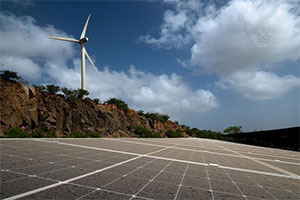 Renewable Energy in Cabo Verde. Credit: UN Photo/Mark Garten
A green economy is an economic model that aims to reduce environmental risks and build a sustainable future. Many of the UN SDGs seek to facilitate a green economy, such as ensuring access to affordable and reliable clean energy, building sustainable cities and communities, and implementing urgent action to combat climate change. Various key negotiations have strived to achieve a green economy, such as the Green New Deal and the Inflation Act of 2022. COP30, held in Belém, Brazil in 2025, agreed to mobilize $1.3 trillion annually for climate action and launched the Belém Mission to 1.5°C. However, the conference was not able to develop a fossil fuel reduction roadmap. Recent years have witnessed a sharp transformation in the geopolitical landscape of international sustainability cooperation. In March 2025, the United States stepped back from formal multilateral support for the SDGs, while China is on the rise as an international leader in renewable energy production. The actions of these global powers may shape shifting alliances on environmental governance. IPS is dedicated to sharing timely news on international developments in building a sustainable future.

The Week with IPS

NEXT STOP - SDGs
Tracking global progress towards a sustainable world
Tracking global progress towards a sustainable world
