Languages
Saturday, September 19, 2026



News and Views from the Global South
Green Economy

Transforming Food Systems: Today’s Realities and Tomorrow’s Challenges
The world’s food systems face two immense challenges today. One, to produce enough food to nourish a global population of seven billion people without harming the environment. Two, to make sure food systems deliver nutrition to everyone, particularly the world’s poorest, many of whom suffer from chronic under-nutrition.
Is Thailand Making Progress Towards Reaching its Climate Change Mitigation Goals?
As preparations are underway for an important formal discussion between countries committed to the Paris Agreement; Thailand, Southeast Asia’s second-largest economy, has been determining its progress towards reducing greenhouse gas (GHG) emissions by 20 to 25 percent by 2030. But experts have warned against merely emphasising policies to affect real changes.
Q&A: Indonesia Takes Steps to Reduce Emissions – But It’s Not Enough
The South Asian nation of Indonesia is the world’s fifth-largest emitter of greenhouses gases (GHG) and is ranked as the world’s second-largest plastic polluter of oceans, just behind China. So when the country committed in the Paris Agreement to limit the rise in average global temperatures to below 2°C by unconditionally reducing its emissions by 29 percent with using its own finances and by 41 percent with international funding, many felt the goals too ambitious.
Can Cities Reach the Zero Waste Goal?
How should cities address the problem of waste? The most important thing is to set a clear objective: that the day will come when nothing will be sent to final disposal or incineration, says an international expert on the subject, retired British professor of environmental chemistry and toxicology Paul Connett, author of the book "The Zero Waste Solution."
“The Sustainable Bioeconomy, a Path Towards Post-Extractivism”
Ecuador has decided to move towards a bioeconomy-based development model, “which must be sustainable,” because otherwise "the remedy could be worse than the disease," said the country’s Environment Minister Tarsicio Granizo, who is spearheading this innovative approach.
Q&A: Air Pollution Remains Cause for Alarm in Asia
At the start of the year the pollution in Vietnam’s capital, Hanoi, reached six times the World Health Organization’s guideline levels for air quality. Yet the levels, which appear higher than those of South Korea’s capital Seoul—where most people monitor the air pollution levels daily—is not treated with equal concern because of a lack of general awareness. This is despite the fact that air pollution has become the largest cause of premature deaths in Asia.
Greening the Way for Thailand’s First Green and Smart City
Thailand’s industrial sector must focus on sustainable and green development to remain competitive in the region.
Agroecology Beats Land and Water Scarcity in Brazil
"Now we live well," say both Givaldo and Nina dos Santos, after showing visiting farmers their 1.25-hectare farm in Brazil’s semi-arid Northeast, which is small but has a great variety of fruit trees, thanks to innovative water and production techniques.
Ocean Conservation Is an Untapped Strategy for Fighting Climate Change
The ocean contributes $1.5 trillion annually to the global economy and assures the livelihood of 10-12 percent of the world’s population. But there’s another reason to protect marine ecosystems—they’re crucial for curbing climate change.
War, High Tariffs and Nationalisation – their Cost to Africa’s Climate
Africa’s political instability, its armed conflicts and regulatory issues are placing at risk investment needed to tackle climate change and reduce greenhouse gas (GHG) emissions on the continent.
Community Work Among Women Improves Lives in Peru’s Andes Highlands
At more than 3,300 m above sea level, in the department of Cuzco, women are beating infertile soil and frost to grow organic food and revive community work practices that date back to the days of the Inca empire in Peru such as the "ayni" and "minka".
Bamboo, A Sustainability Powerhouse
A landmark conference bringing more than 1,200 people from across the world together to promote and explain the importance of bamboo and rattan to global sustainable development and tackling climate change has ended with a raft of agreements and project launches.
Solar Energy in Social Housing, a Discarded Solution in Brazil
“Our main challenge is to get the project back on track," agreed the administrators of two affordable housing complexes, where a small solar power plant was installed for social purposes in Juazeiro, a city in northeast Brazil.
Building West Africa’s Capacity to Access Climate Funding
When Senegalese president Macky Sall opened the 30MW Santhiou Mékhé solar plant last June, the country gained the title of having West Africa's largest such plant. But the distinction was short lived.
Food Sustainability, Migration, Nutrition and Women
We worry about how we can continue to put food on our tables; and yet one-third of food is never eaten, instead being lost or wasted. We worry about eating properly, and yet in many countries, poor nutrition, obesity and micronutrient deficiencies are increasingly common. This trend is taking place in the Americas, Oceania, Asia, Africa and in Europe.
You Are More Powerful than You Think!
Are you overwhelmed by the depressing news coming at you daily? Conflict, forced migrants, famine, floods, hurricanes, extinction of species, climate change, threats of war … a seemingly endless list. It might surprise you, but you can really make a difference on many of these issues.
VIDEO: World Day to Combat Desertification – Land Has True Value. Invest In It
 We are witnessing the degradation of about 24% of the planet's land, with water scarcity affecting almost 2 billion people on the planet.
When a Grass Towers over the Trees
As governments scramble for corrective options to the worsening land degradation set to cost the global economy a whopping 23 trillion dollars within the next 30 years, a humble grass species, the bamboo, is emerging as the unlikely hero.
World Wakes up to Climate Migration
This year is set to be an important milestone in the arduous journey of climate migrants. The global community is now beginning to fathom the challenges of people displaced by events such as floods, storms and sea level rise that are partly fuelled by climate change.
Great Green Wall Brings Hope, Greener Pastures to Africa’s Sahel
Hope, smiles and new vitality seem to be returning slowly but surely in various parts of the Sahel region, where the mighty Sahara Desert has all but ‘eaten’ and degraded huge parts of landscapes, destroying livelihoods and subjecting many communities to extreme poverty.
It Takes More Than Two to Tango: Platform to Achieve SDGs
Buenos Aires is a charming city; rich with history, magnificent architecture, and a soul and music that can pull you to tango in a heartbeat.« Previous Page — Next Page »


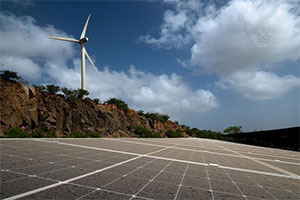 Renewable Energy in Cabo Verde. Credit: UN Photo/Mark Garten
A green economy is an economic model that aims to reduce environmental risks and build a sustainable future. Many of the UN SDGs seek to facilitate a green economy, such as ensuring access to affordable and reliable clean energy, building sustainable cities and communities, and implementing urgent action to combat climate change. Various key negotiations have strived to achieve a green economy, such as the Green New Deal and the Inflation Act of 2022. COP30, held in Belém, Brazil in 2025, agreed to mobilize $1.3 trillion annually for climate action and launched the Belém Mission to 1.5°C. However, the conference was not able to develop a fossil fuel reduction roadmap. Recent years have witnessed a sharp transformation in the geopolitical landscape of international sustainability cooperation. In March 2025, the United States stepped back from formal multilateral support for the SDGs, while China is on the rise as an international leader in renewable energy production. The actions of these global powers may shape shifting alliances on environmental governance. IPS is dedicated to sharing timely news on international developments in building a sustainable future.

The Week with IPS

NEXT STOP - SDGs
Tracking global progress towards a sustainable world
Tracking global progress towards a sustainable world
