Languages
Thursday, September 17, 2026



News and Views from the Global South
Green Economy

How to Green Uganda’s Cities
Locals in Kampala, Uganda’s capital, always have two or three things to say in a conversation about how the city is developing. Some say it is filthy because of the growing waste; others say it is a slum because of its unplanned settlements; and then there are those who say it is just plain inconvenient because of the traffic congestion created by the boda boda (motorcycle taxis) and commuter taxis that honk incessantly as they make their way along the streets.
Fixing the Crisis of Confidence in the Green Climate Fund
The Green Climate Fund's mandate couldn't be more crucial: accelerating climate action in developing countries by supporting transformational investments in adaptation and emissions reduction.
Q & A: Why Switching to Renewable Energy Sources is No Longer a Matter of Morality, But of Economics
When the Global Green Growth Institute (GGGI) was founded eight years ago, the general public thought that renewable energies would never replace oil and coal. Today, the tables have turned.
Q&A: Why Young and Smart Greenpreneurs are the Future of Sustainable Development
Young people – a growing population segment in developing countries – are intrepid innovators and entrepreneurs who can help solve pressing climate and development challenges today.
The Revolutionary Ambition of AGRF 2018 Must be Sustained
In early September 2018, about 2,800 delegates from 79 countries and high-level dignitaries, including current and former heads of states, international agencies, CEOs of global corporations and youth entrepreneurs, and techies involved in agriculture gathered in Kigali for this year’s African Green Revolution Forum (AGRF).
First Steps Towards a Global Agreement on the High Seas
The world’s first efforts to develop a way to govern the high seas – international waters beyond the 200 nautical mile national boundary – is truly underway. The initial round of negotiations at the United Nations has just ended after two weeks of talks.
Q&A: Achieving Sustainable Goals: “In the End it is All About People. If People Want, it Will Happen.”
Today just over two billion people live without readily available, safe water supplies at home. And more than half the world’s population, roughly 4.3 billion people, live in areas where demand for water resources outstrips sustainable supplies for at least part of the year.
“Running Out Of Time” – Local Communities Mobilise for the Climate
Local communities across the globe have risen up to demand commitments on climate change, as frustration mounts over the lack of action.
Law of the Sea Convention Expands to Cover Marine Biological Diversity
Responding to a persistent demand by developing countries, the conservation community and science, the UN General Assembly has commenced a process for bringing the areas beyond national jurisdiction in the oceans under a global legally binding regulatory framework.
UN Begins Talks on World’s First Treaty to Regulate High Seas
After several years of preliminary discussions, the United Nations has begun its first round of inter-governmental negotiations to draft the world’s first legally binding treaty to protect and regulate the “high seas”—which, by definition, extend beyond 200 nautical miles (370 kilometers) and are considered “international waters” shared globally.
Climate Change Becomes a Reality Check for the North
“This season, the month of May was particularly hot and dry,” says Leo De Jong, a commercial farmer in Zeewolde, in Flevopolder, the Netherlands. Flevopolder is in the province of Flevoland, the largest site of land reclamation in the world. Here a hectare of land costs up to 100,000 Euros. “At the moment, we are spending between 20,000 and 25,000 Euros per week on irrigation.”
Maya Farmers in South Belize Hold Strong to Their Climate Change Experiment
In one of Belize’s forest reserves in the Maya Golden Landscape, a group of farmers is working with non-governmental organisations to mitigate and build resilience to climate change with a unique agroforestry project.
New Rules for High Seas Must Include Needs of Poorest Nations
Over-fishing, warming oceans and plastic pollution dominate the headlines when it comes to the state of the seas. Most of the efforts to protect the life of the ocean and the livelihoods of those who depend on it are limited to exclusive economic zones – the band of water up to 200 nautical miles from the coast.
How Guyana Must Prepare to Cope With the ‘Jeopardies and Perils’ of Oil Discovery
Recent huge offshore oil discoveries are believed to have set Guyana– one of the poorest countries in South America–on a path to riches. But they have also highlighted the country’s development challenges and the potential impact of an oil boom.
How Safe Drinking Water in Rural Vanuatu Will Save Women Time While Aiding in Economic Development
Access to safe water for drinking and an adequate supply of water for other purposes is challenging in the rural areas of Vanuatu. A new project, that uses solar water pumping technology, will save time and energy for rural women whose task it is to collect and make water more accessible to their communities.
Fledgling Venture Aims to Make Money from Cutting Food and Packaging Waste
To tackle food waste, Nicholas Lim did not simply spread the word among his friends and family. In an experiment to see if he could make a viable business out of the problem, he co-founded an online platform that allows individuals, eateries and voluntary welfare organisations to order discounted groceries that would otherwise be thrown away.
Mixed Signals as Guyana Develops its Green Economy Strategy
Guyana is forging ahead with plans to exploit vast offshore reserves of oil and gas, even while speaking eloquently of its leadership in transitioning to a green economy at a recent political party congress addressed by the country's president.
New Relationship Evolves Between Society and Energy in Brazil
“We want to make history," agreed the teachers at the Chiquinho Cartaxo Comprehensive Technical Citizen School. They are the first to teach adolescents about generating power from bad weather in the semi-arid Northeast region of Brazil.
Sousa, a Solar Power Capital in an Increasingly Arid Brazil
Sousa, a municipality of 70,000 people in the west of Paraíba, the state in Brazil most threatened by desertification, has become the country's capital of solar energy, with a Catholic church, various businesses, households and even a cemetery generating solar power.
Why We Need Decentralized Renewable Energy to Power the World
As the energy sector is transforming, there is a growing consensus that sustainable energy is a catalyst for achieving most Sustainable Development Goals (SDGs): it is crucial for better health, education, jobs, food production and conservation, as well as water use and quality.
The Sun Powers a Women’s Bakery in Brazil’s Semi-arid Northeast
“The sun which used to torment us now blesses us," said one of the 19 women who run the Community Bakery of Varzea Comprida dos Oliveiras, a settlement in the rural area of Pombal, a municipality of the state of Paraiba, in Brazil's semi-arid Northeast.« Previous Page — Next Page »


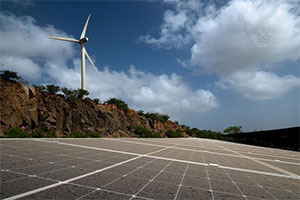 Renewable Energy in Cabo Verde. Credit: UN Photo/Mark Garten
A green economy is an economic model that aims to reduce environmental risks and build a sustainable future. Many of the UN SDGs seek to facilitate a green economy, such as ensuring access to affordable and reliable clean energy, building sustainable cities and communities, and implementing urgent action to combat climate change. Various key negotiations have strived to achieve a green economy, such as the Green New Deal and the Inflation Act of 2022. COP30, held in Belém, Brazil in 2025, agreed to mobilize $1.3 trillion annually for climate action and launched the Belém Mission to 1.5°C. However, the conference was not able to develop a fossil fuel reduction roadmap. Recent years have witnessed a sharp transformation in the geopolitical landscape of international sustainability cooperation. In March 2025, the United States stepped back from formal multilateral support for the SDGs, while China is on the rise as an international leader in renewable energy production. The actions of these global powers may shape shifting alliances on environmental governance. IPS is dedicated to sharing timely news on international developments in building a sustainable future.

The Week with IPS

NEXT STOP - SDGs
Tracking global progress towards a sustainable world
Tracking global progress towards a sustainable world
