Languages
Tuesday, September 15, 2026



News and Views from the Global South
Green Economy

Q&A: How to Transition One of the Fastest-Growing Economies in the World to a Green Growth Model
Driven by garment exports, tourism and construction, Cambodia has sustained an average growth rate of 7.7 percent between 1995 to 2017, making this Southeast Asian nation the sixth fastest-growing economy in the world.
Diversifying Crops to Help Overcome Drought in Brazil
Dozens of trucks used to leave São Gonçalo every day, carrying the local agricultural production, mainly coconuts, to markets throughout Brazil, including the cities of Rio de Janeiro and São Paulo, more than 2,000 kilometers away.
Africa’s Giant Blue Economy Potential
With good reason, Africa is excited over the prospects of sharing in the multi-trillion maritime industry, with the continent’s Agenda 2063 envisioning the blue economy as a foremost contributor to transformation and growth.
The Caribbean Island of Mayreau Could be Split in Two Thanks to Erosion
As a child growing up in Mayreau four decades ago, Filius “Philman” Ollivierre remembers a 70-foot-wide span of land, with the sea on either side that made the rest of the 1.5-square mile island one with Mount Carbuit.
South Korea Looks at How to Accelerate its Transition to Renewable Energy
While major countries have pledged to be powered entirely by renewable energies in order to stop greenhouse gas emissions by 2050, there are a number of states that are investigating ways to implement this transition quickly in order to achieve their goals ahead of this deadline.
“Governments are Starting to See that Organic Food Policy Works”
Many countries and farmers around the world are not readily making the switch to organic farming. But the small Himalayan mountain state of Sikkim, which borders Tibet, Nepal and Bhutan, is the first 100 percent organic farming state in the world.
Is the United Nations in Kenya Fit For Purpose?
The United Nations globally is witnessing some of the most ambitious reforms led by the UN Secretary General Mr. Antonio Guterres. Most relevant to us in Kenya is the entire reform of the development system and how the UN will adapt to a fast-changing development environment.
Q&A: Ready to Help India Access Climate Finance for a Greener Economy
Even in remote and faraway places such as Andamans and Nicobar and Lakshadweep, islands off the coast of India, the government is keen to provide electricity across the entire country.
Rwanda Action Plan Aims to Make Cities Green
An ambitious programme aimed at developing six green secondary cities in Rwanda is underway and is expected to help the country achieve sustainable economic growth through energy efficiency and green job creation.
Big Brands Are Fuelling the Business of Nutrition
Food is an increasingly hot topic, no matter if you are rich or poor. Malnutrition – including undernutrition, overweight and obesity – affects 1 in 3 people around the world.
Youth in Latin America Learn About Paths to Clean Energy
Young Peruvians plan to take advantage of the knowledge acquired in Brazil's semi-arid Northeast to bring water to segments of the population who suffer from shortages, after sharing experiences in that ecoregion on the multiple uses of renewable energies in communities affected by climatic phenomena.
Supporting Morocco’s Quest to Close USD24 Billion Green Investment Gap
Science has increasingly made it clear that the world is on an unsustainable growth model where economic development is occurring at the expense of the environment. The need for a well-balanced approach has therefore become a necessity rather than a luxury.
A New IFC Vision for Greening Banks in Emerging Markets
The International Finance Corporation is rapidly greening its portfolio. This past fiscal year, 36 percent of our own accounts and mobilization supported climate-smart projects — up from 12 percent a decade ago. Since May, we have been applying a carbon price to all project finance investments in the cement, chemicals, and thermal power sectors, at $40-80 per metric ton.
Women & Youth Key to Achieving Agenda 2030 in South-South Cooperation
By 2050 Africa will have 830 million young people. Many countries in the global south, India included are seeing a youth(men and women) bulge. To reap a demographic dividend countries in the global south need to share and exchange knowledge to leapfrog socio-economic transformation.
Helping Ethiopia Achieve Green Growth and Avoid Industrialised Nations’ Environmental Mistakes
As Ethiopia undergoes a period of unprecedented change and reform, the Global Green Growth Institute(GGGI) is partnering with the Ethiopian government to try and ensure this vital period of transition includes the country embracing sustainable growth and avoiding the environmental mistakes made by Western nations.
Students Go Green to End Global Energy Poverty
In Africa, over 640 million people – almost double the population of United States – have no access to electricity, with many relying on dirty sources of energy sources for heating, cooking and lighting. While not offering a solution to the electricity gap in Africa, Brian Kakembo Galabuzi, a Ugandan economics student, can offer a cleaner and cheaper solution.
Indonesia Unveils Low Carbon Development Framework
Indonesia is convinced that low carbon development and a green economy are key to further boosting economic growth without sacrificing environmental sustainability and social inclusivity.
Rwanda Leverages Green Climate Fund’s Opportunities to Fast-Track Sustainable Development
In a move to achieve its green growth aspirations by 2050, Rwanda has placed a major focus on promoting project proposals that shift away from "business as usual" and have a significant impact on curbing climate change while attracting private investment.
Consumption & Emissions: Rich Indians v/s Rich (& Poor) Americans
The growing consumption of the ‘rich’ in ‘poor’ countries has been a running theme in the climate change debate for some time now. A large majority of opinion makers in developed countries, especially the US, are convinced that rising consumption of the rich in the developing world is responsible for climate change.
Leveraging the Potential for Green Growth in Vulnerable Countries
In May the United Nations Secretary General Antonio Guterres announced next year’s summit on climate. This assertion has given the Global Green Growth Institute international momentum, which was reflected in the events of the 73rd session of the United Nations General Assembly (UNGA) in New York City.
Going Full Circle for Growth and the Planet
The business case for making our economy more sustainable is clear. Globally, transitioning to a circular economy - where materials are reused, re-manufactured or recycled-could significantly reduce carbon emissions and deliver over US$1 trillion in material cost savings by 2025.(1) The benefits for Asia and the Pacific would be huge. But to make this happen, the region needs to reconcile its need for economic growth with its ambition for sustainable business.« Previous Page — Next Page »


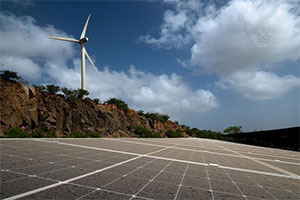 Renewable Energy in Cabo Verde. Credit: UN Photo/Mark Garten
A green economy is an economic model that aims to reduce environmental risks and build a sustainable future. Many of the UN SDGs seek to facilitate a green economy, such as ensuring access to affordable and reliable clean energy, building sustainable cities and communities, and implementing urgent action to combat climate change. Various key negotiations have strived to achieve a green economy, such as the Green New Deal and the Inflation Act of 2022. COP30, held in Belém, Brazil in 2025, agreed to mobilize $1.3 trillion annually for climate action and launched the Belém Mission to 1.5°C. However, the conference was not able to develop a fossil fuel reduction roadmap. Recent years have witnessed a sharp transformation in the geopolitical landscape of international sustainability cooperation. In March 2025, the United States stepped back from formal multilateral support for the SDGs, while China is on the rise as an international leader in renewable energy production. The actions of these global powers may shape shifting alliances on environmental governance. IPS is dedicated to sharing timely news on international developments in building a sustainable future.

The Week with IPS

NEXT STOP - SDGs
Tracking global progress towards a sustainable world
Tracking global progress towards a sustainable world
