Languages
Tuesday, November 17, 2026



News and Views from the Global South
Labour
ARGENTINA: Guardians of the River
"There is no water...there are no fish," says Olga Ledesma, her skin weathered from 40 years of small-scale fishing, as the boat slowly winds its way along a branch of the Paraná river, South America’s second-longest river.
ARGENTINA: Women Create Food and Jobs in Wetlands
Wearing a cap and a white apron, Melina Lucero cuts the heads and tails off fish caught in the Paraná River, before skilfully filleting them. Her co-workers will process and package the fish to sell as traditional, small-scale fish preserves at food fairs along the banks of the river in Argentina.ECONOMY-MEXICO: Analysts Warn of Knock-On Effects
Mexico's economy is wobbling because of the financial problems in its northern neighbour, with which it is closely interlinked. Unemployment is up, companies have put their plans on ice, the government has stopped putting out tenders, remittances from migrants are down, and exports have shrunk.LABOUR-ASIA: Migrant Women’s Success Adds To Brain Drain
Liana Garcellano was teaching in a private school here in the Philippines when she got an offer to teach English in Singapore. Though quite happy with her job in her home country, the promise of higher pay and career advancement spurred Garcellano to try her luck overseas.DEVELOPMENT: Social Cost of Migration Hits Women, Families
Carla Danao is hit by guilt and pain every time she comes home to the Philippines for a visit. This was especially true in August, when she returned to realise that she had been far away and unavailable for her 12-year-old daughter when she had her first menstrual period.WORLD: Fair Trade – An Old Idea That’s Become a Fashion Statement?
The idea of making trade fair is as old as ethics itself.LABOUR: Abuse, Alienation Daily Fare for Women Migrants
Sexual abuse, harassment, poor living conditions and disconnection with their families and own cultures - these are real-life stories that Sharu Joshi Shrestha hears from many Nepali, Bangladeshi and Sri Lankan women migrants who come to her office each day.
ECONOMY: It Pays to Go Green
A new report shows how a greener economy could eradicate poverty by creating tens of millions of new jobs. But it will not happen solely through the market's "magic hand".
SOUTH AFRICA: Nurse Shortage Cripples Health System
In the impoverished informal settlement of Du Noon, 20 kilometres north of Cape Town, sick residents rely on a single clinic staffed by six nurses to meet their health needs.
POLITICS-US: Labour Stakes Hopes on Obama Presidency
After losing over a million jobs in the manufacturing industry in the last eight years, U.S. labour leaders are saying no more to another Republican administration.ECONOMY-KENYA: Shady Deals and Intrigues Haunt Privatisation
The Kenya Railways Corporation was more than a national utility. It was a repository of Kenya’s history, beginning in the 19th century when indentured Indian labourers were brought to the East African region to build the Kenya-Uganda railway line.SOUTH PACIFIC: Cherry Picking Labour
Doubts remain over the "development" potential - promoted by the government and farmers - of a recently-announced scheme which will see Pacific islanders handed temporary working visas to pick Australian fruit.
DEVELOPMENT-ETHIOPIA: Understanding Poverty's Impact on Children
When the school bell rings, Alemtsehay and her three younger sisters rush home to change out of their school uniforms and into tattered clothes to go out begging around Bole Road, one of Addis Ababa's smarter areas.
POLITICS-ANGOLA: Economy Weighing On Voters’ Minds
Angola's economy may be booming on the back of high oil prices and strong diamond exports, but six years after a peace deal ended the 27-year civil war, unemployment stands at around 65 percent.COLOMBIA: Justice on Strike
Some 34,000 judicial sector employees in Colombia began an indefinite strike Wednesday, demanding labour stability, the enforcement of a new salary scheme, and guarantees of independence for the courts.CHILE: Salmon Farm Workers Left Out in the Cold
While non-governmental organisations appreciate the Chilean government's efforts to improve hygiene and environmental conditions in the salmon industry, they are calling for an end to the expansion of salmon farming and solutions for thousands of workers who lost their jobs because of a crisis in the sector.EU: For European People Too
Several events over the past year have raised fundamental questions about whether the European Union's primary mission is to ensure the smooth operation of an economic bloc or to ensure a decent quality of life for its 490 million citizens.
Q&A: "The U.S. Election Is Going to Be Won at the Margins"
Michigan is a key state either presidential nominee needs to win the White House on Nov. 4. Unlike Democratic nominee Barack Obama, John McCain has carried Michigan before when he ran against President George Bush.
SRI LANKA: ‘Animal Tracks’ Lead Villagers Out of Poverty
An impoverished village in southern Sri Lanka is slowly pulling out of poverty by churning out terra cotta moulds of animal footprints for tea connoisseurs all over the world.ECONOMY-US: Activists Target Corporate Chiefs' Tax Subsidies
U.S. taxpayers shell out 20 billion dollars a year to pad business chiefs' earnings and to prop up the world's most lopsided corporate pay scales, say activists seeking to highlight inequality in this election year.
BOLIVIA: Businesses Take On the Green Challenge
What do Bolivia's largest textile mill, an organic cacao cooperative and an indigenous-run tourist hostel in the Amazon have in common? The answer lies in the path, shaky but inspiring, that they are all taking towards sustainable production.« Previous Page — Next Page »


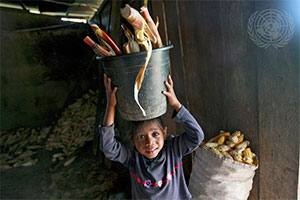 Timorese Girl with Fresh-Picked Corn. Credit: UN Photo/Martine Perret
A global common denominator is the need for a decent job. The economic realities of each country determine just how difficult it is to find one. Despite the labour movement's achievements, serious challenges persist: gender discrimination, child labour, worker migration, the digital divide and AI automation, evaporating pensions, unsafe workplaces, corporate pressure against union organising, negative impacts of trade agreements, and the precariousness of informal employment. The 2025 UN SDG Report identifies jobs and social protections as one of the six priority areas requiring urgent action, with progress either stalled or reversing in many developing nations.
In recent years, the fight to protect labour equality has taken on new dimensions with the rise of Environmental, Social and Governance standards. With the Social aspect aiming to promote equality and human rights, ESG principles have strengthened labour advocacy within corporate and governmental regulatory landscapes. In particular, ESG has become much more institutionalized in emerging economies such as Brazil and China. IPS follows the world’s workers as they confront these challenges - their setbacks and their successes.

The Week with IPS

NEXT STOP - SDGs
Tracking global progress towards a sustainable world
Tracking global progress towards a sustainable world
