Languages
Wednesday, November 18, 2026



News and Views from the Global South
Labour
LABOUR-IRAN: May Day Rally Reveals Deep Discontent
Deep discontent with unemployment, low wages, shortcomings in labour laws and suppression of workers' unions were all too visible at the well-attended May Day rally at Tehran's Shiroudi Stadium.MAY DAY-US: Wal-Mart Skirting Labour Protections
The retail giant Wal-Mart exploits weak U.S. labour laws to prevent union formation and violates the fundamental human rights of its U.S. workers, says a report released Monday on the eve of the May Day labour holiday.MAY DAY-PERU: Striking Miners to March on Lima
Peru’s miners began an indefinite strike Monday demanding respect for labour rights. Their main complaint is against the outsourcing of jobs, as 80 percent of the 100,000 workers in the mining industry - the backbone of the economy – are affected by the phenomenon of subcontracting and outsourcing.Q&A: “You Have to Work Nine to Ten Times Harder Than a Male Farmer”
As activists focus on the challenges facing workers this May Day (May 1), Martha Moside is calling for attention to be paid to the situation of female subsistence farmers in South Africa.MAY DAY-BOLIVIA: New Style Work Force
The May 1 Labour Day marches in the Bolivian capital were a memorable sight two decades ago, a real celebration of workers' unity, led by thousands of helmeted miners carrying their drills. But today the workers' movement is a shadow of its former self, and the present generation of workers, out of necessity, are dispersed in new kinds of occupations.MAY DAY-KENYA: Export Processing Zones Still a Bone of Contention
With working conditions around the world set to be placed in the spotlight on May Day (May 1), Emily Mugo has an axe to grind about her place of employment - in one of Kenya's Export Processing Zones (EPZs).MAY DAY-MALAYSIA: New Law Targets Traffickers, Not Victims
Malaysia has tabled a tough new anti-human trafficking bill that punishes offenders with up to 20 years in prison, but rights activists, who had fought for such a law for a decade, say the bill's success depends heavily on effective enforcement.MAY DAY: Of All, Russian Unions Begin to Lose Members
Squeezed between political change and budgetary difficulties, federal and regional trade unions are beginning to lose large numbers of active members. At many workplaces unions simply do not exist.LABOUR-JAPAN: Xenophobia May Hamper Economic Growth
Junko Nakayama, 56, refuses to believe that the number of foreigners arrested for crimes is decreasing as per statistics released by the National Policy Agency.LABOUR-SPAIN: Immigrants’ Plight Ignored by Unions Ahead of May Day
The conditions faced by immigrants in Spain, who despite their contribution to the economy are the most vulnerable when it comes to labour rights, have not even been mentioned in the demands and grievances voiced by the country's trade union federations as they prepare for May 1, International Labour Day.RIGHTS-BRAZIL: Homeless Join Month of Protests
The Homeless Workers Movement (MTST) blocked three access roads into Sao Paulo on Wednesday, continuing a month-long struggle during which they have invaded a large number of buildings and unoccupied urban sites in several state capitals.LABOUR-INDIA: Worker-Turned-Owners Revive Failing Tea Estates
Faced with unemployment in their failing tea estates, about two years ago, tea pluckers in the rolling highlands of this southern state responded by forming cooperatives to buy out their former employers Tata Tea and turn the gardens into profitable enterprises.LATIN AMERICA: Justice for Women in Mens’ Courts?
Men still dominate the justice system in Latin America, especially the highest-level positions, says a new study presented at an international seminar in the Argentine capital.HEALTH-PARAGUAY: Hello Rome, Goodbye Dengue!
The corridors in Paraguay's Hospital de Clínicas are crammed with dozens of patients with symptoms of dengue waiting for treatment, but in the nurses' station they are having a party. Mirian López, a registered nurse with several years' experience in intensive care, has just found out that she has a job waiting for her in Italy.EDUCATION-IRAN: Ahmadinejad Flunks on Teachers' Strike
An attempt to suppress a prolonged teachers' agitation against low wages, through intimidation and mass arrests, may result in the impeachment of education minister Mahmoud Farshidi, a key member of President Mahmoud Ahmadinejad's cabinet.SRI LANKA: Labour Shortages Plunge Tea Estates Into Doldrums
Once Sri Lanka's sunshine crop and its top export earner, tea is no longer the answer to the country's economic ills, thanks to a serious shortage of plantation workers that began with the mass expulsion of 'Indian Tamils' in the 1960s.EL SALVADOR: Spanish Firm Advocates, Then Breaks Labour Laws
The Spanish tuna-fishing and processing company Grupo Calvo has been accused of serious anti-union practices in El Salvador. The paradox is that Calvo had insisted that this Central American country approve labour laws required by the European Union (EU) for the purpose of obtaining tariff exemptions, as a condition for continuing to invest here.BRAZIL: Women Turning Backs on Information Technology Studies
Women are increasingly abandoning information technology courses in Brazil, in line with a global tendency, warns the Brazilian Computer Society (SBC) and women professors in the field.POPULATION: Aging, But Not Obsolete
The U.N. Commission on Population and Development, meeting in New York this week, is discussing how to harness the untapped potential of older persons to strengthen families, communities and nations.BRAZIL: Continued Turbulence Ahead in Air Traffic Crisis
Brazil's air transport crisis, caused by an air traffic controllers' strike, is not yet over. The crisis has also opened up two additional battle fronts for President Luiz Inácio Lula da Silva: discontent among the military, and the looming threat of a parliamentary inquiry.ECONOMY-INDIA: After Violence SEZs Downsized
Faced with growing opposition from its political opponents as well as civil society, the Indian government has drastically limited the size and use of special economic zones (SEZs) that are meant to attract foreign direct investments and promote exports.« Previous Page — Next Page »


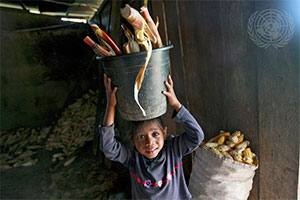 Timorese Girl with Fresh-Picked Corn. Credit: UN Photo/Martine Perret
A global common denominator is the need for a decent job. The economic realities of each country determine just how difficult it is to find one. Despite the labour movement's achievements, serious challenges persist: gender discrimination, child labour, worker migration, the digital divide and AI automation, evaporating pensions, unsafe workplaces, corporate pressure against union organising, negative impacts of trade agreements, and the precariousness of informal employment. The 2025 UN SDG Report identifies jobs and social protections as one of the six priority areas requiring urgent action, with progress either stalled or reversing in many developing nations.
In recent years, the fight to protect labour equality has taken on new dimensions with the rise of Environmental, Social and Governance standards. With the Social aspect aiming to promote equality and human rights, ESG principles have strengthened labour advocacy within corporate and governmental regulatory landscapes. In particular, ESG has become much more institutionalized in emerging economies such as Brazil and China. IPS follows the world’s workers as they confront these challenges - their setbacks and their successes.

The Week with IPS

NEXT STOP - SDGs
Tracking global progress towards a sustainable world
Tracking global progress towards a sustainable world
