Languages
Tuesday, October 6, 2026



News and Views from the Global South
Labour
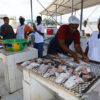
Turning the Tide: How West Africa Is Reasserting Its Food Sovereignty Through Aquaculture
It is an indictment on the global food system that, despite having some of the richest and most endowed natural resources in the world and a burgeoning youth population, West Africa spends more than $2 billion a year importing aquatic foods to feed its people, almost half of which is spent by Côte d’Ivoire alone.
Extreme Heat Undermines Decent Work in North Eastern Kenya
By 9 a.m. on a Wednesday, Hawa Hussein Farah is already watching the temperature climb. Awake since 6 a.m., she has prepared her three children for school before walking them to class and heading to Suuq Mugdi, an open-air market in Garissa town, to buy the fruit she will sell.
Africa at the Epicenter of Child Labour Crisis as Migration Fuels Exploitation
Although global rates of child labour have declined since 2020, the practice remains a serious and persistent violation of children’s rights, undermining their safety, social development, and long-term economic stability. These risks are intensified by structural pressures— poverty, climate shocks, protracted conflict, and unsafe migration— that continue to push vulnerable children into crisis, and in some cases, trafficking and exploitation. The United Nations Children’s Fund (UNICEF) warns that African countries remain among the most affected regions, underscoring the urgent need for coordinated policy action, cross-border cooperation, and sustained investment to protect children on the move and those at risk of labour exploitation.
Trade Liberalisation Undermines Development
Despite lacking both evidence and theory, many economists claim trade liberalisation accelerates development. But only a few economies have gained many jobs from external market access.
Protecting Africa’s Ocean Future and Why a Precautionary Pause on Deep-sea Mining Matters
The world is entering a decisive period for the future of the ocean. With the High Seas Treaty coming into force and meaningful progress being made on the World Trade Organization Agreement on Fisheries Subsidies, global momentum for stronger marine governance is building. Yet, new pressures linked to the push for deep-sea mining — the extraction of minerals from seabed thousands of meters below the ocean surface — threaten to undermine these gains. To safeguard progress, global decision-making will have to keep pace with such emerging risks. In this context, Africa will host several global discussions in 2026, including those that will shape the ocean's future, with a series of opportunities for leadership starting with the African Union Summit in February to the Our Ocean Conference in Mombasa, Kenya in June.
Talent Wasted: Afghanistan’s Educated Women Adapt Under Taliban Restrictions
Young women in Afghanistan’s capital, Kabul, are trying their hands at unfamiliar tasks in embroidery, tailoring and designing beads in market stalls. Many should instead have been sitting at desks writing computer software or reporting news, the fields they trained for.
‘Since the Coup, Factory Employers Have Increasingly Worked with the Military to Restrict Organising and Silence Workers’
CIVICUS speaks to the Business and Human Rights Centre (BHRC) about labour rights abuses in Myanmar’s garment industry since the 2021 military coup.

One Carries a Broom, the Other a Schoolbag
While other children her age prepared for school, eight-year-old Tania once began her workday. Each morning, she picked up a jharu—the household broom—and cleaned floors inside a private home. At the same time, another child of her age in that household lifted a schoolbag and left for class. One carried a broom. The other carried books.
UN Restructuring May Result in Over 2,600 Staff Reductions in the Secretariat and 15 Percent in Budgetary Cuts
The UN Staff Union is on edge -- hoping for the best and expecting the worse -- as the General Assembly will vote on a proposed programme budget for 2026 by December 31.
‘We Need a New Global Legal Framework That Rethinks Sovereignty in the Context of Climate Displacement’
CIVICUS discusses climate displacement and Tuvalu’s future with Kiali Molu, a former civil servant at Tuvalu’s Ministry of Foreign Affairs and currently a PhD candidate at the University of the South Pacific in Fiji and the University of Bergen in Norway. His research focuses on state sovereignty and climate change in the Pacific.
Continued Inaction Despite G20 Report on Worsening Inequality
Although inequality among countries still accounts for a far greater share of income inequality worldwide than national-level inequalities, discussions of inequality continue to focus on the latter.
As COP30 Takes Place, Can Africa Draw Lessons from Brazil on How It Develops Its Livestock Sector?
As the world gathers in Brazil for the UN climate talks, the country’s livestock sector - one of the largest in the world - is understandably in the spotlight.
The World Social Summit in Doha: Time to Act
Qatar hosted the Second World Summit for Social Development from 4–6 November. According to the United Nations, more than 40 Heads of State and Government, 230 ministers and senior officials, and nearly 14,000 attendees took part. Beyond plenaries and roundtables, more than 250 “solution sessions” identified practical ways to advance universal rights to food, housing, decent work, social protection or social security, education, health, care systems and other public services, international labor standards, and the fight against poverty and inequality.
Syria’s Fragile Transition Threatened by Severe Aid Shortfalls and Increasing Abductions, UN Warns
Eleven months after the fall of the Assad regime, Syria continues to grapple with severe instability as the country navigates a turbulent political transition. Rates of displacement have surged, and humanitarian organizations are struggling to support large numbers of refugees returning home. In recent weeks, the United Nations (UN) has documented numerous cases of enforced disappearances and abductions, calling for stronger accountability measures as the transition continues to unfold.
The Top Climate Leaders Are Now in The Global South
When world leaders now gather in Belém, Brazil for the UN climate conference, expectations will be modest. Few believe the meeting will produce any breakthroughs. The United States is retreating from climate engagement. Europe is distracted. The UN is struggling to keep relevant in the 21st century.
From Slogans to Systems: Five Practical Steps for Turning Social Development Commitments into Action at Doha and Beyond
Thirty years ago, world leaders gathered in Copenhagen and made a promise: people would be at the center of development. This November, Heads of State and Government will meet again in Doha, Qatar, for the Second World Summit for Social Development or WSSD2.
Children’s Education Must Be Put At The Forefront of Climate Discussions At COP30
In 2024, the climate crisis has disrupted schooling for millions of students worldwide, weakening workforces and hindering social development on a massive scale. With extreme weather patterns preventing students from accessing a safe, and effective learning environment, the United Nations (UN) and the Geneva Global Hub for Education in Emergencies (EiE Hub) continue to urge the international community to assist the most climate-sensitive areas in building resilient education systems that empower both students and educators.
Data Centre Investments Bad Deals
Opposition to data centres (DCs) has been rapidly spreading internationally due to their fast-growing resource demands. DCs have been proliferating quickly, driven by the popularity of artificial intelligence (AI).
When Taliban Shut Down the Internet, Women Lost their Lifeline to Aid, Education & Each Other
When the Taliban recently cut off the Internet and phone networks across Afghanistan, millions of women and girls were silenced. For those with connectivity, the blackout severed their last link to the outside world – a fragile connection that had kept education, work, and hope alive.
Are Youth-led Revolutions in South Asia a Cause for Concern?
In the Global South, where people under the age of 18 comprise more than 50 percent of the population, youth activism is increasing rapidly. Youngsters are more agile and volatile than older people, less restrained by family, prestige and work. However, many suffer from marginalisation, lack of employment, and poverty. Furthermore, insecurity and limited life experience make young people an easy target for manipulating and unscrupulous politicians, criminal networks, and religious fanatics.
African Voices at UNGA80: Building Sustainable and Self-Reliant Systems Through Innovation
On September 24, African-led organizations convened a high-level side event during the 80th session of the United Nations General Assembly (UNGA80) The event - African-led Innovation: Shaping Sustainable Futures With or Without Aid - was organized in partnership with eHealth Africa, Population Services International (PSI), Population Council, and Reach Digital Health. The dialogue amplified voices from African-led organizations and highlighted the importance of homegrown innovations for sustainability—regardless of the availability of foreign aid—amid shrinking donor funding and widening global inequalities.« Previous Page — Next Page »





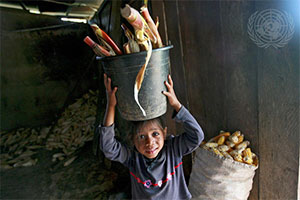 Timorese Girl with Fresh-Picked Corn. Credit: UN Photo/Martine Perret
A global common denominator is the need for a decent job. The economic realities of each country determine just how difficult it is to find one. Despite the labour movement's achievements, serious challenges persist: gender discrimination, child labour, worker migration, the digital divide and AI automation, evaporating pensions, unsafe workplaces, corporate pressure against union organising, negative impacts of trade agreements, and the precariousness of informal employment. The 2025 UN SDG Report identifies jobs and social protections as one of the six priority areas requiring urgent action, with progress either stalled or reversing in many developing nations.
In recent years, the fight to protect labour equality has taken on new dimensions with the rise of Environmental, Social and Governance standards. With the Social aspect aiming to promote equality and human rights, ESG principles have strengthened labour advocacy within corporate and governmental regulatory landscapes. In particular, ESG has become much more institutionalized in emerging economies such as Brazil and China. IPS follows the world’s workers as they confront these challenges - their setbacks and their successes.

The Week with IPS

NEXT STOP - SDGs
Tracking global progress towards a sustainable world
Tracking global progress towards a sustainable world
