Languages
Monday, November 16, 2026



News and Views from the Global South
Gender
CUBA: Women Farmers Bring Innovation to the Mountains
When Odaly Aroche set out from the mountains of Topes de Collantes in central Cuba to see what other women farmers were doing in San Andrés, 380 km west of her home, her neighbours told her she was crazy. But that didn’t stop her.DEVELOPMENT-AFRICA: Better Education Improves Health of Mothers and Children
A new UNICEF report reveals there is still much to be done to reduce infant and maternal mortality in sub-Saharan Africa. Failure to improve care for pregnant women and newborns threatens to undermine progress on all health-related development goals.HEALTH-NEPAL: On Course to Achieve MDG on Maternal Health
Impoverished Nepal has dramatically reduced maternal mortality cases from 540 per 100,000 live births in 2001 to the present 280 - a feat experts attribute chiefly to the legalisation of abortion.ETHIOPIA: Political Space Narrowing
Bertukan Mideksa has a reputation in Ethiopia as a competent politician, but voters will not be able to cast ballots for her in the next national election. The revocation of her 2007 pardon has sent a chill through Ethiopia's opposition parties.DEVELOPMENT: Africa May Face ‘Centuries’ of Poverty
Extreme poverty will continue to blight sub-Saharan Africa for another 200 years unless action to overcome it is intensified, a new report has suggested.
IRAN: ''I Want to Present a Different View of the Women in My Country''
The U.S. government's calls for civil society to work for "regime change" in Iran has increased pressure on activists on the ground who are engaged in a peaceful process of improving their society and addressing social problems, according to Sussan Tahmasebi, a prominent women's right activist in Iran who has not been allowed to leave the country for the past two years.SOUTH AFRICA: Community Gardens Contribute to Food Security
A few years ago 66-year-old grandmother Regina Fhiceka and her family of five ate vegetables only once a week. They would survive on maize and bread the rest of the time - the cheapest food available in the poor township of Philippi, just 15 minutes from the affluent business district of Cape Town.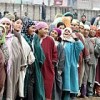
INDIA: Kashmiri Women Repose Faith in Electoral Politics
With voting for the provincial elections in Indian Kashmir safely over, observers say that what was remarkable about the process - apart from its relative peacefulness - was the active participation of women in a Muslim-majority state.
Q&A: Paraguayan Indigenous Minister Calls for Patience
Margarita Mbyvângi, the first indigenous woman to hold a ministerial post in Paraguay, is facing charges of ineffectiveness from among her own ranks. But she is asking for time to achieve her goal: that no one will suffer the slavery and rootlessness that she experienced for nearly 20 years.SRI LANKA: Women Pray for Sons, Husbands Caught in Civil War
As the Sri Lankan army pushes deeper into Tamil rebel-held territory hundreds women can only pray that their sons and husbands, believed held captive by the Liberation Tigers of Tamil Eelam (LTTE), are spared.
Q&A: Failure to Translate Women’s Legal Rights into Action
Each year, for 16 days in December, the world’s focus shifts towards taking action against gender-based violence. Governments and civil society organisations raise awareness around women’s rights and lobby for gender equality. But activists lament that little action is taken throughout the rest of the year and women’s legal rights often fail to be implemented and put to action.Q&A: "We Should Go Beyond Development Aid" Vis-a-vis Africa
"Portugal does not own the European Union’s strategy for Africa, but we do feel a special affection for that continent and recognise that our relationship with them is unlike that with any other region in the world."GENDER-KENYA: Renewed Campaign to Protect Women's Land Rights
Pressure is mounting to include a National Land Policy that ensures equal access to land between women and men in Kenya's new constitution.RIGHTS-SPAIN: Human Traffickers’ Assets to Be Seized
The Spanish government announced a new plan Friday to combat human trafficking, which includes a measure for the immediate seizure of the assets of anyone convicted of involvement in such activities, in particular, those who force foreign women into prostitution.
DOMINICAN REPUBLIC: A Place for Eco-Coffee
Communities in 10 southern provinces of the Dominican Republic are feeling the benefits from the collective activities of small growers of organic coffee. Women participate in the production and sale of the coffee, and their sons and daughters are pursuing studies in order to improve the sector's productivity.
FILM-LIBERIA: The Women Who Ended a War
One night, in a country swept up in a long and harrowing armed conflict, Liberian social worker Leymah Gbowee dreamt that she gathered women together to pray for peace.MEXICO: Supreme Court Debates Transsexual’s Right to Privacy
When transsexuals or transgender persons in the Mexican capital have their birth certificates altered to reflect their change in identity, is it legal to include a notation on the new document indicating that Ms Y used to be Mr X?SWAZILAND: Fighting Gender Violence With Financial Freedom
When a Swazi women's rights organisation noticed that many women continue to stay in violent relationships because they are financially dependent on their abusive partners, they knew something had to change. They started self-help groups that assist women in breaking away from gender-based violence (GBV) by gaining financial muscle.ZAMBIA: Violence Against Women on the Rise
"There will be no peace, security and sustainable economic development in Zambia as long as women’s rights continue to be treated as a secondary issue," said Non-Governmental Organisation Coordination Committee (NGOCC) chairperson Marian Munyinda.HEALTH-LATIN AMERICA: Women Crusaders Against Epidemics
With cutting-edge science, social organisation and a strategy that puts an emphasis on prevention and environmental controls, Cristina Díaz and her team checked the spread of dengue in Cuba, while María Monroy did the same with Chagas’ disease in Guatemala.POLITICS-US: “No Surrender” for Hardline Abortion Foes
While the "March for Life - held annually on Jan. 22, memorialising the United States Supreme Court's 1973 Roe v. Wade decision - has always been one of the high points of the year for anti-abortion organisations and activists, next month's 36th annual gathering may be a much more somber affair.« Previous Page — Next Page »


Women make up half the world's population, but don't nearly share half of the world's wealth, well-being and opportunity. Two-thirds of the world poor are women, disproportionally exposing women to precarious living conditions, disease and unmitigated natural disasters. The media, meanwhile, remains a male-dominated sector in much of the world, contributing to women's voices lacking a crucial amplifier to put their concerns on political agendas and unleash the development potential of their ingenuity. Rather than then stereotypical victims of local and global forces, women are also organizer, innovators, conservators and community builders. These are some of their stories.

The Week with IPS

NEXT STOP - SDGs
Tracking global progress towards a sustainable world
Tracking global progress towards a sustainable world
