Languages
Sunday, October 11, 2026



News and Views from the Global South
Gender

Population Denialism is Reminiscent of Climate Denialism
A new study estimates that global heating will push billions of people outside the comfortable range of temperature and weather in which we have evolved.
Chile: New Constitution in the Hands of the Far Right
On 7 May, Chileans went to the polls to choose a Constitutional Council that will produce a new constitution to replace the one bequeathed by the Pinochet dictatorship – and handed control to a far-right party that never wanted a constitution-making process in the first place.
Interview with Anniwaa Buachie – The Making of a Ghanaian Short Film
Some movie scenes keep replaying in one’s mind long after one has left the cinema, and this is certainly true of Moon Over Aburi, a short film shot in Ghana that has been gaining accolades since its release earlier this year.
Finding Ways to Feed South Africa’s Vast Hungry Population
In the deep rural village of Jekezi in South Africa's Eastern Cape, most young and able-bodied people have fled the area, leaving behind people with disabilities, the elderly, and children.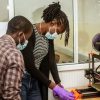
Young Woman Ignites a 3D Printing Revolution in The Gambia
In the heart of The Gambia, an intrepid young woman called Fatou Juka Darbor is blazing a trail for women fuelled by her fiery passion for STEM (Science, Technology, Engineering and Mathematics).
EXPLAINER — Maternal Mortality: Why Has Progress In Saving Women’s Lives Stalled?
A new report reveals that from 2000 to 2015, the global maternal mortality ratio (MMR) fell by 33%, and by more than 50% in 58 countries that had the highest rates of women dying during pregnancy or up to 42 days after delivery. But from 2016 to 2020, maternal mortality barely changed. In 2020, roughly 287,000 women globally died from a maternal cause, which is almost 800 maternal deaths daily, and about one every two minutes.
Parliamentarians Ask G7 Hiroshima Summit to Support Human Security and Vulnerable Communities
Parliamentarians from more than 30 countries agreed to send a strong message to the G7 Hiroshima Summit in Japan later this year, focusing on human security and support of vulnerable communities, including women, girls, youth, aging people, migrants, and indigenous people, among others.
A “New” Saudi Arabia? Changes on the Screen and in Reality
The World changes, though prejudices and misconceptions remain. In 1996, political scientist Samuel Huntington published The Clash of Civilizations and the Remaking of World Order, in which he predicted that people’s cultural and religious identities would become the primary source of conflict in a Post–Cold War World. Huntington’s allegations have been contradicted by a number of critics, among them American Palestinian professor Edward Said, who lamented their extreme cultural determinism, which omitted the dynamic interdependency and interaction of cultures. Said’s own Orientalism depicted a generalised “Western view” of Arab cultures as “static and undeveloped”, while European culture was considered to be “developed, rational, flexible, and superior.” Literature and movies have depicted Arabs as exotic men riding camels and horses through the desert, and their women as dangerously seductive objects of male desire. Eventually, the exotic men turned in to being terrorists, and/or depraved oil-rich magnates, while Muslim women were presented as veiled, enigmatic, and oppressed.
Women’s Cooperatives Work to Sustain the Social Fabric in Argentina
Nearby is an agroecological garden and a plant nursery, further on there are pens for raising pigs and chickens, and close by, in an old one-story house with a tiled roof, twelve women sew pants and blouses. All of this is happening in a portion of a public park near Buenos Aires, where popular cooperatives are fighting the impact of Argentina's long-drawn-out socioeconomic crisis.
Three Imprisoned Iranian Women Journalists Awarded 2023 UNESCO/Guillermo Cano World Press Freedom Prize
Niloofar Hamedi, Elaheh Mohammadi and Narges Mohammadi have been named as the laureates of the 2023 UNESCO/Guillermo Cano World Press Freedom Prize, following the recommendation of an International Jury of media professionals. The awards ceremony took place on the evening of May 2 in New York, in the presence of Audrey Azoulay, Director General of UNESCO.
How the Rise of Timor-Leste’s Aquaculture Sector Is a Blueprint for Other Small Island Nations
For Timor-Leste, as with most other islands in the Pacific, fortunes are to be found in fish – an equity food available to all regardless of status.
To Confront Our Current Crises, It’s Time to Put Our Money Where Our Mouth Is
The finance sector’s role in the current global crises – notably climate, biodiversity, and food security – is significant. Polluting activities and environmentally-destructive practices for short-term economic gains have catapulted us to our current untenable situation. We're ‘sawing off the branch we’re sitting on’ by sacrificing life-giving ecosystem services for profit, and that branch is sagging and splitting under our weight.
“Defending Human Rights Is a Crime in Some Countries and a Deadly Activity in Others”
In today's world, human rights defenders face immense challenges, with threats, attacks, and repression being rampant in many countries. According to the latest report by Front Line Defenders, killings of rights defenders increased in 2022, with a total of 401 deaths across 26 different countries. Despite the adoption of the UN Declaration on Human Rights Defenders 25 years ago, the threats faced by defenders persist globally.
Star Wars Director Sharmeen Obaid-Chinoy — Symbolises A Litany of Firsts For Women
The announcement by Lucas film’s president, Kathleen Kennedy, about the upcoming three new live-action Star Wars films was enough for lawyer Maliha Zia to get euphoric.
The Last Mile to Malaria Elimination: Confronting Gender Inequalities & Power Dynamics
For centuries, malaria has remained one of the deadliest diseases, inflicting great suffering on families and perpetuating the cycle of poverty in many communities and nations. The African region currently accounts for 95% of malaria cases and 96% of malaria deaths globally, with women and girls disproportionately affected by the disease.
Global Solidarity Needed to Address Taliban’s Attacks on Women’s Rights
Matiullah Wesa’s crime was to try to ensure young people got an education in Afghanistan. His recent forceful abduction by the Taliban offers the latest stark reminder that global solidarity and coherent action from the international community are needed to prevent the complete loss of the rights of women and girls in Afghanistan.
Poland Abortion Laws: Repression of Reproductive Rights and Out of Sync – Activists
“People want the abortion laws here liberalised. Society has changed; even the politicians can see it,” Kinga Jelinska, a Polish reproductive rights activist, says. “In four or five years, I believe, the abortion laws here will be liberalised, because it’s what the people support.”
Ending Discrimination Against Women in Family Law is Vital for Economic Progress
Discriminatory family laws and policies that restrict women’s access to educational opportunities, employment, inheritance, property ownership and equal pay, are making women disproportionately vulnerable to the impacts of the global economic downturn.
Andean Indigenous Women’s Knowledge Combats Food Insecurity in Peru
Paulina Locumbe, a 42-year-old peasant farmer who lives in the Andes highlands of southern Peru, learned as a child to harvest and dry crops, one of the ancestral practices with which she combats the food insecurity that affects millions in this Andean country.
Our Wonderful Differences Enriches Societies
When is too much Autism awareness still not enough? This thought recurs every April as we near World Autism Day on April 2, and parents reach out to me after reading enthusiastic and well-meaning news and journal articles – which are actually harmful and hurtful.
CIVICUS Report Exposes a Civil Society Under Attack
As conflict and crises escalate to create human emergencies that have displaced over 100 million people worldwide, civil society’s vital role of advocating for victims and monitoring human rights cannot be over-emphasised.« Previous Page — Next Page »





Women make up half the world's population, but don't nearly share half of the world's wealth, well-being and opportunity. Two-thirds of the world poor are women, disproportionally exposing women to precarious living conditions, disease and unmitigated natural disasters. The media, meanwhile, remains a male-dominated sector in much of the world, contributing to women's voices lacking a crucial amplifier to put their concerns on political agendas and unleash the development potential of their ingenuity. Rather than then stereotypical victims of local and global forces, women are also organizer, innovators, conservators and community builders. These are some of their stories.

The Week with IPS

NEXT STOP - SDGs
Tracking global progress towards a sustainable world
Tracking global progress towards a sustainable world
