Languages
Saturday, October 17, 2026



News and Views from the Global South
Economy & Trade

Historic Inter-American Court Ruling: A Game-Changer for Environmental Defenders?
The Inter-American Court of Human Rights has issued one of the most progressive climate justice decisions of our time. Its historic Advisory Opinion on the climate emergency and human rights, released on July 3, 2025, was unequivocal: States have legal obligations under international human rights law to reduce, prevent, and address climate damage, including reining in big polluters.
Africa’s Development at a Crossroads: Report Warns of Missed SDG Targets Without Urgent Action on Jobs, Equity, and Financing
Africa is making progress on over two-thirds of the Sustainable Development Goals (SDGs), but the pace remains far too slow to meet the 2030 targets, especially in areas like decent employment, gender equality, and access to social protection.
‘After Decades of Making Huge Profits, Companies Shouldn’t Be Allowed to Leave Behind a Toxic Legacy’
CIVICUS speaks with Matthew Renshaw, a partner at a UK law firm that represents Nigerian communities taking legal action against Shell over environmental damage caused by its operations in the Niger Delta.

Forests, Fossil Fuels, and the Fight for the Future: DRC’s Oil Expansion Sparks Global Alarm
The Democratic Republic of Congo (DRC) stands on the precipice of a profound environmental and social crisis, as the government prepares to auction 55 new oil blocks that cover more than half the country’s landmass.
Bullying Southeast Asia with Tariff Threats
US President Trump has successfully used tariff threats to achieve economic, political and even personal goals. These threats, reminiscent of colonialism, have secured submission and concessions.
Mining on the Rise as Clean Energy Demands Shifts Global Commodity Exports
Two-thirds of the developing world, or ninety-five out of 143 economies, are dependent on commodities for export value, making up 60 percent of their merchandise exports. For the least developed world, this number rises to 80 percent, leaving entire nation's revenue vulnerable to price swings, fiscal shocks, and evolving trade compositions. Hidden behind the numbers lies a deeper transformation, one disrupting fossil fuel trade, triggering a higher reliance on mineral exports, particularly on mining essential for green technologies.
How Clustering Multilateral Environmental Agreements Can Bring Multiple Benefits to the Environment
The UN80 Initiative, unveiled in March by Secretary-General António Guterres, is a system-wide effort to reaffirm the UN’s relevance for a rapidly changing world.
To Tackle Microplastic Pollution from Synthetic Textiles, Rebuild Natural Fibre Markets
Plastic pollution has emerged as one of the most pressing environmental challenges of our time. Since the mid-20th century, over 8 billion metric tons of plastic have been produced globally (UNEP, 2021). Shockingly, more than 90% of this plastic waste has not been recycled. Instead, it has been incinerated, buried in landfills, or leaked into the environment where it can persist for hundreds of years, fragmenting into microplastics.
Biogas, a Solution to Poultry Pollution in El Salvador
Still in its early stages and with few players, the poultry sector in El Salvador is taking small steps toward environmentally sustainable production by using its biological waste to generate biogas and, in turn, electricity –an equation that benefits the natural environment, communities, and the farms themselves.
Climate Pressures are Redefining Macroeconomic Resilience in Asia & the Pacific
In the past year, Asia and the Pacific has faced intensifying climate pressures, from extreme heat in Bangladesh and India to devastating floods in northern Thailand and rising food insecurity across the Pacific.
Clean Energy Sources Are Beginning to Overtake Fossil Fuels, But Is It Too Late?
As a result of the worsening climate crisis, extreme weather patterns have disrupted nearly all aspects of human life around the world. With the impacts of fossil fuel reliance being more pronounced than ever before, the United Nations (UN) has implored governments and industries to begin adopting more sustainable, renewable energy sources.
From Haor to Brickfields
 Nikli Upazila, located in the Kishoreganj district of Bangladesh, is part of the haor region, a vast wetland ecosystem characterized by bowl-shaped depressions. This unique geography subjects the area to significant climatic challenges, particularly recurrent flooding. The haor region, including Nikli, experiences a subtropical monsoon climate with distinct wet and dry seasons. During the monsoon season, heavy rainfall often leads to extensive flooding. Flash floods have become increasingly unpredictable and severe in recent years, causing substantial damage to agricultural lands and affecting the livelihoods of local communities. These people, trapped by water and driven by poverty, journey from the Haor to brickfields, where their lives become an endless cycle of hardship.

Global Food Demand in Middle-Income Nations is Rising, UN Report Says
As incomes rise in middle-income countries, so does the demand for animal-sourced calories, resulting in large increases to global food production, and raising the importance for sustainable agriculture amidst growing concerns of climate change.
Kenyan Biochar Project Becomes First in Africa Validated Under European Carbon Standard
In June 2025, Kenyan climate-tech firm Tera became the first African project developer to have its carbon removal initiative independently validated and registered under Riverse, a European standard for engineered climate solutions.
Global South calls for Strategic Energy Transition Amidst SDG Target Slowdowns
At the UN 2025 High Level Political Forum last week, global energy leaders warned that without urgent action in expanding access to clean energy, hundreds of millions will remain vulnerable, and the world will risk falling short of its 2030 SDG deadline.
Advancing Circular Solutions for EV Battery Waste in Asia and the Pacific
The Asia-Pacific region is becoming a showcase for regional solutions. As electric vehicles (EVs) rapidly gain traction, the region must confront a dual challenge: managing the environmental and health risks of end-of-life EV batteries, while actively pursuing the economic and technological opportunities of a circular economy.
Soaring Demand for Electric Vehicles, Lithium-Ion Batteries Creates Environmental Crisis in DRC
Electric vehicles contribute to an ongoing environmental and humanitarian crisis in the Democratic Republic of the Congo (DRC). Mining operations cause deforestation, pollution, food insecurity and exploitative labor practices.
Humans Have Blown Past 6 of 9 ‘Planetary Boundaries’: Governments Alone Won’t Fix This
Nearly ten years after the Paris Agreement — a legally binding commitment to reduce greenhouse gas emissions — the gap between climate goals and government actions remains stubborn.
From Ads to AI: How Big Tech Took Over Everything
“The power of AI carries immense responsibilities. Today, that power sits in the hands of a few,” said UN Secretary-General Antonio Guterres at the 2025 AI Action Summit, reflecting on a deepening reality as we inch closer to a world in complete digital domination. Today, seven of the world's top ten most valuable companies are digital giants, focusing primarily on the output of communication, digital manufacturing, artificial intelligence and digital commerce, which is paving the way for a fully digitized life for all.
China is the Driving Force Behind More, Newer Renewable Energies in Latin America
China, with its investments, products, technology, and innovation focused on solar and wind farms in Latin America and the Caribbean, as well as on electricity networks and services, stands out as a driving force for the region's shift toward energy less reliant on fossil fuels and increasingly cleaner and greener.
From Drylands to Dignity: How Solar Energy and Climate-Smart Farming Are Empowering Communities in Burkina Faso
In the heart of Burkina Faso’s drylands, in the village of Zoungou, a quiet transformation is underway. Alhaji Birba Issa, a smallholder onion farmer, bends over neat rows of lush green crops, the hum of solar-powered pumps audible in the background.« Previous Page — Next Page »





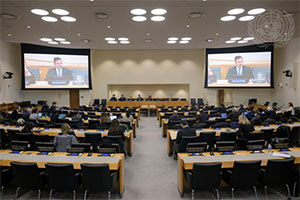 UN Commission on International Trade Law Holds Colloquium on Harmonizing Law in Age of Digital Trade and Finance. Credit: UN Photo/Manuel Elías
Trade has historically been a geopolitical tool that can both be used to propel development as well as entrench inequalities. In various nations in East Asia and Latin America, increased trade, as often seen in export booms, has allowed them to achieve influential standings within the global economy. On the other hand, many low-income countries in Sub-Saharan Africa, Asia, and Latin America struggle to maintain a robust trade performance, and oftentimes are subjugated to exploitative trade dynamics through intense extraction of their natural resources. In recent decades, international trade has reached a new era as emerging economies across the world are rising in economic preeminence. Stable international trade is crucial to world peace as global interconnectedness facilitates reliable diplomacy. Nevertheless, significant challenges are on the rise. Notably, a major wave of United States tariff escalations in January 2025 lifted US import taxes to their highest level since the 1930s, changing market dynamics and forcing renegotiations with global trading partners.These articles are aimed at informing readers about the complexities of trade and its varying effects on development, with a special focus on the consequences of the global economic crisis, the potential of fair trade and the gender implications of trade policies.
Updated by Yilan Batista and Shuli Wong August 2026

The Week with IPS

NEXT STOP - SDGs
Tracking global progress towards a sustainable world
Tracking global progress towards a sustainable world
