Languages
Friday, September 25, 2026



News and Views from the Global South
Energy
COP30: New Faces, Old Issues: What Must Change if Global Climate Talks Are to Deliver Justice for Africa
Three decades after the first Climate COP, the multilateral climate process – which was intended to serve as an instrument of justice and a guardian of the planet’s atmosphere – has fallen far short of its goals.
COP30: The Real Solution to Climate Change Could be Through International Law
At COP15, the developing countries were calling for the temperature to not rise above 1.5 degrees and they ignored the Copenhagen Accord which agreed to 2.0 degrees
A Unified Oceanic Commitment to Tsunami Preparedness
On a quiet July morning in Severo-Kurilsk, a coastal town in the East of the Russian Federation, the sea began to retreat unnaturally fast. Within minutes, tsunami sirens blared and 2,700 residents evacuated to higher ground. Waves up to five meters inundated the port and fish factory, but no lives were lost. The town’s survival reflected years of investment in early warning systems, community drills, and resilient infrastructure. The 2025 Kamchatka tsunami demonstrated what preparedness can achieve when science, governance, and community action align.
As COP30 Nears, We Need All Effective Climate Solutions
A new global study has challenged a key assumption in climate planning: that the planet’s geological “carbon vault” is vast enough to hold all the carbon dioxide (CO₂) we might one day choose to bury underground after we remove it from the atmosphere. It isn’t.
Financing Tropical Forests now is a COP30 Solution that’s Already Working
As the world prepares for COP30 in Belém, all eyes are on Brazil’s proposed Tropical Forests Forever Facility (TFFF)—a bold plan to reward countries for keeping forests standing. It represents a vital part of the long-term vision we need for global forest protection.
Data Centre Investments Bad Deals
Opposition to data centres (DCs) has been rapidly spreading internationally due to their fast-growing resource demands. DCs have been proliferating quickly, driven by the popularity of artificial intelligence (AI).
The Time for a Decade of Island Resilience is Now
As biodiversity loss including ocean degradation, pollution and climate change threaten our planet, islands, and particularly global small island nations, often don't get the spotlight they deserve. Often labeled as vulnerable, the world’s small island nations are in fact powerful beacons of resilience.
The Dangers of Green Mining
Even amidst the regressive resistance of the current U.S. administration, the world is shifting toward a green energy future. As governments pledge to phase out fossil fuels, companies tout electric vehicles, and financiers pour billions into solar, wind and batteries, it seems the necessary transition from fossil fuels to clean energy is finally picking up pace.
New Climate Goal: To Quadruple Sustainable Fuels
Quadrupling the production and use of sustainable fuels by 2035 is the goal of a new international initiative to drive energy transition and mitigate the climate crisis, which will be launched during Brazil's climate summit in November.
Guiding Disaster Risk-Reduction Investments Through AI-Powered Tools
The theme of this year’s International Day for Disaster Risk Reduction, “Fund Resilience, Not Disasters,” called for the urgent need to shift from reactive spending on recovery to proactive investment in disaster risk reduction.
Moldova’s Democratic Defiance
Democracy was the winner and Russia the loser in Moldova’s 28 September election. The incumbent pro-Europe Party of Action and Solidarity (PAS) won a parliamentary majority on just over half of the vote, while support for a pro-Russia coalition collapsed to a record low. The result came in the face of Russia’s most intense attempt yet to influence an election, with a propaganda and disinformation operation allegedly orchestrated by Ilan Shor, a disgraced Moldovan oligarch who fled to Russia to escape jail time for his role in a massive fraud.
No African Development from Western Trade Policies
The World Bank’s 1981 Berg Report provided the blueprint for structural adjustment, including economic liberalisation in Africa. Urging trade liberalisation, it promised growth from its supposed comparative advantage in agriculture.
From Storm to Strength: Odisha’s “Zero Casualty” Model for Community-Centered Disaster Resilience
South Asia is home to nearly two billion people and ranks among the most disaster-prone subregions in Asia and the Pacific. Every year, millions face exposure to floods, cyclones and other extreme events. The Bay of Bengal alone accounts for nearly 80 per cent of global cyclone-related deaths, with storms striking Bangladesh, India and Sri Lanka with growing frequency.
Are Youth-led Revolutions in South Asia a Cause for Concern?
In the Global South, where people under the age of 18 comprise more than 50 percent of the population, youth activism is increasing rapidly. Youngsters are more agile and volatile than older people, less restrained by family, prestige and work. However, many suffer from marginalisation, lack of employment, and poverty. Furthermore, insecurity and limited life experience make young people an easy target for manipulating and unscrupulous politicians, criminal networks, and religious fanatics.
It’s Past Time to Make Polluters Pay
I was 16 years old when Super-Typhoon Haiyan tore through my community in Eastern Samar in the Philippines. It remains one of the deadliest storms in history, killing more than 6,000 people and displacing millions. My community lost everything: Loved ones, family homes and land, our ways to earn a living and rebuild, and our sense of safety all vanished overnight.
An Overdose of Renewables, New Energy Risk in Brazil
Wind and solar power sources, essential for the energy transition to mitigate the climate crisis, have become a risk of power outages in Brazil.
UN80 – Is it time for the Re-emergence of the Global Ministerial Environment Forum?
“We shall have to do more with less” was the summary message from a meeting in Oslo, Norway, this spring (2025), where the Minister of Foreign Affairs of Norway, Espen Barth Eide and Guy Ryder, Under-Secretary-General for Policy at the UN and Chair of UN80, both spoke about UN80 and the necessity to reform the UN.
Frontline of a Planetary Emergency: Africa Demands Climate Justice and Action
The room at the Swiss Inn Nexus Hotel in Bole was silent but tense as Sunita Narain, one of the world’s most influential environmental voices, fixed her gaze on rows of African journalists, scientists, and policymakers. Her tone was gentle, but the words cut deep.
Better Use of the World’s Expertise in Navigating the Polycrisis
Other articles in this series on clustering conventions that are addressed by the Triple Environmental Crisis of pollution (Stanley-Jones), biodiversity (Schally) and climate change (Azores) I have touched on the idea of clustering not only conventions but the science-policy bodies established separately to serve them. We address the question of the negative consequences of maintaining status quo and identify how “consolidating knowledge” might make a difference.
Mexico Experiments With Residential Solar Panels, But They Are Still Insufficient
Over the past four months, Mexican researcher Nicolás Velázquez has paid around US$23 for electricity, thanks to the photovoltaic system installed in his home in the northern city of Mexicali.
‘Angola produces large quantities of oil and diamonds, yet most people don’t see the benefits’
CIVICUS discusses recent protests in Angola with Florindo Chivucute, founder and executive director of Friends of Angola, a US-based civil society organisation established in 2014 that works to promote democracy, human rights and good governance in Angola.
« Previous Page — Next Page »


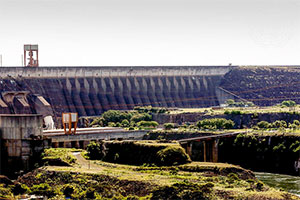 UN Power Plant, Paraguay. Credit: UN Photo/Evan Schneider
Energy has posed a great challenge for economies around the world. As global energy consumption skyrockets throughout the years, so does the need for sustainable solutions. The Sustainable Development Goals are essential in providing people with access to safe, affordable, and sustainable energy sources that minimize harm on the planet. Progress towards these goals opens the door for an advancement in modernization for communities on a global level and allows for a potential mitigation of tensions between nations.
The UN’s Summit of the Future in 2024 offered new initiatives that are being taken to achieve these goals, including a decreased reliance on fossil fuels, a switch to renewable energy sources, and improved climate financing.
IPS is well positioned to provide relevant, insightful, and compelling analysis of recent updates and measures being taken around the world to achieve a cleaner future.

The Week with IPS

NEXT STOP - SDGs
Tracking global progress towards a sustainable world
Tracking global progress towards a sustainable world
