Languages
Sunday, November 29, 2026



News and Views from the Global South
Food and Agriculture
GUATEMALA: Devoured by Malnutrition
The ambulance pulls off the road, just where a steep rocky track leads up to the remote Guatemalan village of Shumpá. The health professionals' mission is to save the life of a malnourished two-year-old girl.JAPAN: Economic Reforms Breed Young Underclass
Japan's much acclaimed economic recovery means little to Masami, 24, who has been hopping jobs for the past five years after giving up plans to attend university because his father was ailing.NEPAL: Aid Must Double to Even Approach MDGs
Nepal needs to double its foreign aid to 7.9 billion US dollars if it wants to achieve the Millennium Development Goals (MDGs)set out by the United Nations, but more cash alone will not solve the country's development needs.DEVELOPMENT: Hunger Due to Injustice, Not Lack of Food
Millions of people die of hunger-related causes every year. However, that is not because of actual shortages of food, but is a result of social injustice and political, social and economic exclusion, argue non-governmental organisations that launched a campaign in Spain on World Food Day Monday.SOUTHERN AFRICA: Fighting Hunger May Not Always Require Food
Several studies in Southern Africa show that the direct transfer of cash to people living on or below the breadline not only prevents hunger, but also further impoverishment.SOUTH ASIA: Meeting MDGs Requires Better Basic Services
Nine years ago Nepal's health ministry set up two health posts in remote Dhugesadh village, where the nearest hospital is a three to four day walk away. Till today, no doctors have arrived to staff them.LATIN AMERICA: Cozinha Brasil Goes Regional
A successful Brazilian programme aimed at fighting hunger and reducing waste of food will be expanded throughout Latin America, by means of an agreement with the United Nations Food and Agriculture Organisation (FAO).HEALTH-NEPAL: Custom, Ignorance Breed Severe Malnutrition
In Nepal's western terai (plains) districts, a silent epidemic is brewing. Children and women are racked by diseases arising from malnutrition and anaemia-not because of a lack of food but because of faulty food habits and traditional customs, say health workers in the region.NEPAL: Selling Daughters Into Bondage May End
With a young daughter in her lap, Sudhani Chaudhary, 30, carefully picks freshly harvested corn inside a small mud hut in Deukhuri Valley of Nepal's south-western Dang district. One of her four young daughters, not quite aged 10, lives in a distant town working as a housemaid for a family, she says. "I am told she is attending school.''DEVELOPMENT: Real Aid to LDCs Declining
Meeting last year in Gleneagles, Scotland, the G8 group of rich countries pledged to make African debt relief, accelerated aid, and increased trade their top priorities. One year later, most of those initiatives have not borne fruit. The only part of the programme running according to schedule is debt relief, which can look very good on paper but translates into very little improvement on the ground.DEVELOPMENT: From “Survival or a Better Life”, to Survival and a Better Life
At the recent meeting of the Global Environment Facility (GEF) held in Cape Town, South Africa, the key word was "partnership".NEPAL: Peace Comes Piecemeal for NGO Workers
A tall lanky youth rounds a bend in a mountain path and sees a group, stripped of their packs, resting in the shade of a tree near a small waterfall. He approaches, says hello and shakes hands with those nearest and then stretches and even clambers up a small incline to clasp hands with everyone, rare behaviour in this remote hill region.NEPAL: Undying Hunger in the Hinterland
Here on the narrow trails carved into the steep, emerald hills that plunge into the winding Karnali River hundreds of metres below, villagers have one thing on their minds: emergency rice.AFGHANISTAN: Drought, Poppy Profits Cause Wheat Shortage
Millions of Afghans are facing hunger because of a food shortage that the government and aid agencies say is because of a prolonged dry spell in the country.TRADE-INDIA: Rare Unity Against West’s Farm Subsidies
Setting aside ideological divisions, observers in India have endorsed the government's decision to quit the Doha development round of the World Trade Organisation, rather than compromise on the issue of the West's agricultural subsides that endanger the livelihoods of hundreds of millions of farmers in India and other developing countries.NEPAL: Emergency Food Op Starved for Donors
Scepticism among potential donors could ground a United Nations plan to deliver emergency food aid to villagers in Nepal's drought-hit northwest.DEVELOPMENT-AFRICA: To End Hunger – More Aid, Quicker Aid, Smarter Aid
Global aid agency Oxfam has called for a thorough review of efforts to end hunger in Africa, arguing that emergency assistance is often inadequate and arrives too late - while the underlying causes of hunger are going largely unaddressed.INDONESIA: Water Scarcity Dries Up Rice Growers’ Livelihoods
At the age of 60, Wilhemus Handur should have been enjoying his retirement. Instead, the father of seven has to think hard how to earn enough money to buy rice for his family's daily consumption.CUBA-U.S.: Faith Groups Tell Bush to “Love Thy Neighbour”
As the United States again toughens its sanctions against Cuba, in what the Fidel Castro government says amounts to a "declaration of war," another caravan organised by the inter-faith foundation Pastors for Peace arrived in the island nation's capital with 100 tonnes of humanitarian aid.VENEZUELA-COLOMBIA: Refugees and Marginalised Share Help and Hardship
Despite occasional rivalries between Colombians and Venezuelans, the armed conflict in Colombia has renewed the links of brotherhood and solidarity between these two "Bolivarian" nations, known as such because both claim Simón Bolívar as hero of independence from Spain.RIGHTS: An Empty Stomach? Tell It to the UN!
Citizens may soon be able to complain to the United Nations when their governments are not treating them well - if these administrations have agreed to a host of new economic, social and cultural rights, that is.« Previous Page — Next Page »


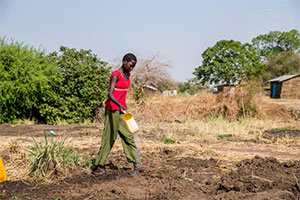 Farming on the Outskirts of Juba. Credit: UN Photo/JC McIlwaine
Promoting human and planetary health is a central focus of the United Nations, as laid out in the 2030 Sustainable Development Goals (SDGs). World hunger and unsustainable farming practices continue to be pressing concerns for the world. According to the 2025 State of Food Security and Nutrition in the World report by the Food and Agriculture Organization (FAO), 673 million people faced hunger in 2024. There are stark regional disparities, with the FAO projecting that 60% of the world population facing hunger will reside in Africa by 2030. Globally, the prevalence of food insecurity has remained consistently higher for women than men.
Sustainable and efficient national food systems are essential in preserving health, education, environmental well-being, peace, economy, and security. However, creating sustainable food systems can be a challenging endeavor, as food production takes a heavy toll on the environment. The agricultural sector accounts for a significant portion of greenhouse gases. Finding safe, sustainable, and ethical strategies to feed the world is crucial in ensuring planetary longevity. A recent initiative from 2023, the EU Regulation on Deforestation-free Products (EUDR), seeks to advocate for sustainable food systems. The main driver of deforestation is the expansion of agricultural land used to produce commodities like cattle, wood, cocoa, coffee, etc. The EUDR is part of the 2020 European Green New Deal and the EU Biodiversity Strategy for 2030 and aims to limit Europe’s consumption of products linked with deforestation by requiring that companies prove that their products are deforestation-free. Despite aiming to achieve major strides in sustainability, policies such as EUDR also raise socioeconomic concerns for targeted countries. Many emerging Latin American economies are impacted by the policy, and have raised the question of how developing countries can grapple with the tensions between economic development and advancing sustainability.
IPS has been at the forefront of providing compelling and insightful stories on communities facing hunger as well as the cost of food production. IPS uses statistics from FAO, the World Food Programme (WFP) and the International Fund for Agricultural Development (IFAD) to bring relevant and hard-hitting facts to readers. This gathering of information and data from such organizations helps bring the best stories from IPS journalists working in the different regions in consultation with experts on the ground.

The Week with IPS

NEXT STOP - SDGs
Tracking global progress towards a sustainable world