Languages
Tuesday, November 17, 2026



News and Views from the Global South
Humanitarian Emergencies
Huge Health Needs for World’s One Billion Migrants
With an estimated 1 billion migrants today --or one in every seven people-- their health needs are huge. Nevertheless, health systems are struggling to adapt and consequently access to health services among migrant populations varies widely and is often inadequate.
Unrest Brings North-East Nigeria Next to Starvation
Years of violence and unrest in North-East Nigeria have left millions of people at risk of starving to death. Both the violent up surging of Boko Haram and the government’s harsh military crackdown have left already historically marginalised communities with next to nothing.
Humankind’s Ability to Feed Itself, Now in Jeopardy
Mankind’s future ability to feed itself is in jeopardy due to intensifying pressures on natural resources, mounting inequality, and the fallout from a changing climate, warns a new United Nations’ report.
South Sudan Declares Famine, Other Countries May Follow Warns UNICEF
South Sudan Monday became the first country to declare famine since 2012, as UNICEF warned that 1.4 million children are at risk of dying from starvation with famine also imminent in Nigeria, Somalia, and Yemen.
Red Tape Snarls Nepal’s Ambitious Poverty-Alleviation Plans
Juna Bhujel of Sindupalchowk District, 85 kilometres northeast of Nepal’s capital Kathmandu, lost her daughter-in-law in the Apr. 25, 2015 earthquake. Fortunately, she managed to rescue her two-year-old grandson, who was trapped between her mother’s body and the rubble.
Worst Drought in Decades Drives Food Price Spike in East Africa
The most severe drought in decades, which has struck parts of Ethiopia and is exacerbated by a particularly strong El Niño effect, has led to successive failed harvests and widespread livestock deaths in some areas, and humanitarian needs have tripled since the beginning of 2015, the United Nations warns.
Mistrust Hindering Global Solutions, says Secretary General
The global lack of confidence and trust is undermining the ability to solve the world’s complex problems, said UN Secretary-General during an international conference.
Ravaging Drought Deepens in Kenya
Experts warn that Kenya is in the grip of the worst drought in recent history as government estimates show the number of people who are acutely food insecure has risen to 2.7 million, up from two million in January.
No Hidden Figures: Success Stories Can Help Girls’ STEM Careers
What makes a young girl believe she is less intelligent and capable than a boy? And what happens when those children face the ‘hard’ subjects like science, technology, engineering and mathematics (STEM)? A recent study, ‘Gender stereotypes about intellectual ability emerge early and influence children’s interests’ showed that by the age of 6, girls were already less likely than boys to describe their own gender as ‘brilliant’, and less likely to join an activity labelled for ‘very, very smart’ kids.
Supporting Local Organisations: A Syrian Perspective
Just 0.2 percent of humanitarian funding goes directly to local and national NGOs, according to a major UN review of humanitarian financing published ahead of the 2016 World Humanitarian Summit.
New, Aggressive Rust Imperils Wheat Crops in Europe, Africa, Asia
Wheat rust, a family of fungal diseases that can cause crop losses of up to 100 per cent in untreated susceptible wheat, is making further advances in Europe, Africa and Asia, according to two new studies produced by scientists in collaboration with the United Nations.
Europe Urged to Address ‘Tragic’ Loss of Lives in Mediterranean
European leaders should take decisive action to address the tragic loss of life on the Central Mediterranean route and the deplorable conditions for migrants and refugees in Libya, urged two major United Nations agencies dealing with migrants and refugees.
Families of the “Disappeared” Search for Clandestine Graves in Mexico
Juan de Dios is eight years old and is looking for his younger sister, Zoe Zuleica Torres Gómez, who went missing in December 2015, when she was only five years old, in the northeastern state of San Luis Potosí. He is the youngest searcher for clandestine graves in Mexico.
Kenyans Turn to Wild Fruits and Insects as Drought Looms
Too hungry to play, hundreds of starving children in Tiaty Constituency of Baringo County instead sit by the fire, watching the pot boil, in the hope that it is only a matter of minutes before their next meal.
Insecurity Fuelling Food Shortages in Lake Chad Basin: UN Coordinator
Children under five years of age are not surviving due to severe food shortages in some parts of the Lake Chad region, says Toby Lanzer, UN Assistant Secretary-General and Regional Humanitarian Coordinator for the Sahel.
Drought Could Cost Sri Lanka Billions
The warnings are stark, the instructions, for a change, clear. Sri Lanka is heading into one of its worst droughts in recent history, and according some estimates the worst in 30 years. The reservoirs are running on empty, at 30 percent or less capacity. Only 12 percent of the island’s power generation is currently from hydropower and 85 percent comes from thermal, with a staggering 41 percent from coal.
Trump to Pull Out of the UN, Expel It from the US?
So far, Donald Trump’s first decisions as president of the United States have left no doubt that he intends to implement his electoral threats, while most likely not fulfilling the promises he made as a candidate.
Threat of Famine Looms in Yemen
Millions of Yemenis could soon face widespread famine if no action is taken to improve food access through humanitarian or trade means, an early warning system has said.
Migrants Seeking Europe Catch Their Breath in Morocco
With a stable economy and a peaceful political climate, Morocco – which has always been a transit country for migrants -- is becoming a potential new destination for settlement. The elusive dream for most of those who cross the Sahara, though, is still Europe.
Islamic Nations to Host Pledging Conference on Aid to Yemen
While the international community remains intensely pre-occupied with the six-year-old civil war ravaging Syria, the ongoing military conflict in Yemen has triggered a relatively neglected humanitarian crises threatening to explode.
Quality Water for All a Life and Death Issue in Bangladesh
There is no exaggerating how crucial water is for human survival, particularly in countries like Bangladesh, which is crisscrossed by rivers. The level of water in a river here directly affects the lifestyles and livelihoods of the people living on its two sides, so much so that rivers and water bodies of varied sizes are an inseparable part of Bengali culture and heritage.« Previous Page — Next Page »


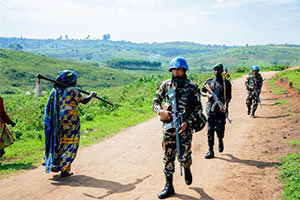 MONUSCO Peacekeepers and FARDC Soldiers Patrol Fataki Area. Credit: UN Photo/Jorkim Jotham Pituwa
Conflict, human rights violations, natural disasters, and famine have been at the forefront of concerns for humanitarian organizations. The escalation of humanitarian crises has led to over 239 million people in need of humanitarian assistance at the start of 2026, as estimated by OCHA’s Global Humanitarian Overview. The 2025 humanitarian appeal received only $12 billion, the lowest funding in over a decade, which has left 24 million fewer people reached in comparison to 2024. Conflict has remained the primary driver of crisis.
Humanitarian emergencies massively impact progress towards the Sustainable Development Goals (SDGs), adversely affecting economic development, inequality, education, planetary well-being, and poverty. Millions of people are faced with reduced access to essential services, including shelter, food, healthcare, and access to clean drinking water. UN Organizations such as UNHCR and the United Nations Children’s Fund (UNICEF) are committed to providing direct relief to affected communities when state governments cannot.
The United Nations 2024 Summit of the Future discussed measures that will be taken to reduce global inequality and promote peacekeeping efforts around the world. The recent UN Climate Change Conference (COP30) in Belém, Brazil, agreed to mobilize $1.3 trillion annually for climate action by 2035, operationalize the loss and damage fund, and triple adaptation finance. However, a fossil fuel transition commitment was not secured, despite climate change and the greenhouse effect being major contributors to humanitarian crises worldwide.
Countries across the world have also rallied to end humanitarian crises, as witnessed in conflicts such as Palestine and Ukraine. IPS is committed to providing relevant and in-depth reports of humanitarian emergencies around the world and their implications.

The Week with IPS

NEXT STOP - SDGs
Tracking global progress towards a sustainable world
Tracking global progress towards a sustainable world