Languages
Sunday, November 15, 2026



News and Views from the Global South
Labour
RIGHTS: Jailed Fishermen Await Thaw in India-Pakistan Relations
Almost 400 Indian fishermen continue to languish in Pakistani prisons despite having completed their prison terms. Their release has been hampered by tensions in the relations between their country and neighbouring Pakistan.LABOUR: Sorting Garbage – Green and Dignified Work
More than 1,500 representatives of waste recyclers from 13 countries, and thousands of other visitors, including the host country Brazil's left-wing President Luiz Inácio Lula da Silva, met last week in São Paulo, demonstrating that they are no longer pariahs in our throw-away society.
ENVIRONMENT: Rethinking Jobs for a Sustainable Economy
The possibility of environmental catastrophe has led many leaders, scholars and average citizens to reconsider an economy based on constant growth. It is becoming clear that people, especially in the United States, will need to consume less in the way of natural resources to avoid planetary peril.PHILIPPINES: Children Worst Hit by Economic Crisis
"I get an allowance of 50 pesos (about one U.S. dollar) a day, of which 20 pesos (40 U.S. cents) is for fare," says 17-year-old Dana Jane Estrada.MEXICO: Int’l Tribunal ‘Scandalised’ by Denials of Workers’ Rights
On the day his trade union section held elections for officials, "our offices were occupied, damaged and ransacked" by thugs from the executive committee of the National Teachers Union (SNTE), said Mexican teacher Gerardo Cruz, a leader in the CNTE, a dissident caucus seeking reform within the union.
JAPAN: Death from Overwork Persists Amid Economic Crunch
One morning nine months ago, Kenji Hamada's colleagues were surprised to find him in their Tokyo office slumped over his desk. They thought he was sleeping, but when he did not wake up after two hours, they realised he was dead.
PHILIPPINES: Women’s Rights Laws in Place
Although the enacting in August of the Magna Carta of Women (MCW) - a major law aiming to end discrimination against women across the archipelago - was well-received here, there remain concerns about whether the legislation will be fully implemented.
CAMBODIA: Global Crisis Mostly Bypassing the Young – For Now
Mey Chamnan has learned the hard way about the global economic crisis. Both she and her husband were fired from their 50 U.S.-dollar a month jobs in a local garment factory after declining overseas orders caused huge job losses across Cambodia's garment industry.RIGHTS: Women Still Sidelined in Economic Decision-Making
Gender equality contributes to economic growth, but economic growth does not always contribute to gender equality, says the United Nations World Survey on the Role of Women in Development launched Tuesday, a message well timed in the context of the current financial crisis.
WATER-UGANDA: Reducing Run-off To Protect Lake Victoria
The Ggaba landing site on Lake Victoria is the nearest wholesale fish market to the Ugandan capital, Kampala. More than 6,000 people live and work in this fishing community.NICARAGUA: Young People Exiled by Poverty
If they could, about 60 percent of Nicaraguans under 30 would go to live abroad, according to studies on migration, which find that the country's chronic poverty is the main reason for wanting to migrate.TRADE: Govt’s May Need to Do for Workers What They Did for Banks
The finding by the World Trade Organisation (WTO) and the International Labour Organisation (ILO) that the dropping of trade tariffs leads to jobs being lost in the formal sector while informal jobs grow is another confirmation of the adverse consequences of forced trade liberalisation.MIGRATION-EL SALVADOR: Broken Homes, Broken Families
Zoila, 54, is raising her two grandchildren, who were left behind when her daughter headed to the United States in search of a better income. There are many women like her acting as surrogate mothers to their grandchildren in El Salvador, one of the Latin American countries with the largest proportion of its population living and working abroad.LABOUR-EUROPE: This Job Is Killing Me
A spate of suicides in France is raising new questions about precarious working conditions imposed by authoritarian management models.ECONOMY: ‘It’s Smart to Invest in Girls’
Sending more girls to school may help poor countries get out of the economic slump faster, the NGO Plan International says in a new report. Just a one percent rise in the number of girls attending secondary school boosts a country's annual per capita income growth by 0.3 percent.
URUGUAY: Prison Without Bars Offers True Rehabilitation
Fabián Rodríguez has two years to go on a long sentence for robbery. After spending time in three overcrowded maximum security prisons in Uruguay, he finally landed in a rehabilitation centre where work and respect are central pillars. Now he runs a bakery which supplies 200 inmates as well as the guards.
MEXICO: Indigenous Enterprises Unite
Mexico is about to become the first Latin American country with an indigenous chamber of business, dedicated to promoting and representing more than one million micro and small enterprises that are on the frontline in the fight against poverty.LATIN AMERICA: Big Gender, Ethnic Gaps in Wages Found
Indigenous people, descendants of Africans, and women in Latin America earn significantly less money than their predominantly white male peers of similar age and education levels, according to a new study released here Monday by the Inter-American Development Bank (IDB).
PHILIPPINES: Like Men, Women Aim to Put Food on the Table
Despite experiencing an unsuccessful first foray into the world of commerce, the members of the Canduman Women's Co-operative (CWC) remain focused on producing a profit to aid their families' day-to-day living expenses.
BOLIVIA: Amazon Nuts at Exploitative Prices
Bolivia is the world's leading exporter of the shelled Brazil nut, a nutritious food source that grows abundantly in the country's Amazon rainforest region. But in this tropical paradise, many of the nut-gatherers live in hellish conditions.MIGRATION: Remittances Also Drive Political Change
The world's 200 million international migrants have traditionally been viewed in terms of dollars and cents: how much hard currency have they remitted to their home countries?« Previous Page — Next Page »


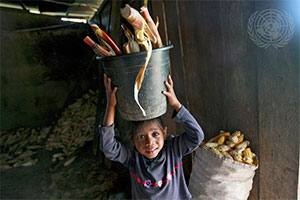 Timorese Girl with Fresh-Picked Corn. Credit: UN Photo/Martine Perret
A global common denominator is the need for a decent job. The economic realities of each country determine just how difficult it is to find one. Despite the labour movement's achievements, serious challenges persist: gender discrimination, child labour, worker migration, the digital divide and AI automation, evaporating pensions, unsafe workplaces, corporate pressure against union organising, negative impacts of trade agreements, and the precariousness of informal employment. The 2025 UN SDG Report identifies jobs and social protections as one of the six priority areas requiring urgent action, with progress either stalled or reversing in many developing nations.
In recent years, the fight to protect labour equality has taken on new dimensions with the rise of Environmental, Social and Governance standards. With the Social aspect aiming to promote equality and human rights, ESG principles have strengthened labour advocacy within corporate and governmental regulatory landscapes. In particular, ESG has become much more institutionalized in emerging economies such as Brazil and China. IPS follows the world’s workers as they confront these challenges - their setbacks and their successes.

The Week with IPS

NEXT STOP - SDGs
Tracking global progress towards a sustainable world
Tracking global progress towards a sustainable world
