Languages
Sunday, November 15, 2026



News and Views from the Global South
Labour

GENDER: For U.S., Lessons in CEDAW From San Francisco
In 1998, San Francisco stepped up and joined the world.SRI LANKA: Rights Groups Blame Gov’t Apathy for Migrant Woes
Dozens of Sri Lankan migrant workers languishing under a flyover in Jeddah in Saudi Arabia, claiming to be stranded, exemplify the crisis of migration that Sri Lankan authorities have faced over the years.US-COLOMBIA: Activists Target “World of Coca-Cola”
Activists from the U.S. and Colombia are targeting the World of Coca-Cola museum, located near its headquarters in Atlanta, Georgia, accusing the company of "union busting", paying its workers "poverty wages", and engaging in environmentally destructive practices.LEBANON: Migrant Women Dying on the Job
October and November have been bloody months for Lebanon's migrant domestic workers - over the last five weeks nine women have died. Most deaths have been reported as suicide.
Q&A: Impact of Crisis in Latin America Less Severe than in the Past
Thanks to effective social policies and measures that have strengthened the economy, most of the countries of Latin America and the Caribbean have managed to weather the impact of the global recession, although poverty has risen slightly for the first time since 2002.LABOR-INDONESIA: Future Looks Bleak for Laid-Off Workers
Ida Farida, 33, never imagined she would lose the job that she had held for 10 years.
CORRUPTION-SIERRA LEONE: Song Sparks Governance Debate
Nothing has ever sparked a debate on the state of governance in the country like the song released by one of Sierra Leone’s most popular artists, Emerson Bockarie.DEVELOPMENT: To Grab, Or To Invest
The World Food Security Summit in Rome this week opened up a dispute between what may be investment in farmland to some, but is seen as land grab by others.TRADE: Kenya Faces Job Losses, Collapsing Sectors in Wake of Doha
The consequences of the Doha Round of trade talks for larger developing countries in sub-Saharan Africa could include job losses and deindustrialisation if a new study forecasting how Kenya is set to be affected is anything to go by.Q&A: “What is Important is to Give Equal Opportunity” – Part 2
Although women have long made major contributions to science, their efforts have often been overlooked. For the past 12 years, the United Nations Educational, Scientific and Cultural Organisation (UNESCO) has teamed up with cosmetics giant L'Oréal to highlight the achievements of female scientists.GENDER: Women in Science Face Discrimination in India – Part 1
Just 10 of the 443 Indian scientists who received the prestigious Shanti Swarup Bhatnagar (SSB) award in the last 50 years were women.DEVELOPMENT: Hunger Summit’s Failure Exposes Grim Reality
There are two main ways the flop of this week’s United Nations World Food Security Summit in Rome - which has been snubbed by the world’s top leaders, has failed to deliver binding aid commitments, or to set a target date for the eradication of hunger - is being read.LATIN AMERICA: Community-Based Social Innovation Wins Prizes
Community control of public funds will no longer be just an effective local idea, put into practice by social activists and community leaders in a town in southern Brazil. Now that it has won first prize in ECLAC's fifth Social Innovation Contest, it is likely to spread throughout Latin America.
DEVELOPMENT: Farmers Not Invited to Food Summit?
World farmers are not part of the official delegations at the Food and Agriculture Organisation (FAO) food summit on food security that opened here Monday. But they came anyhow to express their views, since, they say, it is their communities that are most impacted by the food crisis.ECONOMY-US: “Green” Jobs Should Be Black and Brown Too
The Barack Obama administration's drive to promote a "green" economy is not working in the interest of poor people in the United States, especially those who belong to minority communities, according to a new study by a leading think tank.
AGRICULTURE-ZIMBABWE: New Methods to Maximise Yields
Last season, for the first time in her more than 20 years as a farmer, Elizabeth Runema harvested her maize crop at the beginning of February.
MIDEAST: Gaza Graduates Search for Vitamin W
"We fast a long time," says Gaza graduate Mona Ismail, 23. "Only to break our fast on a piece of onion."WEST AFRICA: Helping Pirates to Plunder the Oceans
West Africa is one of the world’s regions most affected by pirate fishers. Illegal, unreported or unregulated fishing has been devastating local livelihoods and ecosystems for decades. National fisheries management authorities are often helpless to protect their maritime resources.MEXICO: Women Package the Sweet Taste of Nostalgia
Years ago, when Catalina Sánchez saw an opportunity to earn an income and improve her family’s living conditions by growing and selling nopales - an edible cactus native to Mexico - she probably never imagined that her idea would spawn three businesses.ARGENTINA: Child Benefits Expanded to Unemployed and Informal Workers
A new monthly family allowance of nearly 50 dollars per child that will be paid out as of December to parents who are unemployed or work in the informal economy in Argentina was heralded by experts as an extraordinary step forward in terms of social policy.
ECONOMY: Ghana Boosts Apprenticeships for Jobless Young Women
The small shack beside Marjorie Patterson's house encloses evidence of a hard day's work. Bags overflow with the bold prints of traditional African fabrics.« Previous Page — Next Page »


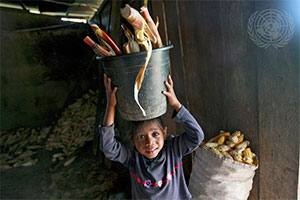 Timorese Girl with Fresh-Picked Corn. Credit: UN Photo/Martine Perret
A global common denominator is the need for a decent job. The economic realities of each country determine just how difficult it is to find one. Despite the labour movement's achievements, serious challenges persist: gender discrimination, child labour, worker migration, the digital divide and AI automation, evaporating pensions, unsafe workplaces, corporate pressure against union organising, negative impacts of trade agreements, and the precariousness of informal employment. The 2025 UN SDG Report identifies jobs and social protections as one of the six priority areas requiring urgent action, with progress either stalled or reversing in many developing nations.
In recent years, the fight to protect labour equality has taken on new dimensions with the rise of Environmental, Social and Governance standards. With the Social aspect aiming to promote equality and human rights, ESG principles have strengthened labour advocacy within corporate and governmental regulatory landscapes. In particular, ESG has become much more institutionalized in emerging economies such as Brazil and China. IPS follows the world’s workers as they confront these challenges - their setbacks and their successes.

The Week with IPS

NEXT STOP - SDGs
Tracking global progress towards a sustainable world
Tracking global progress towards a sustainable world
