Languages
Thursday, November 19, 2026



News and Views from the Global South
Labour
WORLD SOCIAL FORUM: In Bangladesh, Potters Shape Their Future
Old man Maneendra Paal talks with his head bent and hands busy casting bases for bird-patterned earthen vases, one of the popular items produced at this small-scale pottery industry in the Bijoypur village in Comilla, a district in eastern Bangladesh.INDIA-BURMA: Gas Deal Wins Kudos, But Activists Warn of Rights Abuses
While a new trilateral deal for Burma to export natural gas to India through Bangladesh augurs well economically for New Delhi, activists warned that the Burmese military regime could implement the project using forced labour.RIGHTS-CHILE: Sexual Harassment Law Finally Approved After 13 Years
After taking 13 years to make its way through Congress, a law against sexual harassment in the workplace has been unanimously approved by the Senate in Chile, where an estimated 20 percent of working women are subjected to this form of abuse.TSUNAMI IMPACT: Thai Compassion for Burmese Migrants Wears Thin
Underpaid and exploited, Burmese migrant workers are often the hidden face of Thailand. When a killer tsunami lashed the western Andaman Sea coastline of Thailand on Dec. 26, it came as no surprise to Burmese activists that none of the local authorities bothered to account for the bodies of these workers washed up on beaches.WORLD SOCIAL FORUM: In the U.S., Polls and Bullets Blot Out Upcoming Summit
Activists from the United States are heading to Brazil for the upcoming World Social Forum, determined to refute the widespread belief that their country has "gone Republican". They’re also in search of fresh inspiration for the fight against the exploitation of people, and natural resources.TRADE-US: This Time, Giant Sucking Sound Heard From the East
Thirteen years ago, the fringe presidential candidate Ross Perot lamented what he colourfully termed "a giant sucking sound" of U.S. jobs heading to Mexico. Now it seems Perot was looking in the wrong direction.HEALTH-PHILIPPINES: Doctors Ditching Profession to be Nurses
''Why can't we be called heroes too?" Dr Ramon Santos (not his real name) asked, wondering why this label often used to describe Filipino overseas contract workers in Hong Kong and the Middle East are not being applied to doctors-turned-nurses like him. "They call us selfish, unpatriotic, greedy."EDUCATION-CAMEROON: Private Trumps Public – For Better and For Worse
In 1993, the government of Cameroon passed a law allowing private tertiary education institutions to be established in the country. Now, almost a decade later, is this decision still viewed as the right one? That depends on who you ask.LABOUR-INDONESIA: New Year Brings Brighter Image for Police
Indonesia’s police is moving to erase its Suharto-era history of brutality in handling workers’ strikes, by developing guidelines that order its personnel to stay away from labour disputes.RIGHTS-BURMA: The Trafficking Trap Persists in Border Towns
A Burmese woman sits on the wooden floor of a small room in Ranong, a Thai town bordering southern-most Burma. Over the sound of a whirring fan, the 18-year-old who is just over four feet tall recounts her past.MEXICO: Lone Hunger Striker Protests "Insulting" Minimum Wage
Politicians, church leaders and trade unionists have vocally criticised Mexico's new minimum wage, set at four dollars a day for 2005, which would only cover the cost of two tubes of toothpaste, for example. But only one man was moved to take the drastic action of waging a hunger strike on a busy city street.LATIN AMERICA: Pension Reforms Hit Women Hard
Changes to pension systems in Latin America have heightened gender-based discrimination and will lead to greater poverty and vulnerability among women if corrective measures are not adopted, according to Sonia Montaño, chief of the ECLAC Women and Development Unit.INT’L MIGRANTS DAY-SINGAPORE: Place to Call Home for Asian Expats
Everyday in this tiny island republic of four million people, thousands of well-educated and highly-qualified Asian expatriates quietly go about their work, often mistaken as locals.INT’L MIGRANTS DAY-JAPAN: Helping Filipino Workers Help Themselves
Rain or shine, Mercy, a 29-year-old Filipino domestic worker in Tokyo, attends free weekly computer classes for migrant workers. This programme, she says, will soon help her find a better job - paving the way for a more secure future.BURMA: Labour Body Could Crack the Whip on Junta
Will Burma's military regime finally have to pay a price for its continued practice of forced labour?MEDIA-SOUTH-EAST ASIA: Imaging of Migrants Often Negative – Critics
Malaysia and Singapore may have become reliant on migrant labour to sustain their economies over the past 20 years, but social acceptance or appreciation of the value of their work lags far behind.ECONOMICS-ASIA: Beware of the Growth Deception, Warns U.N. Body
A regional U.N. body is displaying rare courage in knocking down the mantra that impressive economic growth figures are a panacea to help developing countries rise out of poverty.LABOUR-SINGAPORE: Unscrupulous Agents Need to Be Weeded Out
Kalaivanan's recruitment agent back home in Tamil Nadu, India, guaranteed him a salary of 336 U.S. dollars a month and at least one year of employment after he arrived in this city-state.MALAYSIA: Undocumented Workers to Become ‘The Hunted’ in 2005
Take advantage of the general amnesty and leave before the extended deadline of Dec. 31 or face arrest, fine, whipping and a long jail term.LABOUR: Half of World’s Workers Live in Poverty, Says ILO
That there were 185.9 million unemployed people around the world in 2003 is discouraging enough, but the fact that three times that many people were working and yet making less than one dollar a day is even more troubling.EAST ASIA: China on Track to Achieve a Millennium Goal – ILO
China's rapid march towards economic prosperity is helping East Asia guarantee its place as one region in the developing South that would meet a 2015 deadline of halving the number of people living on less than one U.S. dollar a day.« Previous Page — Next Page »


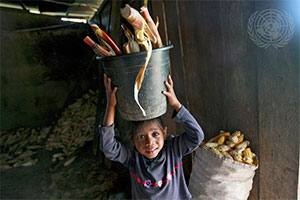 Timorese Girl with Fresh-Picked Corn. Credit: UN Photo/Martine Perret
A global common denominator is the need for a decent job. The economic realities of each country determine just how difficult it is to find one. Despite the labour movement's achievements, serious challenges persist: gender discrimination, child labour, worker migration, the digital divide and AI automation, evaporating pensions, unsafe workplaces, corporate pressure against union organising, negative impacts of trade agreements, and the precariousness of informal employment. The 2025 UN SDG Report identifies jobs and social protections as one of the six priority areas requiring urgent action, with progress either stalled or reversing in many developing nations.
In recent years, the fight to protect labour equality has taken on new dimensions with the rise of Environmental, Social and Governance standards. With the Social aspect aiming to promote equality and human rights, ESG principles have strengthened labour advocacy within corporate and governmental regulatory landscapes. In particular, ESG has become much more institutionalized in emerging economies such as Brazil and China. IPS follows the world’s workers as they confront these challenges - their setbacks and their successes.

The Week with IPS

NEXT STOP - SDGs
Tracking global progress towards a sustainable world
Tracking global progress towards a sustainable world
